

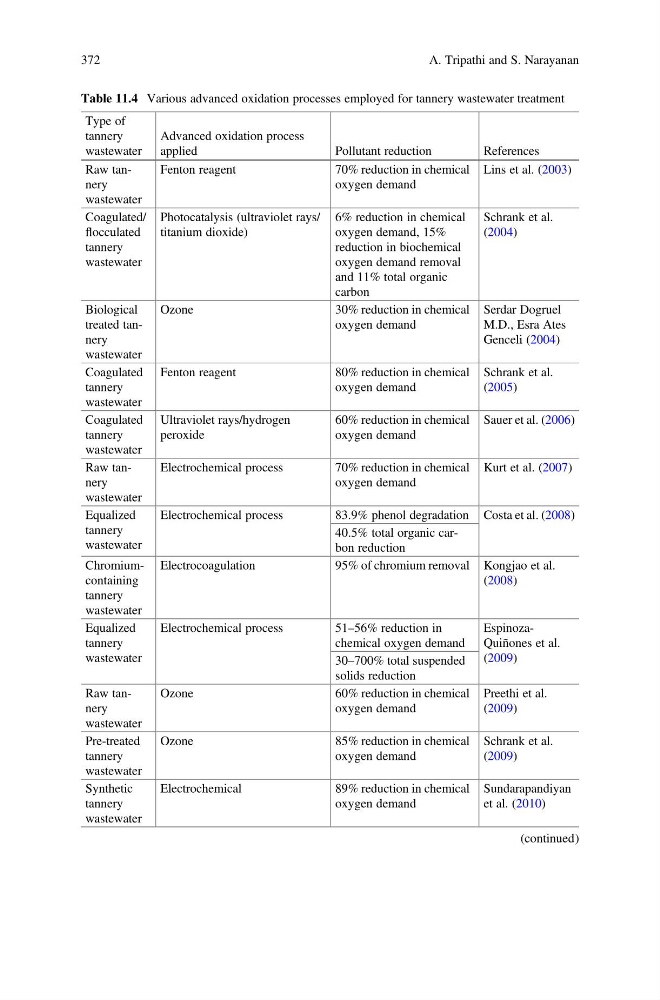
Table 11.4 Various advanced oxidation processes employed for tannery wastewater treatment
Type of
tannery
wastewater
Advanced oxidation process
applied
Pollutant reduction
References
Raw tannery
wastewater
Fenton reagent
70% reduction in chemical
oxygen demand
Lins et al. (2003)
Coagulated/
flocculated
tannery
wastewater
Photocatalysis (ultraviolet rays/
titanium dioxide)
6% reduction in chemical
oxygen demand, 15%
reduction in biochemical
oxygen demand removal
and 11% total organic
carbon
Schrank et al.
(2004)
Biological
treated tannery
wastewater
Ozone
30% reduction in chemical
oxygen demand
Serdar Dogruel
M.D., Esra Ates
Genceli (2004)
Coagulated
tannery
wastewater
Fenton reagent
80% reduction in chemical
oxygen demand
Schrank et al.
(2005)
Coagulated
tannery
wastewater
Ultraviolet rays/hydrogen
peroxide
60% reduction in chemical
oxygen demand
Sauer et al. (2006)
Raw tannery
wastewater
Electrochemical process
70% reduction in chemical
oxygen demand
Kurt et al. (2007)
Equalized
tannery
wastewater
Electrochemical process
83.9% phenol degradation Costa et al. (2008)
40.5% total organic carbon reduction
Chromiumcontaining
tannery
wastewater
Electrocoagulation
95% of chromium removal Kongjao et al.
(2008)
Equalized
tannery
wastewater
Electrochemical process
51–56% reduction in
chemical oxygen demand
EspinozaQuiñones et al.
(2009)
30–700% total suspended
solids reduction
Raw tannery
wastewater
Ozone
60% reduction in chemical
oxygen demand
Preethi et al.
(2009)
Pre-treated
tannery
wastewater
Ozone
85% reduction in chemical
oxygen demand
Schrank et al.
(2009)
Synthetic
tannery
wastewater
Electrochemical
89% reduction in chemical
oxygen demand
Sundarapandiyan
et al. (2010)
(continued)
372
A. Tripathi and S. Narayanan
Type of
tannery
wastewater
Advanced oxidation process
applied
Pollutant reduction
References
Raw tannery
wastewater
Fenton reagent
70% reduction in chemical
oxygen demand
Lins et al. (2003)
Coagulated/
flocculated
tannery
wastewater
Photocatalysis (ultraviolet rays/
titanium dioxide)
6% reduction in chemical
oxygen demand, 15%
reduction in biochemical
oxygen demand removal
and 11% total organic
carbon
Schrank et al.
(2004)
Biological
treated tannery
wastewater
Ozone
30% reduction in chemical
oxygen demand
Serdar Dogruel
M.D., Esra Ates
Genceli (2004)
Coagulated
tannery
wastewater
Fenton reagent
80% reduction in chemical
oxygen demand
Schrank et al.
(2005)
Coagulated
tannery
wastewater
Ultraviolet rays/hydrogen
peroxide
60% reduction in chemical
oxygen demand
Sauer et al. (2006)
Raw tannery
wastewater
Electrochemical process
70% reduction in chemical
oxygen demand
Kurt et al. (2007)
Equalized
tannery
wastewater
Electrochemical process
83.9% phenol degradation Costa et al. (2008)
40.5% total organic carbon reduction
Chromiumcontaining
tannery
wastewater
Electrocoagulation
95% of chromium removal Kongjao et al.
(2008)
Equalized
tannery
wastewater
Electrochemical process
51–56% reduction in
chemical oxygen demand
EspinozaQuiñones et al.
(2009)
30–700% total suspended
solids reduction
Raw tannery
wastewater
Ozone
60% reduction in chemical
oxygen demand
Preethi et al.
(2009)
Pre-treated
tannery
wastewater
Ozone
85% reduction in chemical
oxygen demand
Schrank et al.
(2009)
Synthetic
tannery
wastewater
Electrochemical
89% reduction in chemical
oxygen demand
Sundarapandiyan
et al. (2010)
(continued)
372
A. Tripathi and S. Narayanan