

11.5.2 Treatment Ponds/Constructed Wetlands
The utilization of these systems has been expanded and effectively implemented to
expel various contaminates from wastewaters. They are a man-made environmentally friendly system intended for the dismissal of pollutants from industrial and
municipal wastewater (Mant et al. 2006). Their functioning depends on various
parameters such as type of soil, nature of wastewater, microorganisms and plants.
Hence, there is a need to develop a categorized microbial populations to treat
wastewater (Calheiros et al. 2007).
The findings of Calheiros et al. indicates the development of P. australis and
T. latifolia in constructed wetlands under 0.3 and 0.6 m/day hydraulic load leads to a
chemical oxygen demand reduction 41–73%, and 41–58% biochemical oxygen
demand in tannery wastewater (Calheiros et al. 2007). In a study conducted by
Mant et al. for chrome removal, P. purpureum and removes 97–99.6% chrome,
while B. decumbens removes 78.1% and 68.5% within 24 h (Mant et al. 2006). The
establishment of two plant species, i.e., Arundo donax and Sarcocornia fruticosa, in
constructed wetland to treat tannery wastewater results in 51 and 80% chemical
oxygen demand and 53 and 90% biochemical oxygen demand reduction (Calheiros
et al. 2012).
The integrated treatment pond system can be employed to treat tannery wastewater on pilot scale and a combination of maturation pond, and the secondary
facultative pond was also an efficient approach for tannery wastewater treatment
(Tadesse et al. 2004).
11.5.3 Biological Treatment
Biological treatment includes the decomposition of waste by aerobic or anaerobic
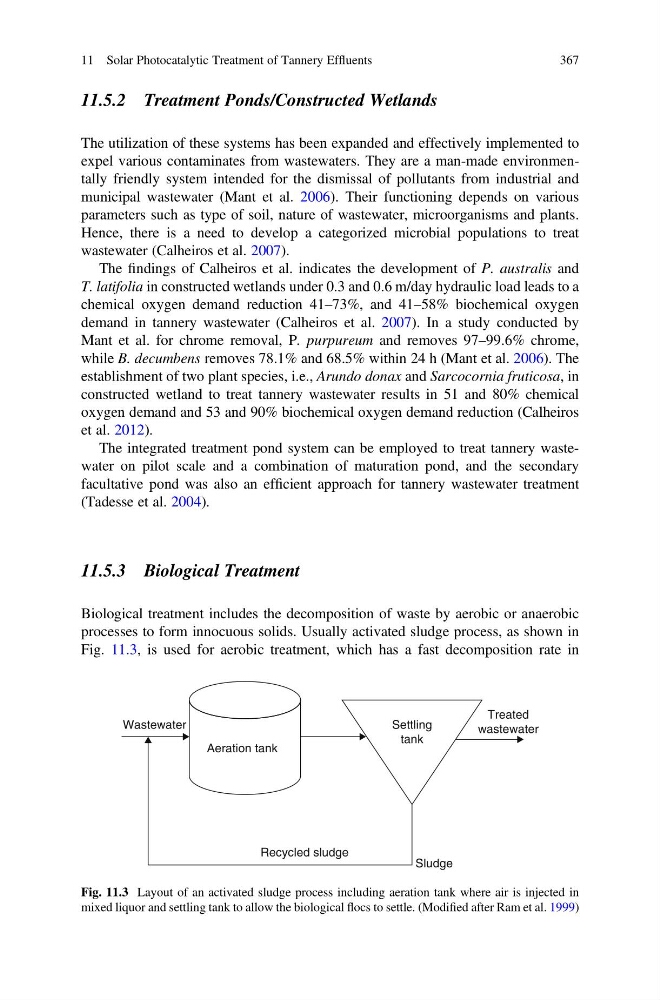
processes to form innocuous solids. Usually activated sludge process, as shown in
Fig. 11.3, is used for aerobic treatment, which has a fast decomposition rate in
Aeration tank
Wastewater
Settling
tank
Treated
wastewater
Recycled sludge
Sludge
Fig. 11.3 Layout of an activated sludge process including aeration tank where air is injected in
mixed liquor and settling tank to allow the biological flocs to settle. (Modified after Ram et al. 1999)
11 Solar Photocatalytic Treatment of Tannery Effluents
367
The utilization of these systems has been expanded and effectively implemented to
expel various contaminates from wastewaters. They are a man-made environmentally friendly system intended for the dismissal of pollutants from industrial and
municipal wastewater (Mant et al. 2006). Their functioning depends on various
parameters such as type of soil, nature of wastewater, microorganisms and plants.
Hence, there is a need to develop a categorized microbial populations to treat
wastewater (Calheiros et al. 2007).
The findings of Calheiros et al. indicates the development of P. australis and
T. latifolia in constructed wetlands under 0.3 and 0.6 m/day hydraulic load leads to a
chemical oxygen demand reduction 41–73%, and 41–58% biochemical oxygen
demand in tannery wastewater (Calheiros et al. 2007). In a study conducted by
Mant et al. for chrome removal, P. purpureum and removes 97–99.6% chrome,
while B. decumbens removes 78.1% and 68.5% within 24 h (Mant et al. 2006). The
establishment of two plant species, i.e., Arundo donax and Sarcocornia fruticosa, in
constructed wetland to treat tannery wastewater results in 51 and 80% chemical
oxygen demand and 53 and 90% biochemical oxygen demand reduction (Calheiros
et al. 2012).
The integrated treatment pond system can be employed to treat tannery wastewater on pilot scale and a combination of maturation pond, and the secondary
facultative pond was also an efficient approach for tannery wastewater treatment
(Tadesse et al. 2004).
11.5.3 Biological Treatment
Biological treatment includes the decomposition of waste by aerobic or anaerobic
processes to form innocuous solids. Usually activated sludge process, as shown in
Fig. 11.3, is used for aerobic treatment, which has a fast decomposition rate in
Aeration tank
Wastewater
Settling
tank
Treated
wastewater
Recycled sludge
Sludge
Fig. 11.3 Layout of an activated sludge process including aeration tank where air is injected in
mixed liquor and settling tank to allow the biological flocs to settle. (Modified after Ram et al. 1999)
11 Solar Photocatalytic Treatment of Tannery Effluents
367