

11.5 Treatment Methodology for Tannery Wastewater
11.5.1 Primary Treatment
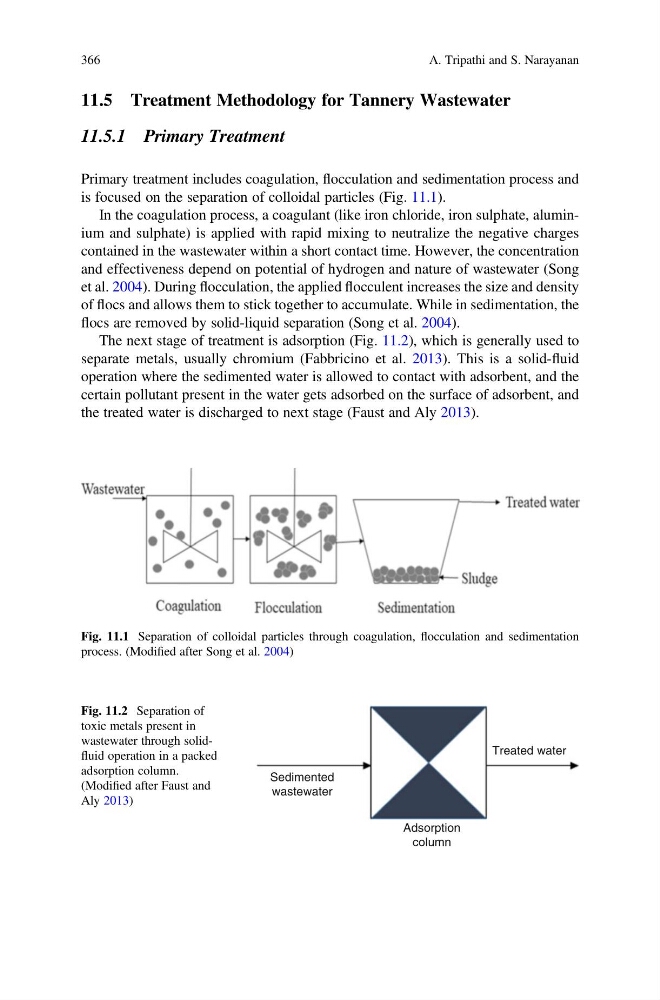
Primary treatment includes coagulation, flocculation and sedimentation process and
is focused on the separation of colloidal particles (Fig. 11.1).
In the coagulation process, a coagulant (like iron chloride, iron sulphate, aluminium and sulphate) is applied with rapid mixing to neutralize the negative charges
contained in the wastewater within a short contact time. However, the concentration
and effectiveness depend on potential of hydrogen and nature of wastewater (Song
et al. 2004). During flocculation, the applied flocculent increases the size and density
of flocs and allows them to stick together to accumulate. While in sedimentation, the
flocs are removed by solid-liquid separation (Song et al. 2004).
The next stage of treatment is adsorption (Fig. 11.2), which is generally used to
separate metals, usually chromium (Fabbricino et al. 2013). This is a solid-fluid
operation where the sedimented water is allowed to contact with adsorbent, and the
certain pollutant present in the water gets adsorbed on the surface of adsorbent, and
the treated water is discharged to next stage (Faust and Aly 2013).
Fig. 11.1 Separation of colloidal particles through coagulation, flocculation and sedimentation
process. (Modified after Song et al. 2004)
Sedimented
wastewater
Treated water
Adsorption
column
Fig. 11.2 Separation of
toxic metals present in
wastewater through solidfluid operation in a packed
adsorption column.
(Modified after Faust and
Aly 2013)
366
A. Tripathi and S. Narayanan
11.5.1 Primary Treatment
Primary treatment includes coagulation, flocculation and sedimentation process and
is focused on the separation of colloidal particles (Fig. 11.1).
In the coagulation process, a coagulant (like iron chloride, iron sulphate, aluminium and sulphate) is applied with rapid mixing to neutralize the negative charges
contained in the wastewater within a short contact time. However, the concentration
and effectiveness depend on potential of hydrogen and nature of wastewater (Song
et al. 2004). During flocculation, the applied flocculent increases the size and density
of flocs and allows them to stick together to accumulate. While in sedimentation, the
flocs are removed by solid-liquid separation (Song et al. 2004).
The next stage of treatment is adsorption (Fig. 11.2), which is generally used to
separate metals, usually chromium (Fabbricino et al. 2013). This is a solid-fluid
operation where the sedimented water is allowed to contact with adsorbent, and the
certain pollutant present in the water gets adsorbed on the surface of adsorbent, and
the treated water is discharged to next stage (Faust and Aly 2013).
Fig. 11.1 Separation of colloidal particles through coagulation, flocculation and sedimentation
process. (Modified after Song et al. 2004)
Sedimented
wastewater
Treated water
Adsorption
column
Fig. 11.2 Separation of
toxic metals present in
wastewater through solidfluid operation in a packed
adsorption column.
(Modified after Faust and
Aly 2013)
366
A. Tripathi and S. Narayanan