

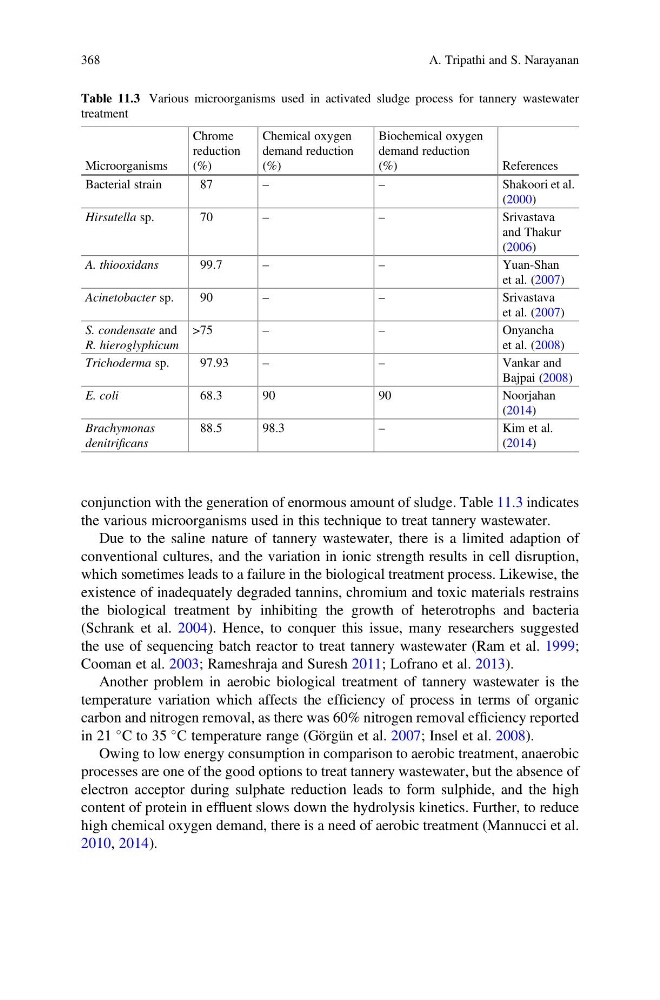
conjunction with the generation of enormous amount of sludge. Table 11.3 indicates
the various microorganisms used in this technique to treat tannery wastewater.
Due to the saline nature of tannery wastewater, there is a limited adaption of
conventional cultures, and the variation in ionic strength results in cell disruption,
which sometimes leads to a failure in the biological treatment process. Likewise, the
existence of inadequately degraded tannins, chromium and toxic materials restrains
the biological treatment by inhibiting the growth of heterotrophs and bacteria
(Schrank et al. 2004). Hence, to conquer this issue, many researchers suggested
the use of sequencing batch reactor to treat tannery wastewater (Ram et al. 1999;
Cooman et al. 2003; Rameshraja and Suresh 2011; Lofrano et al. 2013).
Another problem in aerobic biological treatment of tannery wastewater is the
temperature variation which affects the efficiency of process in terms of organic
carbon and nitrogen removal, as there was 60% nitrogen removal efficiency reported
in 21
C to 35
C temperature range (Görgün et al. 2007; Insel et al. 2008).
Owing to low energy consumption in comparison to aerobic treatment, anaerobic
processes are one of the good options to treat tannery wastewater, but the absence of
electron acceptor during sulphate reduction leads to form sulphide, and the high
content of protein in effluent slows down the hydrolysis kinetics. Further, to reduce
high chemical oxygen demand, there is a need of aerobic treatment (Mannucci et al.
2010, 2014).
Table 11.3 Various microorganisms used in activated sludge process for tannery wastewater
treatment
Microorganisms
Chrome
reduction
(%)
Chemical oxygen
demand reduction
(%)
Biochemical oxygen
demand reduction
(%)
References
Bacterial strain
87
–
–
Shakoori et al.
(2000)
Hirsutella sp.
70
–
–
Srivastava
and Thakur
(2006)
A. thiooxidans
99.7
–
–
Yuan-Shan
et al. (2007)
Acinetobacter sp.
90
–
–
Srivastava
et al. (2007)
S. condensate and
R. hieroglyphicum
>75
–
–
Onyancha
et al. (2008)
Trichoderma sp.
97.93
–
–
Vankar and
Bajpai (2008)
E. coli
68.3
90
90
Noorjahan
(2014)
Brachymonas
denitrificans
88.5
98.3
–
Kim et al.
(2014)
368
A. Tripathi and S. Narayanan
the various microorganisms used in this technique to treat tannery wastewater.
Due to the saline nature of tannery wastewater, there is a limited adaption of
conventional cultures, and the variation in ionic strength results in cell disruption,
which sometimes leads to a failure in the biological treatment process. Likewise, the
existence of inadequately degraded tannins, chromium and toxic materials restrains
the biological treatment by inhibiting the growth of heterotrophs and bacteria
(Schrank et al. 2004). Hence, to conquer this issue, many researchers suggested
the use of sequencing batch reactor to treat tannery wastewater (Ram et al. 1999;
Cooman et al. 2003; Rameshraja and Suresh 2011; Lofrano et al. 2013).
Another problem in aerobic biological treatment of tannery wastewater is the
temperature variation which affects the efficiency of process in terms of organic
carbon and nitrogen removal, as there was 60% nitrogen removal efficiency reported
in 21
C to 35
C temperature range (Görgün et al. 2007; Insel et al. 2008).
Owing to low energy consumption in comparison to aerobic treatment, anaerobic
processes are one of the good options to treat tannery wastewater, but the absence of
electron acceptor during sulphate reduction leads to form sulphide, and the high
content of protein in effluent slows down the hydrolysis kinetics. Further, to reduce
high chemical oxygen demand, there is a need of aerobic treatment (Mannucci et al.
2010, 2014).
Table 11.3 Various microorganisms used in activated sludge process for tannery wastewater
treatment
Microorganisms
Chrome
reduction
(%)
Chemical oxygen
demand reduction
(%)
Biochemical oxygen
demand reduction
(%)
References
Bacterial strain
87
–
–
Shakoori et al.
(2000)
Hirsutella sp.
70
–
–
Srivastava
and Thakur
(2006)
A. thiooxidans
99.7
–
–
Yuan-Shan
et al. (2007)
Acinetobacter sp.
90
–
–
Srivastava
et al. (2007)
S. condensate and
R. hieroglyphicum
>75
–
–
Onyancha
et al. (2008)
Trichoderma sp.
97.93
–
–
Vankar and
Bajpai (2008)
E. coli
68.3
90
90
Noorjahan
(2014)
Brachymonas
denitrificans
88.5
98.3
–
Kim et al.
(2014)
368
A. Tripathi and S. Narayanan