

Heterojunction
Over the past decades, designing of heterojunctions was introduced as a best route to
reduce the recombination rate of electronÀhole produced under light irradiation
(Wang et al. 2014; Huang et al. 2015a). The Bi-based photocatalysts, with an
appropriate band gap, have capability to produce electrons under solar light. However, the excited electron and holes potentially recombined very fast together. From
this view, heterojunction construction can have a great role in enhancing
photocatalytic efficiencies of Bi-based photocatalysts. Bi-based heterojunctions
include conventional and ZÀscheme heterojunctions. Among the conventional
heterojunctions, the type II junction is the most usual one, while in ZÀscheme
type, the newly merged direct ZÀscheme heterojunction appears to be the most
effective junction structure used for exploring the capacity of photo-generated
carriers (Wang et al. 2014; Low et al. 2017). Figure 10.14 depicted schematics for
heterojunctions (Type II) and ZÀscheme heterojunction.
Binary Bi are heterojunctions with two kinds of BiÀcompounds, and also Binary
Bi compounds can produce heterojunctions with non-BiÀcompound.
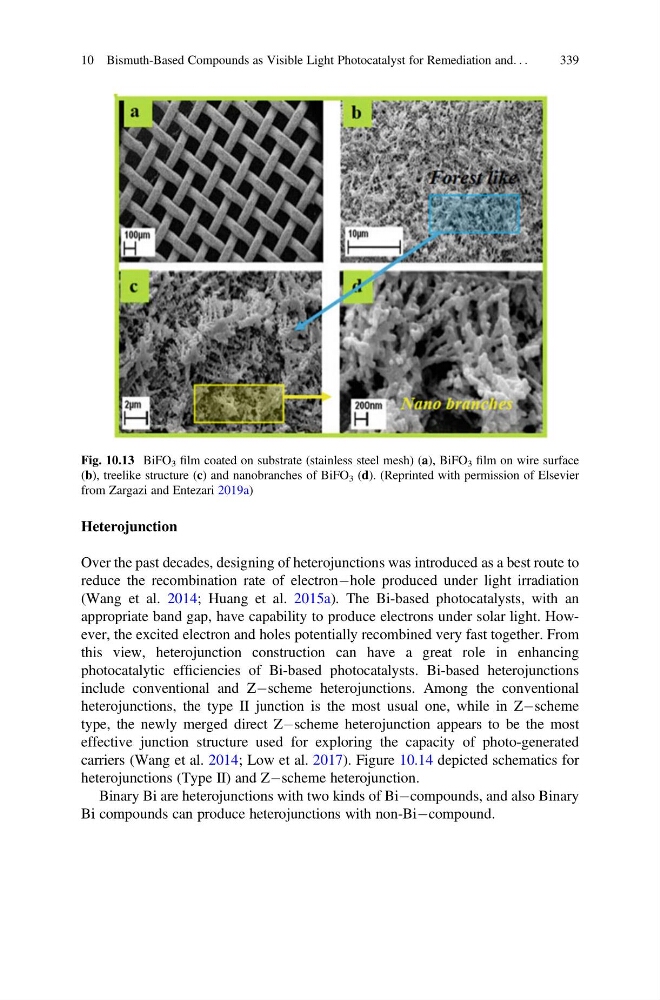
Fig. 10.13 BiFO 3 film coated on substrate (stainless steel mesh) (a), BiFO 3 film on wire surface
(b), treelike structure (c) and nanobranches of BiFO 3 (d). (Reprinted with permission of Elsevier
from Zargazi and Entezari 2019a)
10 Bismuth-Based Compounds as Visible Light Photocatalyst for Remediation and. . .
339
Over the past decades, designing of heterojunctions was introduced as a best route to
reduce the recombination rate of electronÀhole produced under light irradiation
(Wang et al. 2014; Huang et al. 2015a). The Bi-based photocatalysts, with an
appropriate band gap, have capability to produce electrons under solar light. However, the excited electron and holes potentially recombined very fast together. From
this view, heterojunction construction can have a great role in enhancing
photocatalytic efficiencies of Bi-based photocatalysts. Bi-based heterojunctions
include conventional and ZÀscheme heterojunctions. Among the conventional
heterojunctions, the type II junction is the most usual one, while in ZÀscheme
type, the newly merged direct ZÀscheme heterojunction appears to be the most
effective junction structure used for exploring the capacity of photo-generated
carriers (Wang et al. 2014; Low et al. 2017). Figure 10.14 depicted schematics for
heterojunctions (Type II) and ZÀscheme heterojunction.
Binary Bi are heterojunctions with two kinds of BiÀcompounds, and also Binary
Bi compounds can produce heterojunctions with non-BiÀcompound.
Fig. 10.13 BiFO 3 film coated on substrate (stainless steel mesh) (a), BiFO 3 film on wire surface
(b), treelike structure (c) and nanobranches of BiFO 3 (d). (Reprinted with permission of Elsevier
from Zargazi and Entezari 2019a)
10 Bismuth-Based Compounds as Visible Light Photocatalyst for Remediation and. . .
339