

Type II: Conventional Heterojunction
In comparison with the trinary types of heterojunctions, the second junction type is
the most suitable one. Bi-compounds and semiconductors with small band gap
formed heterojunction (type II) as conduction band and valence band levels of
semiconductors should be lower than the BiÀcompound portion. For example,
Fan et al. (2016) fabricated a binary BiÀcompounds Bi 2 MoO 6 -BiOI heterojunction
(Fig. 10.15a, b) by anion exchange method which exhibited high photocatalytic
degradation efficiency for rhodamine B in comparison with BiOI or Bi 2 MoO 6 alone
(Fig. 10.15c). Optimal molar ratio of Mo/I is 50% made heterojunction (Type II)
between two components having highest efficiency under white light (Fig. 10.15d).
It is notable that three matched BiÀcompounds can be combined together to produce
a ternary heterojunction such as Bi 2 S 3 /Bi 2 O 3 /MoS 2 (Ke et al. 2017). Improved
photocatalytic activity of Bi 2 S 3 /Bi 2 O 3 /MoS 2 ternary BiÀcompounds can be attributed to enhancing of light adsorption and high separation of electronÀhole by
double heterojunction (Type II) (Fig. 10.16). Moreover, some other heterojunctions
with low band gap semiconductors such as non-BiÀcompounds were performed for
improving photocatalytic degradation of different pollutants.
For instance, gÀC 3 N 4 compounds could be coupled with Bi 2 WO 6 , BiVO 4 , Bi 2 S 3 ,
Bi 2 O 3 , and Bi 2 MoO 6 which exhibited improved photocatalytic properties in degradation of pollutants. Numerous synthesis strategies for heterojunctions (Type II)
have been introduced, and most of Bi-based heterojunctions led to improve
photocatalytic efficiency (Table 10.1).
Direct Z-Scheme Heterojunctions
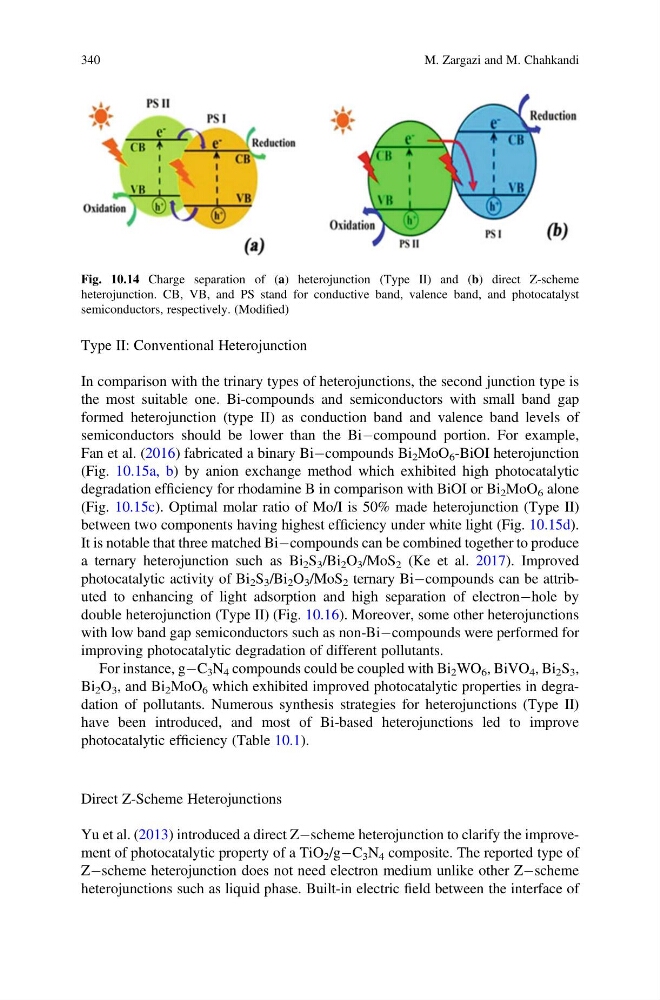
Yu et al. (2013) introduced a direct ZÀscheme heterojunction to clarify the improvement of photocatalytic property of a TiO 2 /gÀC 3 N 4 composite. The reported type of
ZÀscheme heterojunction does not need electron medium unlike other ZÀscheme
heterojunctions such as liquid phase. Built-in electric field between the interface of
Fig. 10.14 Charge separation of (a) heterojunction (Type II) and (b) direct Z-scheme
heterojunction. CB, VB, and PS stand for conductive band, valence band, and photocatalyst
semiconductors, respectively. (Modified)
340
M. Zargazi and M. Chahkandi
In comparison with the trinary types of heterojunctions, the second junction type is
the most suitable one. Bi-compounds and semiconductors with small band gap
formed heterojunction (type II) as conduction band and valence band levels of
semiconductors should be lower than the BiÀcompound portion. For example,
Fan et al. (2016) fabricated a binary BiÀcompounds Bi 2 MoO 6 -BiOI heterojunction
(Fig. 10.15a, b) by anion exchange method which exhibited high photocatalytic
degradation efficiency for rhodamine B in comparison with BiOI or Bi 2 MoO 6 alone
(Fig. 10.15c). Optimal molar ratio of Mo/I is 50% made heterojunction (Type II)
between two components having highest efficiency under white light (Fig. 10.15d).
It is notable that three matched BiÀcompounds can be combined together to produce
a ternary heterojunction such as Bi 2 S 3 /Bi 2 O 3 /MoS 2 (Ke et al. 2017). Improved
photocatalytic activity of Bi 2 S 3 /Bi 2 O 3 /MoS 2 ternary BiÀcompounds can be attributed to enhancing of light adsorption and high separation of electronÀhole by
double heterojunction (Type II) (Fig. 10.16). Moreover, some other heterojunctions
with low band gap semiconductors such as non-BiÀcompounds were performed for
improving photocatalytic degradation of different pollutants.
For instance, gÀC 3 N 4 compounds could be coupled with Bi 2 WO 6 , BiVO 4 , Bi 2 S 3 ,
Bi 2 O 3 , and Bi 2 MoO 6 which exhibited improved photocatalytic properties in degradation of pollutants. Numerous synthesis strategies for heterojunctions (Type II)
have been introduced, and most of Bi-based heterojunctions led to improve
photocatalytic efficiency (Table 10.1).
Direct Z-Scheme Heterojunctions
Yu et al. (2013) introduced a direct ZÀscheme heterojunction to clarify the improvement of photocatalytic property of a TiO 2 /gÀC 3 N 4 composite. The reported type of
ZÀscheme heterojunction does not need electron medium unlike other ZÀscheme
heterojunctions such as liquid phase. Built-in electric field between the interface of
Fig. 10.14 Charge separation of (a) heterojunction (Type II) and (b) direct Z-scheme
heterojunction. CB, VB, and PS stand for conductive band, valence band, and photocatalyst
semiconductors, respectively. (Modified)
340
M. Zargazi and M. Chahkandi