

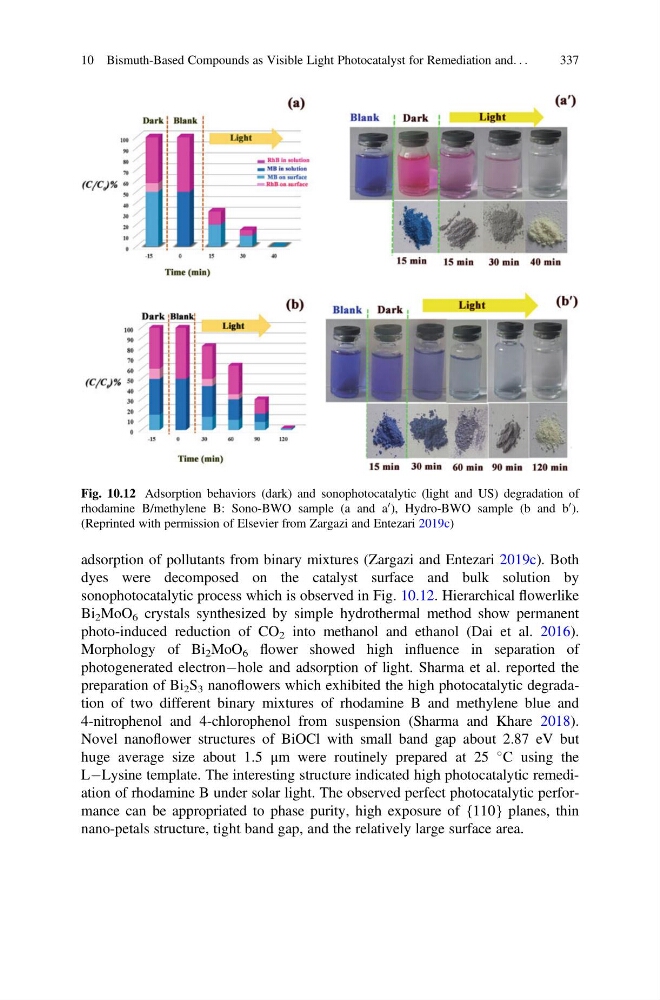
adsorption of pollutants from binary mixtures (Zargazi and Entezari 2019c). Both
dyes were decomposed on the catalyst surface and bulk solution by
sonophotocatalytic process which is observed in Fig. 10.12. Hierarchical flowerlike
Bi 2 MoO 6 crystals synthesized by simple hydrothermal method show permanent
photo-induced reduction of CO 2 into methanol and ethanol (Dai et al. 2016).
Morphology of Bi 2 MoO 6 flower showed high influence in separation of
photogenerated electronÀhole and adsorption of light. Sharma et al. reported the
preparation of Bi 2 S 3 nanoflowers which exhibited the high photocatalytic degradation of two different binary mixtures of rhodamine B and methylene blue and
4-nitrophenol and 4-chlorophenol from suspension (Sharma and Khare 2018).
Novel nanoflower structures of BiOCl with small band gap about 2.87 eV but
huge average size about 1.5 μm were routinely prepared at 25
C using the
LÀLysine template. The interesting structure indicated high photocatalytic remediation of rhodamine B under solar light. The observed perfect photocatalytic performance can be appropriated to phase purity, high exposure of {110} planes, thin
nano-petals structure, tight band gap, and the relatively large surface area.
Fig. 10.12 Adsorption behaviors (dark) and sonophotocatalytic (light and US) degradation of
rhodamine B/methylene B: Sono-BWO sample (a and a
0 ), Hydro-BWO sample (b and b
0 ).
(Reprinted with permission of Elsevier from Zargazi and Entezari 2019c)
10 Bismuth-Based Compounds as Visible Light Photocatalyst for Remediation and. . .
337
dyes were decomposed on the catalyst surface and bulk solution by
sonophotocatalytic process which is observed in Fig. 10.12. Hierarchical flowerlike
Bi 2 MoO 6 crystals synthesized by simple hydrothermal method show permanent
photo-induced reduction of CO 2 into methanol and ethanol (Dai et al. 2016).
Morphology of Bi 2 MoO 6 flower showed high influence in separation of
photogenerated electronÀhole and adsorption of light. Sharma et al. reported the
preparation of Bi 2 S 3 nanoflowers which exhibited the high photocatalytic degradation of two different binary mixtures of rhodamine B and methylene blue and
4-nitrophenol and 4-chlorophenol from suspension (Sharma and Khare 2018).
Novel nanoflower structures of BiOCl with small band gap about 2.87 eV but
huge average size about 1.5 μm were routinely prepared at 25
C using the
LÀLysine template. The interesting structure indicated high photocatalytic remediation of rhodamine B under solar light. The observed perfect photocatalytic performance can be appropriated to phase purity, high exposure of {110} planes, thin
nano-petals structure, tight band gap, and the relatively large surface area.
Fig. 10.12 Adsorption behaviors (dark) and sonophotocatalytic (light and US) degradation of
rhodamine B/methylene B: Sono-BWO sample (a and a
0 ), Hydro-BWO sample (b and b
0 ).
(Reprinted with permission of Elsevier from Zargazi and Entezari 2019c)
10 Bismuth-Based Compounds as Visible Light Photocatalyst for Remediation and. . .
337