

One-dimensional Bi 2 MoO 6 nanosheets were fabricated via electrospinning which
demonstrated remarkable photocatalytic efficiency within remediation of rhodamine
B and methylene blue under simulated visible light (Sun et al. 2013b).
Hierarchical BiÀcompounds
Hierarchical structures can be highlighted as ordered architectures assembled from
low- dimensional building blocks, such as nanofibers, nanorods, nanoribbons,
nanosheets, and nanoplates. Recently, great attention has been attracted to hierarchical assemblies due to the proper electronic, optical properties, layered structure,
and catalytic efficiency which has bold difference with low-dimensional
sub-component (Luo et al. 2019; Song et al. 2019). Herein, the synthesis of hierarchical BiÀcompounds has attracted more efforts from the view of specific morphologies to gain high photocatalytic performance. The hierarchical Bi 2 WO 6 hollow
tubes demonstrated high photo-induced catalytic efficiency for elimination of rhodamine B under simulated visible light, which was related to Bi 2 WO 6 structure, tight
band gap, and gross surface area (Yafei et al. 2013). Zargazi et al. indicated the high
simultaneous photocatalytic and sonophotocatalytic performances of Bi 2 WO 6
nanoflowers for binary mixture (methylene blue and rhodamine B) synthesized by
ultrasonic-assisted hydrothermal which attributed effect of morphology in
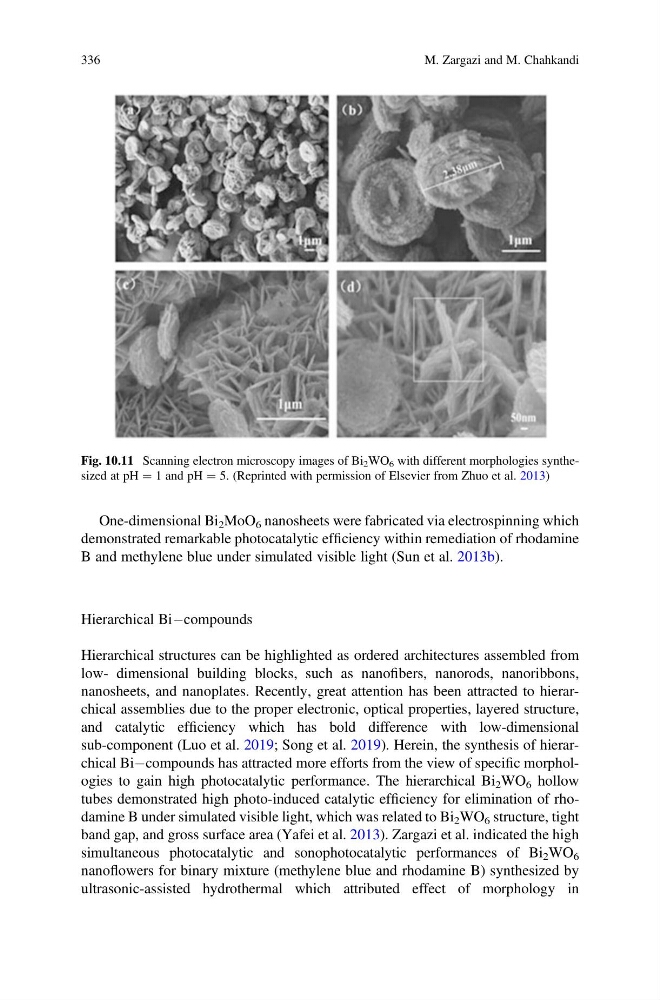
Fig. 10.11 Scanning electron microscopy images of Bi 2 WO 6 with different morphologies synthesized at pH ¼ 1 and pH ¼ 5. (Reprinted with permission of Elsevier from Zhuo et al. 2013)
336
M. Zargazi and M. Chahkandi
demonstrated remarkable photocatalytic efficiency within remediation of rhodamine
B and methylene blue under simulated visible light (Sun et al. 2013b).
Hierarchical BiÀcompounds
Hierarchical structures can be highlighted as ordered architectures assembled from
low- dimensional building blocks, such as nanofibers, nanorods, nanoribbons,
nanosheets, and nanoplates. Recently, great attention has been attracted to hierarchical assemblies due to the proper electronic, optical properties, layered structure,
and catalytic efficiency which has bold difference with low-dimensional
sub-component (Luo et al. 2019; Song et al. 2019). Herein, the synthesis of hierarchical BiÀcompounds has attracted more efforts from the view of specific morphologies to gain high photocatalytic performance. The hierarchical Bi 2 WO 6 hollow
tubes demonstrated high photo-induced catalytic efficiency for elimination of rhodamine B under simulated visible light, which was related to Bi 2 WO 6 structure, tight
band gap, and gross surface area (Yafei et al. 2013). Zargazi et al. indicated the high
simultaneous photocatalytic and sonophotocatalytic performances of Bi 2 WO 6
nanoflowers for binary mixture (methylene blue and rhodamine B) synthesized by
ultrasonic-assisted hydrothermal which attributed effect of morphology in
Fig. 10.11 Scanning electron microscopy images of Bi 2 WO 6 with different morphologies synthesized at pH ¼ 1 and pH ¼ 5. (Reprinted with permission of Elsevier from Zhuo et al. 2013)
336
M. Zargazi and M. Chahkandi