

as visible light photocatalyst which exhibited higher photocatalytic performance for
methylene blue and rhodamine B compared to BiFeO 3 synthesized by solÀgel
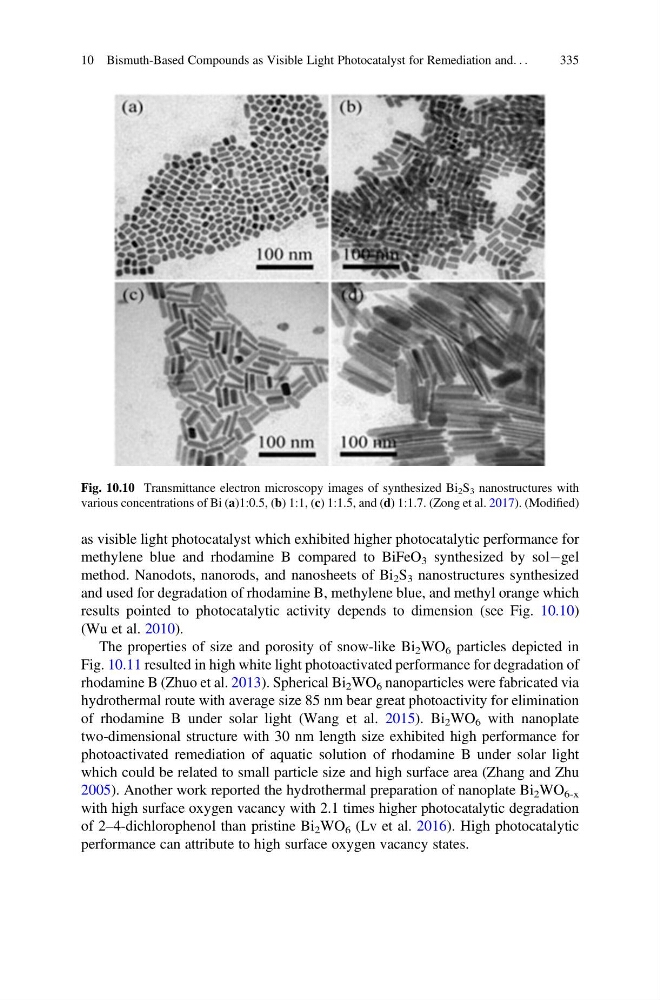
method. Nanodots, nanorods, and nanosheets of Bi 2 S 3 nanostructures synthesized
and used for degradation of rhodamine B, methylene blue, and methyl orange which
results pointed to photocatalytic activity depends to dimension (see Fig. 10.10)
(Wu et al. 2010).
The properties of size and porosity of snow-like Bi 2 WO 6 particles depicted in
Fig. 10.11 resulted in high white light photoactivated performance for degradation of
rhodamine B (Zhuo et al. 2013). Spherical Bi 2 WO 6 nanoparticles were fabricated via
hydrothermal route with average size 85 nm bear great photoactivity for elimination
of rhodamine B under solar light (Wang et al. 2015). Bi 2 WO 6 with nanoplate
two-dimensional structure with 30 nm length size exhibited high performance for
photoactivated remediation of aquatic solution of rhodamine B under solar light
which could be related to small particle size and high surface area (Zhang and Zhu
2005). Another work reported the hydrothermal preparation of nanoplate Bi 2 WO 6-x
with high surface oxygen vacancy with 2.1 times higher photocatalytic degradation
of 2–4-dichlorophenol than pristine Bi 2 WO 6 (Lv et al. 2016). High photocatalytic
performance can attribute to high surface oxygen vacancy states.
Fig. 10.10 Transmittance electron microscopy images of synthesized Bi 2 S 3 nanostructures with
various concentrations of Bi (a)1:0.5, (b) 1:1, (c) 1:1.5, and (d) 1:1.7. (Zong et al. 2017). (Modified)
10 Bismuth-Based Compounds as Visible Light Photocatalyst for Remediation and. . .
335
methylene blue and rhodamine B compared to BiFeO 3 synthesized by solÀgel
method. Nanodots, nanorods, and nanosheets of Bi 2 S 3 nanostructures synthesized
and used for degradation of rhodamine B, methylene blue, and methyl orange which
results pointed to photocatalytic activity depends to dimension (see Fig. 10.10)
(Wu et al. 2010).
The properties of size and porosity of snow-like Bi 2 WO 6 particles depicted in
Fig. 10.11 resulted in high white light photoactivated performance for degradation of
rhodamine B (Zhuo et al. 2013). Spherical Bi 2 WO 6 nanoparticles were fabricated via
hydrothermal route with average size 85 nm bear great photoactivity for elimination
of rhodamine B under solar light (Wang et al. 2015). Bi 2 WO 6 with nanoplate
two-dimensional structure with 30 nm length size exhibited high performance for
photoactivated remediation of aquatic solution of rhodamine B under solar light
which could be related to small particle size and high surface area (Zhang and Zhu
2005). Another work reported the hydrothermal preparation of nanoplate Bi 2 WO 6-x
with high surface oxygen vacancy with 2.1 times higher photocatalytic degradation
of 2–4-dichlorophenol than pristine Bi 2 WO 6 (Lv et al. 2016). High photocatalytic
performance can attribute to high surface oxygen vacancy states.
Fig. 10.10 Transmittance electron microscopy images of synthesized Bi 2 S 3 nanostructures with
various concentrations of Bi (a)1:0.5, (b) 1:1, (c) 1:1.5, and (d) 1:1.7. (Zong et al. 2017). (Modified)
10 Bismuth-Based Compounds as Visible Light Photocatalyst for Remediation and. . .
335