

Lee et al. (Lee et al. 2017) claimed to fabrication of sandwich structures bear
transparent pliable light-emitting diodes with capable usage in wearable electronic
instruments with transparent textiles. Lee et al. (Lee et al. 2017) used electrospinning
method to intercalating light-emitting diodes of ZnO@graphene quantum dots in
transparent nanofiber textile to safeguard QLED devices versus the degradation. Lee
et al. (Lee et al. 2017) attended the obtained results can inspire new-generation
methods of wearable electronic cloths and so on.
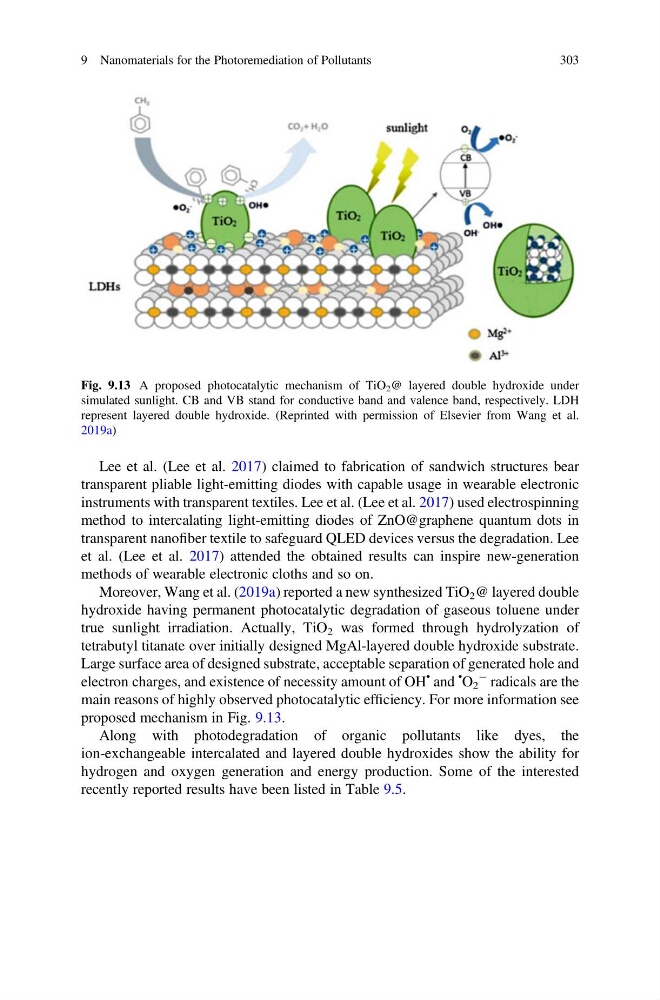
Moreover, Wang et al. (2019a) reported a new synthesized TiO 2 @ layered double
hydroxide having permanent photocatalytic degradation of gaseous toluene under
true sunlight irradiation. Actually, TiO 2 was formed through hydrolyzation of
tetrabutyl titanate over initially designed MgAl-layered double hydroxide substrate.
Large surface area of designed substrate, acceptable separation of generated hole and
electron charges, and existence of necessity amount of OH
• and
• O 2
À radicals are the
main reasons of highly observed photocatalytic efficiency. For more information see
proposed mechanism in Fig. 9.13.
Along with photodegradation of organic pollutants like dyes, the
ion-exchangeable intercalated and layered double hydroxides show the ability for
hydrogen and oxygen generation and energy production. Some of the interested
recently reported results have been listed in Table 9.5.
Fig. 9.13 A proposed photocatalytic mechanism of TiO 2 @ layered double hydroxide under
simulated sunlight. CB and VB stand for conductive band and valence band, respectively. LDH
represent layered double hydroxide. (Reprinted with permission of Elsevier from Wang et al.
2019a)
9 Nanomaterials for the Photoremediation of Pollutants
303
transparent pliable light-emitting diodes with capable usage in wearable electronic
instruments with transparent textiles. Lee et al. (Lee et al. 2017) used electrospinning
method to intercalating light-emitting diodes of ZnO@graphene quantum dots in
transparent nanofiber textile to safeguard QLED devices versus the degradation. Lee
et al. (Lee et al. 2017) attended the obtained results can inspire new-generation
methods of wearable electronic cloths and so on.
Moreover, Wang et al. (2019a) reported a new synthesized TiO 2 @ layered double
hydroxide having permanent photocatalytic degradation of gaseous toluene under
true sunlight irradiation. Actually, TiO 2 was formed through hydrolyzation of
tetrabutyl titanate over initially designed MgAl-layered double hydroxide substrate.
Large surface area of designed substrate, acceptable separation of generated hole and
electron charges, and existence of necessity amount of OH
• and
• O 2
À radicals are the
main reasons of highly observed photocatalytic efficiency. For more information see
proposed mechanism in Fig. 9.13.
Along with photodegradation of organic pollutants like dyes, the
ion-exchangeable intercalated and layered double hydroxides show the ability for
hydrogen and oxygen generation and energy production. Some of the interested
recently reported results have been listed in Table 9.5.
Fig. 9.13 A proposed photocatalytic mechanism of TiO 2 @ layered double hydroxide under
simulated sunlight. CB and VB stand for conductive band and valence band, respectively. LDH
represent layered double hydroxide. (Reprinted with permission of Elsevier from Wang et al.
2019a)
9 Nanomaterials for the Photoremediation of Pollutants
303