

separation of electron–hole with low recombination rate is a key involving factor of
performance of photo-remediation, water splitting, and general photocatalytic applications. An advanced method to gain the purpose of adequate separation of electron–
hole is structural manipulation of layered materials with interstitial inserting of
heteroatoms to engineering charge transfer procedure (Zong et al. 2011; Gao et al.
2013; Xiong et al. 2016; Cui et al. 2017; Li et al. 2017a; Cao et al. 2018). Further
alternative structure is two-dimensional layered double hydroxide having general
formula of [M 1 À x
2+ M x
3+ (OH) 2 ]
x+
(A
nÀ1 ) x/n .mH 2 O. The negatively charged A anion
is accommodated betwixt of positive-charged M layers of two various divalent and
trivalent metal ions (Chen et al. 2019; Jo et al. 2019; Li et al. 2019b; Wang et al.
2019a; Yang et al. 2019). Generally, the main applicable researching fields on
ion-exchangeable materials can be highlighted as dye degradation, removal of
toxic gaseous like NO, toluene, and so on, water splitting, light-emitting diode,
solar cell, Cr(VI) reduction, CO 2 transformation to carbonic fuel like methane, and
so on (Zong et al. 2011; Gao et al. 2013; Xiong et al. 2016; Cui et al. 2017; Lee et al.
2017; Li et al. 2017a, 2018c, 2019b; Cao et al. 2018; Chen et al. 2019; Yang et al.
2019; Jo et al. 2019; Wang et al. 2019a). The reported ion-exchangeable layered
sheets having negatively charged particles intercalated between layers with positive
charge have different species like carbonate/Zn, ZnNi and ZnCu hydroxides, carbonated/Bi 2 WO 6 , TiO 2 /polyvinyl alcohol, alkaline metal ions/carbon nitride, NO 3
À
/
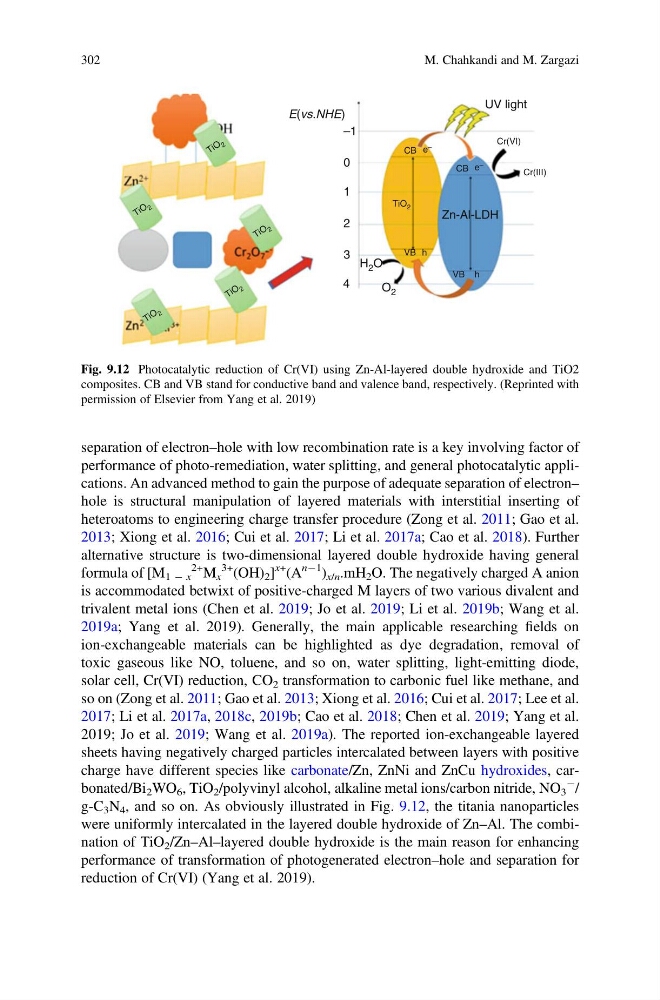
g-C 3 N 4 , and so on. As obviously illustrated in Fig. 9.12, the titania nanoparticles
were uniformly intercalated in the layered double hydroxide of Zn–Al. The combination of TiO 2 /Zn–Al–layered double hydroxide is the main reason for enhancing
performance of transformation of photogenerated electron–hole and separation for
reduction of Cr(VI) (Yang et al. 2019).
T iO 2
E(vs.NHE)
–1
0
1
2
3
T iO 2
T iO 2
T iO 2
T iO 2
CB
e –
e –
CB
Cr(VI)
Cr(III)
Zn-Al-LDH
UV light
VB
VB
h
h
4
H 2 O
O 2
TiO 2
Fig. 9.12 Photocatalytic reduction of Cr(VI) using Zn-Al-layered double hydroxide and TiO2
composites. CB and VB stand for conductive band and valence band, respectively. (Reprinted with
permission of Elsevier from Yang et al. 2019)
302
M. Chahkandi and M. Zargazi
performance of photo-remediation, water splitting, and general photocatalytic applications. An advanced method to gain the purpose of adequate separation of electron–
hole is structural manipulation of layered materials with interstitial inserting of
heteroatoms to engineering charge transfer procedure (Zong et al. 2011; Gao et al.
2013; Xiong et al. 2016; Cui et al. 2017; Li et al. 2017a; Cao et al. 2018). Further
alternative structure is two-dimensional layered double hydroxide having general
formula of [M 1 À x
2+ M x
3+ (OH) 2 ]
x+
(A
nÀ1 ) x/n .mH 2 O. The negatively charged A anion
is accommodated betwixt of positive-charged M layers of two various divalent and
trivalent metal ions (Chen et al. 2019; Jo et al. 2019; Li et al. 2019b; Wang et al.
2019a; Yang et al. 2019). Generally, the main applicable researching fields on
ion-exchangeable materials can be highlighted as dye degradation, removal of
toxic gaseous like NO, toluene, and so on, water splitting, light-emitting diode,
solar cell, Cr(VI) reduction, CO 2 transformation to carbonic fuel like methane, and
so on (Zong et al. 2011; Gao et al. 2013; Xiong et al. 2016; Cui et al. 2017; Lee et al.
2017; Li et al. 2017a, 2018c, 2019b; Cao et al. 2018; Chen et al. 2019; Yang et al.
2019; Jo et al. 2019; Wang et al. 2019a). The reported ion-exchangeable layered
sheets having negatively charged particles intercalated between layers with positive
charge have different species like carbonate/Zn, ZnNi and ZnCu hydroxides, carbonated/Bi 2 WO 6 , TiO 2 /polyvinyl alcohol, alkaline metal ions/carbon nitride, NO 3
À
/
g-C 3 N 4 , and so on. As obviously illustrated in Fig. 9.12, the titania nanoparticles
were uniformly intercalated in the layered double hydroxide of Zn–Al. The combination of TiO 2 /Zn–Al–layered double hydroxide is the main reason for enhancing
performance of transformation of photogenerated electron–hole and separation for
reduction of Cr(VI) (Yang et al. 2019).
T iO 2
E(vs.NHE)
–1
0
1
2
3
T iO 2
T iO 2
T iO 2
T iO 2
CB
e –
e –
CB
Cr(VI)
Cr(III)
Zn-Al-LDH
UV light
VB
VB
h
h
4
H 2 O
O 2
TiO 2
Fig. 9.12 Photocatalytic reduction of Cr(VI) using Zn-Al-layered double hydroxide and TiO2
composites. CB and VB stand for conductive band and valence band, respectively. (Reprinted with
permission of Elsevier from Yang et al. 2019)
302
M. Chahkandi and M. Zargazi