

through self-grown organic content over ZnO surface, the hybrid p–n junction was
prepared. It shows the catalysis activity for Rhodamine 6G degradation (Chae et al.
2019) and the next one prepared from aqueous media at low temperature and
growing of ZnO over Co 3 O 4 having light-emitting diode property (Kim et al.
2017). Some of more recent introduced p–n heterojunction photocatalyst are collected in Table 9.4.
9.3.4 Ion-Exchangeable Semiconductors
The wide range of ion-exchangeable compounds with layered structures can be
classified into oxides and hydroxides. The ion-exchangeable compounds bear zigzag
lepidocrocite sheet type intercalated with counter ions of hydrates protons arrive
with high capability of solar energy utilization. As above discussed, adequate
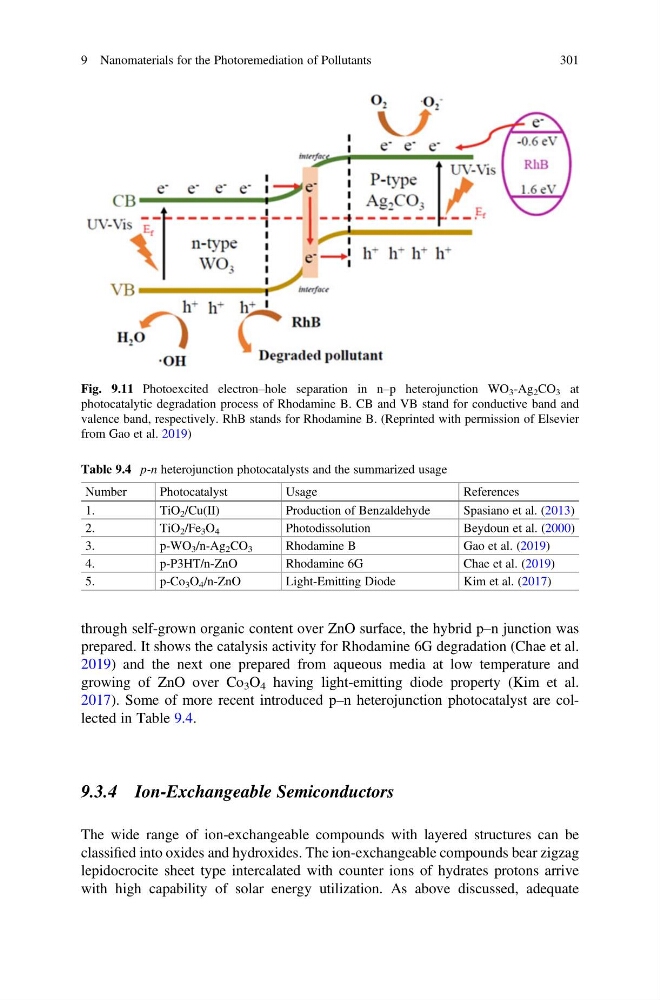
Fig. 9.11 Photoexcited electron–hole separation in n–p heterojunction WO 3 -Ag 2 CO 3 at
photocatalytic degradation process of Rhodamine B. CB and VB stand for conductive band and
valence band, respectively. RhB stands for Rhodamine B. (Reprinted with permission of Elsevier
from Gao et al. 2019)
Table 9.4 p-n heterojunction photocatalysts and the summarized usage
Number
Photocatalyst
Usage
References
1.
TiO 2 /Cu(II)
Production of Benzaldehyde
Spasiano et al. (2013)
2.
TiO 2 /Fe 3 O 4
Photodissolution
Beydoun et al. (2000)
3.
p-WO 3 /n-Ag 2 CO 3
Rhodamine B
Gao et al. (2019)
4.
p-P3HT/n-ZnO
Rhodamine 6G
Chae et al. (2019)
5.
p-Co 3 O 4 /n-ZnO
Light-Emitting Diode
Kim et al. (2017)
9 Nanomaterials for the Photoremediation of Pollutants
301
prepared. It shows the catalysis activity for Rhodamine 6G degradation (Chae et al.
2019) and the next one prepared from aqueous media at low temperature and
growing of ZnO over Co 3 O 4 having light-emitting diode property (Kim et al.
2017). Some of more recent introduced p–n heterojunction photocatalyst are collected in Table 9.4.
9.3.4 Ion-Exchangeable Semiconductors
The wide range of ion-exchangeable compounds with layered structures can be
classified into oxides and hydroxides. The ion-exchangeable compounds bear zigzag
lepidocrocite sheet type intercalated with counter ions of hydrates protons arrive
with high capability of solar energy utilization. As above discussed, adequate
Fig. 9.11 Photoexcited electron–hole separation in n–p heterojunction WO 3 -Ag 2 CO 3 at
photocatalytic degradation process of Rhodamine B. CB and VB stand for conductive band and
valence band, respectively. RhB stands for Rhodamine B. (Reprinted with permission of Elsevier
from Gao et al. 2019)
Table 9.4 p-n heterojunction photocatalysts and the summarized usage
Number
Photocatalyst
Usage
References
1.
TiO 2 /Cu(II)
Production of Benzaldehyde
Spasiano et al. (2013)
2.
TiO 2 /Fe 3 O 4
Photodissolution
Beydoun et al. (2000)
3.
p-WO 3 /n-Ag 2 CO 3
Rhodamine B
Gao et al. (2019)
4.
p-P3HT/n-ZnO
Rhodamine 6G
Chae et al. (2019)
5.
p-Co 3 O 4 /n-ZnO
Light-Emitting Diode
Kim et al. (2017)
9 Nanomaterials for the Photoremediation of Pollutants
301