

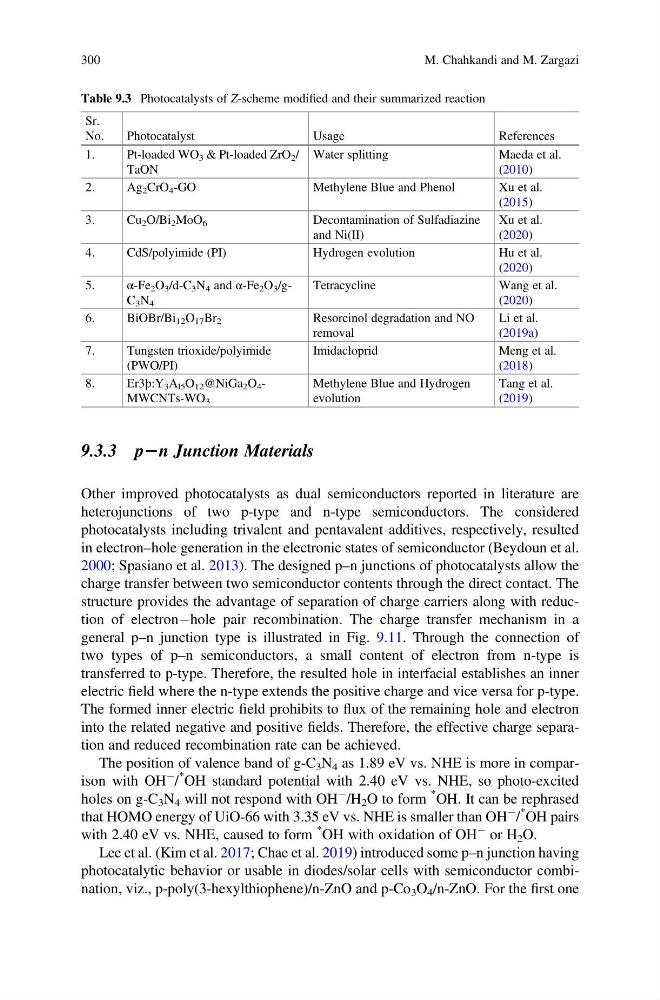
9.3.3 p2n Junction Materials
Other improved photocatalysts as dual semiconductors reported in literature are
heterojunctions of two p-type and n-type semiconductors. The considered
photocatalysts including trivalent and pentavalent additives, respectively, resulted
in electron–hole generation in the electronic states of semiconductor (Beydoun et al.
2000; Spasiano et al. 2013). The designed p–n junctions of photocatalysts allow the
charge transfer between two semiconductor contents through the direct contact. The
structure provides the advantage of separation of charge carriers along with reduction of electronÀhole pair recombination. The charge transfer mechanism in a
general p–n junction type is illustrated in Fig. 9.11. Through the connection of
two types of p–n semiconductors, a small content of electron from n-type is
transferred to p-type. Therefore, the resulted hole in interfacial establishes an inner
electric field where the n-type extends the positive charge and vice versa for p-type.
The formed inner electric field prohibits to flux of the remaining hole and electron
into the related negative and positive fields. Therefore, the effective charge separation and reduced recombination rate can be achieved.
The position of valence band of g-C 3 N 4 as 1.89 eV vs. NHE is more in comparison with OH
À
/
* OH standard potential with 2.40 eV vs. NHE, so photo-excited
holes on g-C 3 N 4 will not respond with OH
À /H 2 O to form
* OH. It can be rephrased
that HOMO energy of UiO-66 with 3.35 eV vs. NHE is smaller than OH
À /
* OH pairs
with 2.40 eV vs. NHE, caused to form
* OH with oxidation of OH
À or H 2 O.
Lee et al. (Kim et al. 2017; Chae et al. 2019) introduced some p–n junction having
photocatalytic behavior or usable in diodes/solar cells with semiconductor combination, viz., p-poly(3-hexylthiophene)/n-ZnO and p-Co 3 O 4 /n-ZnO. For the first one
Table 9.3 Photocatalysts of Z-scheme modified and their summarized reaction
Sr.
No.
Photocatalyst
Usage
References
1.
Pt-loaded WO 3 & Pt-loaded ZrO 2 /
TaON
Water splitting
Maeda et al.
(2010)
2.
Ag 2 CrO 4 -GO
Methylene Blue and Phenol
Xu et al.
(2015)
3.
Cu 2 O/Bi 2 MoO 6
Decontamination of Sulfadiazine
and Ni(II)
Xu et al.
(2020)
4.
CdS/polyimide (PI)
Hydrogen evolution
Hu et al.
(2020)
5.
α-Fe 2 O 3 /d-C 3 N 4 and α-Fe 2 O 3 /gC 3 N 4
Tetracycline
Wang et al.
(2020)
6.
BiOBr/Bi 12 O 17 Br 2
Resorcinol degradation and NO
removal
Li et al.
(2019a)
7.
Tungsten trioxide/polyimide
(PWO/PI)
Imidacloprid
Meng et al.
(2018)
8.
Er3þ:Y 3 A l5 O 12 @NiGa 2 O 4 -
MWCNTs-WO 3
Methylene Blue and Hydrogen
evolution
Tang et al.
(2019)
300
M. Chahkandi and M. Zargazi
Other improved photocatalysts as dual semiconductors reported in literature are
heterojunctions of two p-type and n-type semiconductors. The considered
photocatalysts including trivalent and pentavalent additives, respectively, resulted
in electron–hole generation in the electronic states of semiconductor (Beydoun et al.
2000; Spasiano et al. 2013). The designed p–n junctions of photocatalysts allow the
charge transfer between two semiconductor contents through the direct contact. The
structure provides the advantage of separation of charge carriers along with reduction of electronÀhole pair recombination. The charge transfer mechanism in a
general p–n junction type is illustrated in Fig. 9.11. Through the connection of
two types of p–n semiconductors, a small content of electron from n-type is
transferred to p-type. Therefore, the resulted hole in interfacial establishes an inner
electric field where the n-type extends the positive charge and vice versa for p-type.
The formed inner electric field prohibits to flux of the remaining hole and electron
into the related negative and positive fields. Therefore, the effective charge separation and reduced recombination rate can be achieved.
The position of valence band of g-C 3 N 4 as 1.89 eV vs. NHE is more in comparison with OH
À
/
* OH standard potential with 2.40 eV vs. NHE, so photo-excited
holes on g-C 3 N 4 will not respond with OH
À /H 2 O to form
* OH. It can be rephrased
that HOMO energy of UiO-66 with 3.35 eV vs. NHE is smaller than OH
À /
* OH pairs
with 2.40 eV vs. NHE, caused to form
* OH with oxidation of OH
À or H 2 O.
Lee et al. (Kim et al. 2017; Chae et al. 2019) introduced some p–n junction having
photocatalytic behavior or usable in diodes/solar cells with semiconductor combination, viz., p-poly(3-hexylthiophene)/n-ZnO and p-Co 3 O 4 /n-ZnO. For the first one
Table 9.3 Photocatalysts of Z-scheme modified and their summarized reaction
Sr.
No.
Photocatalyst
Usage
References
1.
Pt-loaded WO 3 & Pt-loaded ZrO 2 /
TaON
Water splitting
Maeda et al.
(2010)
2.
Ag 2 CrO 4 -GO
Methylene Blue and Phenol
Xu et al.
(2015)
3.
Cu 2 O/Bi 2 MoO 6
Decontamination of Sulfadiazine
and Ni(II)
Xu et al.
(2020)
4.
CdS/polyimide (PI)
Hydrogen evolution
Hu et al.
(2020)
5.
α-Fe 2 O 3 /d-C 3 N 4 and α-Fe 2 O 3 /gC 3 N 4
Tetracycline
Wang et al.
(2020)
6.
BiOBr/Bi 12 O 17 Br 2
Resorcinol degradation and NO
removal
Li et al.
(2019a)
7.
Tungsten trioxide/polyimide
(PWO/PI)
Imidacloprid
Meng et al.
(2018)
8.
Er3þ:Y 3 A l5 O 12 @NiGa 2 O 4 -
MWCNTs-WO 3
Methylene Blue and Hydrogen
evolution
Tang et al.
(2019)
300
M. Chahkandi and M. Zargazi