

within visible light photocatalytic performance have been prepared by loading of
cuprous oxide, graphite carbon nitride, bismuth oxide, cadmium sulfite, and metal
organic frameworks (Li et al. 2019a; Yi et al. 2019; Hu et al. 2020; Wang et al. 2020;
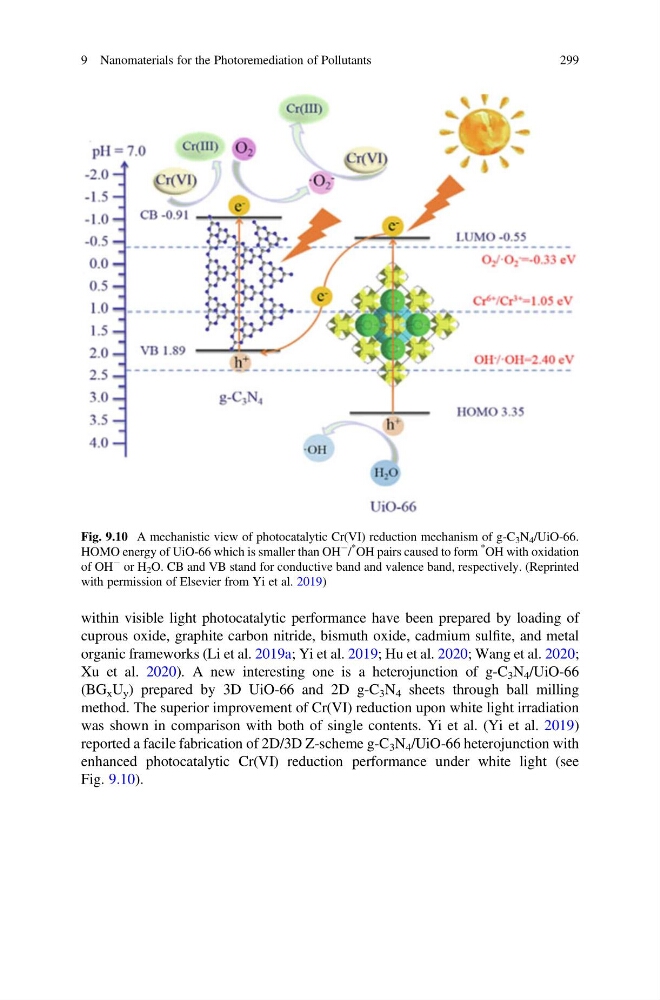
Xu et al. 2020). A new interesting one is a heterojunction of g-C 3 N 4 /UiO-66
(BG x U y ) prepared by 3D UiO-66 and 2D g-C 3 N 4 sheets through ball milling
method. The superior improvement of Cr(VI) reduction upon white light irradiation
was shown in comparison with both of single contents. Yi et al. (Yi et al. 2019)
reported a facile fabrication of 2D/3D Z-scheme g-C 3 N 4 /UiO-66 heterojunction with
enhanced photocatalytic Cr(VI) reduction performance under white light (see
Fig. 9.10).
Fig. 9.10 A mechanistic view of photocatalytic Cr(VI) reduction mechanism of g-C 3 N 4 /UiO-66.
HOMO energy of UiO-66 which is smaller than OH
À
/
*
OH pairs caused to form
*
OH with oxidation
of OH
À or H 2 O. CB and VB stand for conductive band and valence band, respectively. (Reprinted
with permission of Elsevier from Yi et al. 2019)
9 Nanomaterials for the Photoremediation of Pollutants
299
cuprous oxide, graphite carbon nitride, bismuth oxide, cadmium sulfite, and metal
organic frameworks (Li et al. 2019a; Yi et al. 2019; Hu et al. 2020; Wang et al. 2020;
Xu et al. 2020). A new interesting one is a heterojunction of g-C 3 N 4 /UiO-66
(BG x U y ) prepared by 3D UiO-66 and 2D g-C 3 N 4 sheets through ball milling
method. The superior improvement of Cr(VI) reduction upon white light irradiation
was shown in comparison with both of single contents. Yi et al. (Yi et al. 2019)
reported a facile fabrication of 2D/3D Z-scheme g-C 3 N 4 /UiO-66 heterojunction with
enhanced photocatalytic Cr(VI) reduction performance under white light (see
Fig. 9.10).
Fig. 9.10 A mechanistic view of photocatalytic Cr(VI) reduction mechanism of g-C 3 N 4 /UiO-66.
HOMO energy of UiO-66 which is smaller than OH
À
/
*
OH pairs caused to form
*
OH with oxidation
of OH
À or H 2 O. CB and VB stand for conductive band and valence band, respectively. (Reprinted
with permission of Elsevier from Yi et al. 2019)
9 Nanomaterials for the Photoremediation of Pollutants
299