

9.2.3 Thermodynamic
The efficiency of catalytic process can be measured by two numeric and energetic
methods. The numeric method needs to “inherent quantum efficiency; Ø” definition
which means the products value ratio, based on primer photoreaction rate, and to
value absorbed photons by system. In practical, in heterogeneous photocatalytic
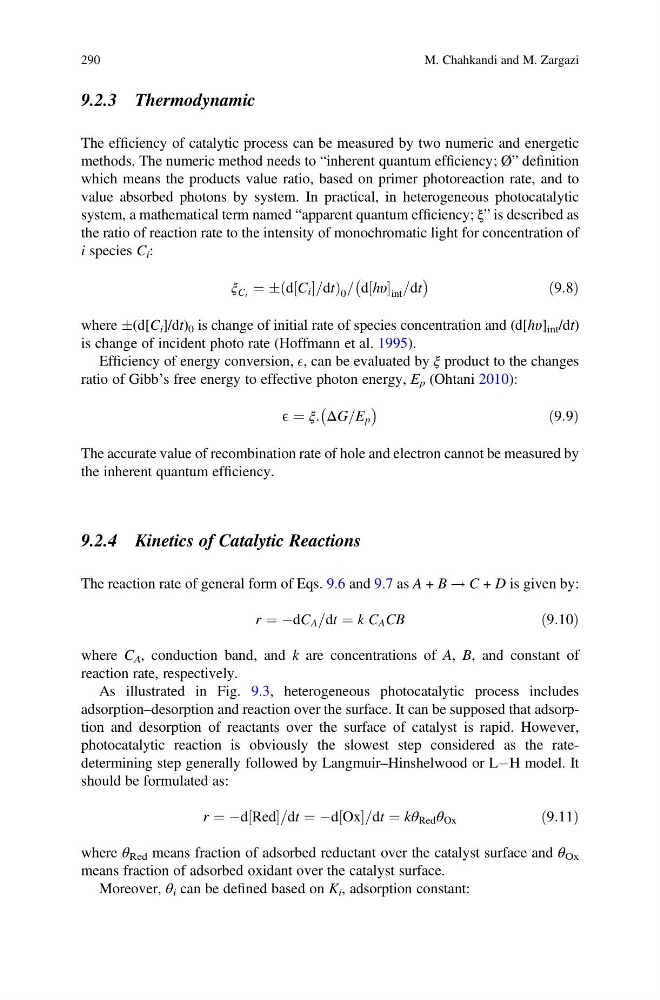
system, a mathematical term named “apparent quantum efficiency; ξ” is described as
the ratio of reaction rate to the intensity of monochromatic light for concentration of
i species C i :
ξ C i ¼ Æ d C i
½ =dt
ð
Þ 0 = d hυ
½ int =dt
À
Á
ð9:8Þ
where Æ(d[C i ]/dt) 0 is change of initial rate of species concentration and (d[hυ] int /dt)
is change of incident photo rate (Hoffmann et al. 1995).
Efficiency of energy conversion, E, can be evaluated by ξ product to the changes
ratio of Gibb’s free energy to effective photon energy, E p (Ohtani 2010):
E ¼ ξ: ΔG=E p
À
Á
ð9:9Þ
The accurate value of recombination rate of hole and electron cannot be measured by
the inherent quantum efficiency.
9.2.4 Kinetics of Catalytic Reactions
The reaction rate of general form of Eqs. 9.6 and 9.7 as A + B ! C + D is given by:
r ¼ ÀdC A =dt ¼ k C A CB
ð9:10Þ
where C A , conduction band, and k are concentrations of A, B, and constant of
reaction rate, respectively.
As illustrated in Fig. 9.3, heterogeneous photocatalytic process includes
adsorption–desorption and reaction over the surface. It can be supposed that adsorption and desorption of reactants over the surface of catalyst is rapid. However,
photocatalytic reaction is obviously the slowest step considered as the ratedetermining step generally followed by Langmuir–Hinshelwood or LÀH model. It
should be formulated as:
r ¼ Àd Red
½
=dt ¼ Àd Ox
½ =dt ¼ kθ Red θ Ox
ð9:11Þ
where θ Red means fraction of adsorbed reductant over the catalyst surface and θ Ox
means fraction of adsorbed oxidant over the catalyst surface.
Moreover, θ i can be defined based on K i , adsorption constant:
290
M. Chahkandi and M. Zargazi
The efficiency of catalytic process can be measured by two numeric and energetic
methods. The numeric method needs to “inherent quantum efficiency; Ø” definition
which means the products value ratio, based on primer photoreaction rate, and to
value absorbed photons by system. In practical, in heterogeneous photocatalytic
system, a mathematical term named “apparent quantum efficiency; ξ” is described as
the ratio of reaction rate to the intensity of monochromatic light for concentration of
i species C i :
ξ C i ¼ Æ d C i
½ =dt
ð
Þ 0 = d hυ
½ int =dt
À
Á
ð9:8Þ
where Æ(d[C i ]/dt) 0 is change of initial rate of species concentration and (d[hυ] int /dt)
is change of incident photo rate (Hoffmann et al. 1995).
Efficiency of energy conversion, E, can be evaluated by ξ product to the changes
ratio of Gibb’s free energy to effective photon energy, E p (Ohtani 2010):
E ¼ ξ: ΔG=E p
À
Á
ð9:9Þ
The accurate value of recombination rate of hole and electron cannot be measured by
the inherent quantum efficiency.
9.2.4 Kinetics of Catalytic Reactions
The reaction rate of general form of Eqs. 9.6 and 9.7 as A + B ! C + D is given by:
r ¼ ÀdC A =dt ¼ k C A CB
ð9:10Þ
where C A , conduction band, and k are concentrations of A, B, and constant of
reaction rate, respectively.
As illustrated in Fig. 9.3, heterogeneous photocatalytic process includes
adsorption–desorption and reaction over the surface. It can be supposed that adsorption and desorption of reactants over the surface of catalyst is rapid. However,
photocatalytic reaction is obviously the slowest step considered as the ratedetermining step generally followed by Langmuir–Hinshelwood or LÀH model. It
should be formulated as:
r ¼ Àd Red
½
=dt ¼ Àd Ox
½ =dt ¼ kθ Red θ Ox
ð9:11Þ
where θ Red means fraction of adsorbed reductant over the catalyst surface and θ Ox
means fraction of adsorbed oxidant over the catalyst surface.
Moreover, θ i can be defined based on K i , adsorption constant:
290
M. Chahkandi and M. Zargazi