

θ i ¼ K i C i = K i C i þ 1
ð
Þ
ð 9:12Þ
Combination of Eqs. (9.11) and (9.12) can be rephrased as:
r ¼ kK Red C Red K Ox C Ox = K Red C Red þ 1
ð
ÞK Ox C Ox þ 1
ð
Þ
ð 9:13Þ
Actually, K i value which is experimentally determined in dark means no
photocatalytic reaction. Some simple approximations can reduce the complexity
form of Eq. (9.13). The oxidant can be considered as a pure liquid, so θ Ox ¼ 1; or
as a fluid solution, based on Henry’s law, θ Ox ¼ constant. Therefore:
r ¼ k
0
θ Red ¼ k
0 K Red C Red = K Red C Red þ 1
ð
Þ
ð 9:14Þ
If C Red ¼ C Red, max , so θ Red ¼ 1 and r ¼ k
0
:
In contrast, if C Red ( C Red, max , so θ Red ¼ K Red C Red
and r ¼ k
0 K Red C Red ¼ K apparent C Red
ð9:15Þ
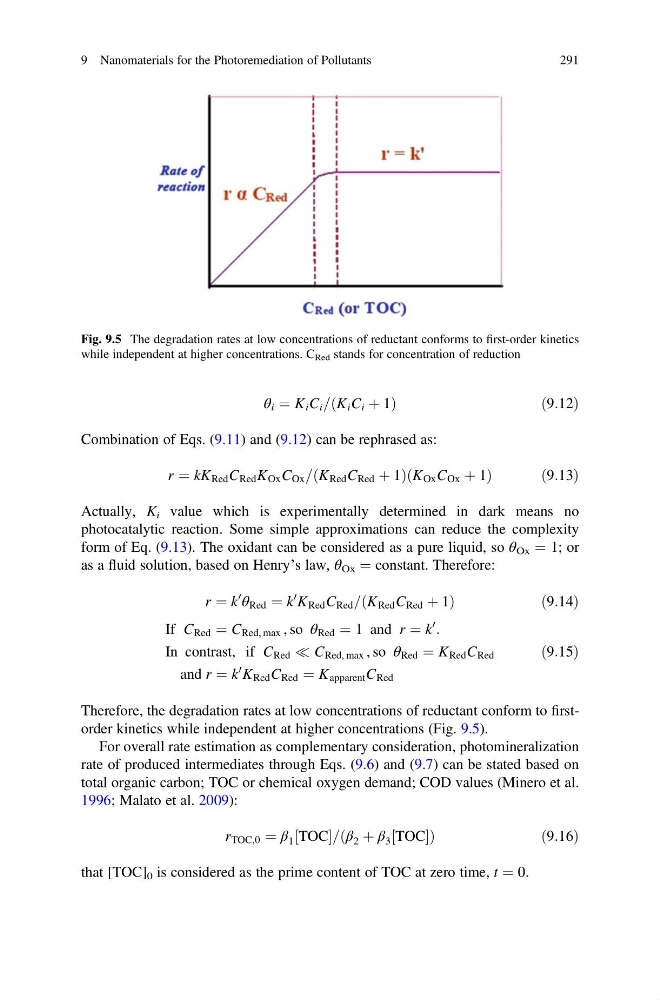
Therefore, the degradation rates at low concentrations of reductant conform to firstorder kinetics while independent at higher concentrations (Fig. 9.5).
For overall rate estimation as complementary consideration, photomineralization
rate of produced intermediates through Eqs. (9.6) and (9.7) can be stated based on
total organic carbon; TOC or chemical oxygen demand; COD values (Minero et al.
1996; Malato et al. 2009):
r TOC,0 ¼ β 1 TOC
½
= β 2 þ β 3 TOC
½
ð
Þ
ð 9:16Þ
that [TOC] 0 is considered as the prime content of TOC at zero time, t ¼ 0.
Fig. 9.5 The degradation rates at low concentrations of reductant conforms to first-order kinetics
while independent at higher concentrations. C Red stands for concentration of reduction
9 Nanomaterials for the Photoremediation of Pollutants
291
ð
Þ
ð 9:12Þ
Combination of Eqs. (9.11) and (9.12) can be rephrased as:
r ¼ kK Red C Red K Ox C Ox = K Red C Red þ 1
ð
ÞK Ox C Ox þ 1
ð
Þ
ð 9:13Þ
Actually, K i value which is experimentally determined in dark means no
photocatalytic reaction. Some simple approximations can reduce the complexity
form of Eq. (9.13). The oxidant can be considered as a pure liquid, so θ Ox ¼ 1; or
as a fluid solution, based on Henry’s law, θ Ox ¼ constant. Therefore:
r ¼ k
0
θ Red ¼ k
0 K Red C Red = K Red C Red þ 1
ð
Þ
ð 9:14Þ
If C Red ¼ C Red, max , so θ Red ¼ 1 and r ¼ k
0
:
In contrast, if C Red ( C Red, max , so θ Red ¼ K Red C Red
and r ¼ k
0 K Red C Red ¼ K apparent C Red
ð9:15Þ
Therefore, the degradation rates at low concentrations of reductant conform to firstorder kinetics while independent at higher concentrations (Fig. 9.5).
For overall rate estimation as complementary consideration, photomineralization
rate of produced intermediates through Eqs. (9.6) and (9.7) can be stated based on
total organic carbon; TOC or chemical oxygen demand; COD values (Minero et al.
1996; Malato et al. 2009):
r TOC,0 ¼ β 1 TOC
½
= β 2 þ β 3 TOC
½
ð
Þ
ð 9:16Þ
that [TOC] 0 is considered as the prime content of TOC at zero time, t ¼ 0.
Fig. 9.5 The degradation rates at low concentrations of reductant conforms to first-order kinetics
while independent at higher concentrations. C Red stands for concentration of reduction
9 Nanomaterials for the Photoremediation of Pollutants
291