

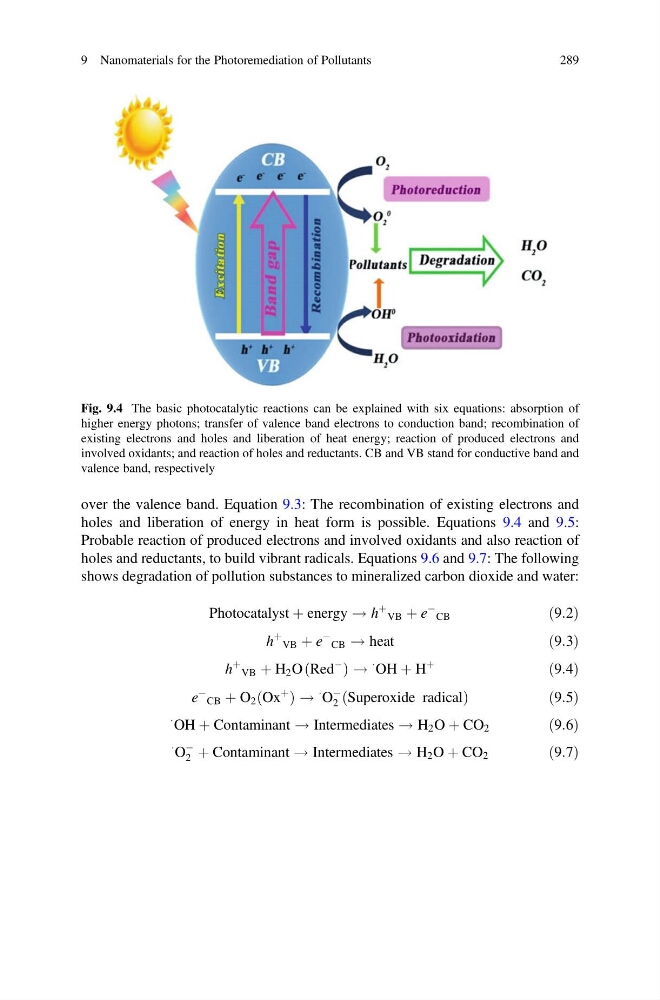
over the valence band. Equation 9.3: The recombination of existing electrons and
holes and liberation of energy in heat form is possible. Equations 9.4 and 9.5:
Probable reaction of produced electrons and involved oxidants and also reaction of
holes and reductants, to build vibrant radicals. Equations 9.6 and 9.7: The following
shows degradation of pollution substances to mineralized carbon dioxide and water:
Photocatalyst þ energy ! h
þ
VB þ e
À
CB
ð9:2Þ
h
þ
VB þ e
À
CB ! heat
ð9:3Þ
h
þ
VB þ H 2 O Red
À
ð
Þ!
Á OH þ H
þ
ð9:4Þ
e
À
CB þ O 2 Ox
þ
ð
Þ!
Á O
À
2 Superoxide radical
ð
Þ
ð9:5Þ
Á OH þ Contaminant ! Intermediates ! H 2 O þ CO 2
ð9:6Þ
Á O
À
2 þ Contaminant ! Intermediates ! H 2 O þ CO 2
ð9:7Þ
Fig. 9.4 The basic photocatalytic reactions can be explained with six equations: absorption of
higher energy photons; transfer of valence band electrons to conduction band; recombination of
existing electrons and holes and liberation of heat energy; reaction of produced electrons and
involved oxidants; and reaction of holes and reductants. CB and VB stand for conductive band and
valence band, respectively
9 Nanomaterials for the Photoremediation of Pollutants
289
holes and liberation of energy in heat form is possible. Equations 9.4 and 9.5:
Probable reaction of produced electrons and involved oxidants and also reaction of
holes and reductants, to build vibrant radicals. Equations 9.6 and 9.7: The following
shows degradation of pollution substances to mineralized carbon dioxide and water:
Photocatalyst þ energy ! h
þ
VB þ e
À
CB
ð9:2Þ
h
þ
VB þ e
À
CB ! heat
ð9:3Þ
h
þ
VB þ H 2 O Red
À
ð
Þ!
Á OH þ H
þ
ð9:4Þ
e
À
CB þ O 2 Ox
þ
ð
Þ!
Á O
À
2 Superoxide radical
ð
Þ
ð9:5Þ
Á OH þ Contaminant ! Intermediates ! H 2 O þ CO 2
ð9:6Þ
Á O
À
2 þ Contaminant ! Intermediates ! H 2 O þ CO 2
ð9:7Þ
Fig. 9.4 The basic photocatalytic reactions can be explained with six equations: absorption of
higher energy photons; transfer of valence band electrons to conduction band; recombination of
existing electrons and holes and liberation of heat energy; reaction of produced electrons and
involved oxidants; and reaction of holes and reductants. CB and VB stand for conductive band and
valence band, respectively
9 Nanomaterials for the Photoremediation of Pollutants
289