

8.3 Membrane Processes
The membrane processes can be divided into two categories: passive and active.
Passive processes do not require external energy for carrying out the separation,
while the active processes require an external source of energy to bring out the
separation. Passive processes include forward osmosis, diffusion dialysis, hemodialysis, membrane solvent extraction, supported liquid membranes, etc., while the
active processes include reverse osmosis, electrodialysis, ultrafiltration,
nanofiltration, and membrane distillation. Membrane is a barrier, and its surface
controls the separation excepting in cases where the separation is diffusion controlled like membrane solvent extraction (in such cases, membrane provides a large
interfacial contact area to enhance the separation).
8.3.1 Principle of Membrane Separation
One can visualize the membrane separation as described in the diagram (Fig. 8.5).
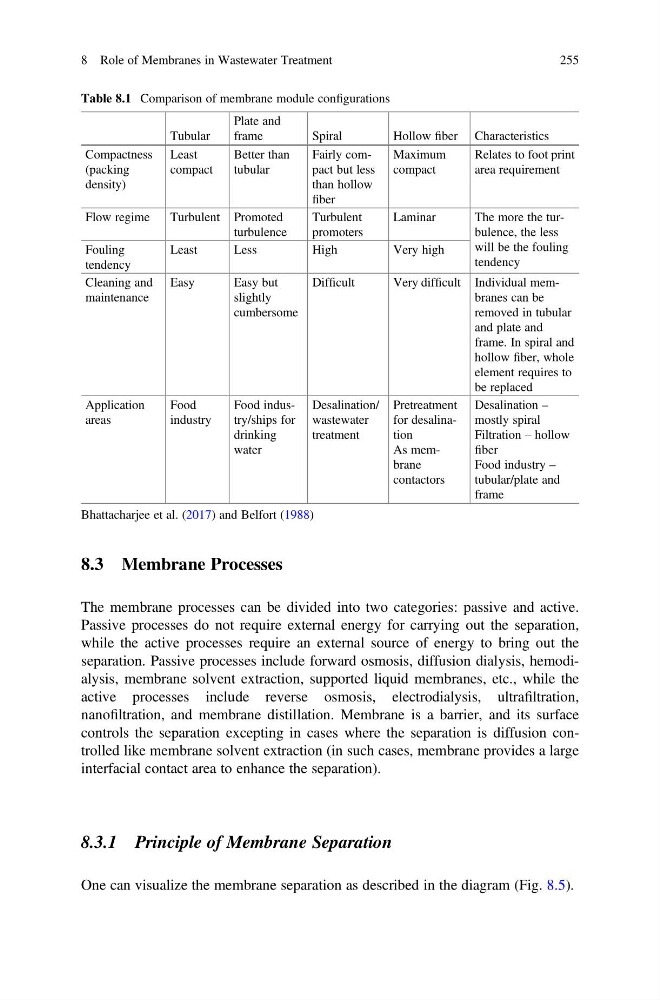
Table 8.1 Comparison of membrane module configurations
Tubular
Plate and
frame
Spiral
Hollow fiber Characteristics
Compactness
(packing
density)
Least
compact
Better than
tubular
Fairly compact but less
than hollow
fiber
Maximum
compact
Relates to foot print
area requirement
Flow regime
Turbulent Promoted
turbulence
Turbulent
promoters
Laminar
The more the turbulence, the less
will be the fouling
tendency
Fouling
tendency
Least
Less
High
Very high
Cleaning and
maintenance
Easy
Easy but
slightly
cumbersome
Difficult
Very difficult Individual membranes can be
removed in tubular
and plate and
frame. In spiral and
hollow fiber, whole
element requires to
be replaced
Application
areas
Food
industry
Food industry/ships for
drinking
water
Desalination/
wastewater
treatment
Pretreatment
for desalination
As membrane
contactors
Desalination –
mostly spiral
Filtration – hollow
fiber
Food industry –
tubular/plate and
frame
Bhattacharjee et al. (2017) and Belfort (1988)
8 Role of Membranes in Wastewater Treatment
255
The membrane processes can be divided into two categories: passive and active.
Passive processes do not require external energy for carrying out the separation,
while the active processes require an external source of energy to bring out the
separation. Passive processes include forward osmosis, diffusion dialysis, hemodialysis, membrane solvent extraction, supported liquid membranes, etc., while the
active processes include reverse osmosis, electrodialysis, ultrafiltration,
nanofiltration, and membrane distillation. Membrane is a barrier, and its surface
controls the separation excepting in cases where the separation is diffusion controlled like membrane solvent extraction (in such cases, membrane provides a large
interfacial contact area to enhance the separation).
8.3.1 Principle of Membrane Separation
One can visualize the membrane separation as described in the diagram (Fig. 8.5).
Table 8.1 Comparison of membrane module configurations
Tubular
Plate and
frame
Spiral
Hollow fiber Characteristics
Compactness
(packing
density)
Least
compact
Better than
tubular
Fairly compact but less
than hollow
fiber
Maximum
compact
Relates to foot print
area requirement
Flow regime
Turbulent Promoted
turbulence
Turbulent
promoters
Laminar
The more the turbulence, the less
will be the fouling
tendency
Fouling
tendency
Least
Less
High
Very high
Cleaning and
maintenance
Easy
Easy but
slightly
cumbersome
Difficult
Very difficult Individual membranes can be
removed in tubular
and plate and
frame. In spiral and
hollow fiber, whole
element requires to
be replaced
Application
areas
Food
industry
Food industry/ships for
drinking
water
Desalination/
wastewater
treatment
Pretreatment
for desalination
As membrane
contactors
Desalination –
mostly spiral
Filtration – hollow
fiber
Food industry –
tubular/plate and
frame
Bhattacharjee et al. (2017) and Belfort (1988)
8 Role of Membranes in Wastewater Treatment
255