

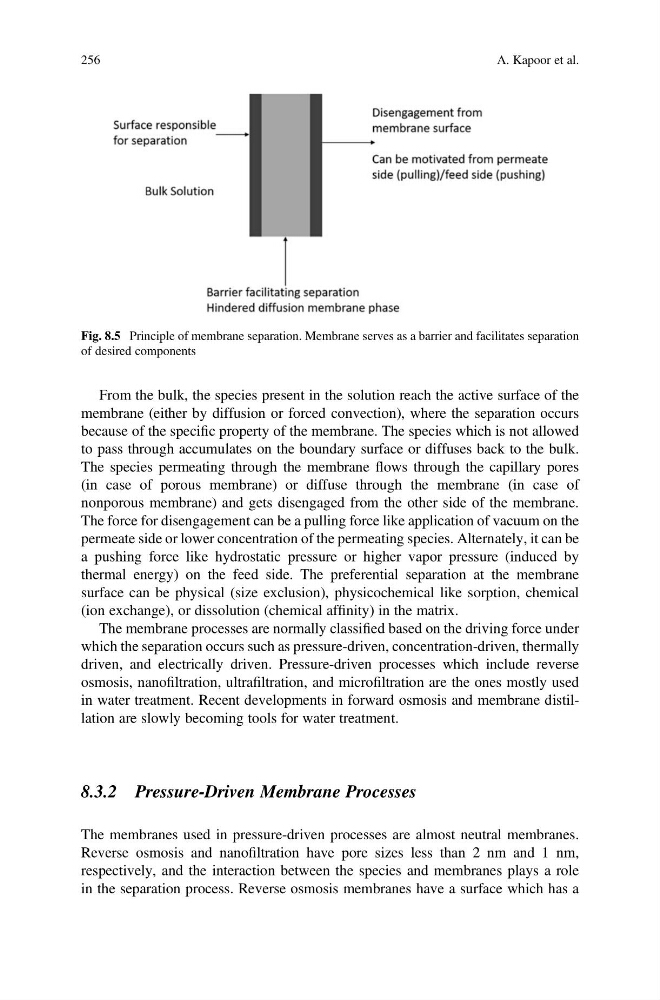
From the bulk, the species present in the solution reach the active surface of the
membrane (either by diffusion or forced convection), where the separation occurs
because of the specific property of the membrane. The species which is not allowed
to pass through accumulates on the boundary surface or diffuses back to the bulk.
The species permeating through the membrane flows through the capillary pores
(in case of porous membrane) or diffuse through the membrane (in case of
nonporous membrane) and gets disengaged from the other side of the membrane.
The force for disengagement can be a pulling force like application of vacuum on the
permeate side or lower concentration of the permeating species. Alternately, it can be
a pushing force like hydrostatic pressure or higher vapor pressure (induced by
thermal energy) on the feed side. The preferential separation at the membrane
surface can be physical (size exclusion), physicochemical like sorption, chemical
(ion exchange), or dissolution (chemical affinity) in the matrix.
The membrane processes are normally classified based on the driving force under
which the separation occurs such as pressure-driven, concentration-driven, thermally
driven, and electrically driven. Pressure-driven processes which include reverse
osmosis, nanofiltration, ultrafiltration, and microfiltration are the ones mostly used
in water treatment. Recent developments in forward osmosis and membrane distillation are slowly becoming tools for water treatment.
8.3.2 Pressure-Driven Membrane Processes
The membranes used in pressure-driven processes are almost neutral membranes.
Reverse osmosis and nanofiltration have pore sizes less than 2 nm and 1 nm,
respectively, and the interaction between the species and membranes plays a role
in the separation process. Reverse osmosis membranes have a surface which has a
Fig. 8.5 Principle of membrane separation. Membrane serves as a barrier and facilitates separation
of desired components
256
A. Kapoor et al.
membrane (either by diffusion or forced convection), where the separation occurs
because of the specific property of the membrane. The species which is not allowed
to pass through accumulates on the boundary surface or diffuses back to the bulk.
The species permeating through the membrane flows through the capillary pores
(in case of porous membrane) or diffuse through the membrane (in case of
nonporous membrane) and gets disengaged from the other side of the membrane.
The force for disengagement can be a pulling force like application of vacuum on the
permeate side or lower concentration of the permeating species. Alternately, it can be
a pushing force like hydrostatic pressure or higher vapor pressure (induced by
thermal energy) on the feed side. The preferential separation at the membrane
surface can be physical (size exclusion), physicochemical like sorption, chemical
(ion exchange), or dissolution (chemical affinity) in the matrix.
The membrane processes are normally classified based on the driving force under
which the separation occurs such as pressure-driven, concentration-driven, thermally
driven, and electrically driven. Pressure-driven processes which include reverse
osmosis, nanofiltration, ultrafiltration, and microfiltration are the ones mostly used
in water treatment. Recent developments in forward osmosis and membrane distillation are slowly becoming tools for water treatment.
8.3.2 Pressure-Driven Membrane Processes
The membranes used in pressure-driven processes are almost neutral membranes.
Reverse osmosis and nanofiltration have pore sizes less than 2 nm and 1 nm,
respectively, and the interaction between the species and membranes plays a role
in the separation process. Reverse osmosis membranes have a surface which has a
Fig. 8.5 Principle of membrane separation. Membrane serves as a barrier and facilitates separation
of desired components
256
A. Kapoor et al.