

The energy level of M
n+
/M
(n À 1)+ is less negative as compared with CB energy level
of the native photocatalyst; but the energy level of M
n+
/M
(n + 1)+ is slightly positive
as compared with the VB energy level of the native photocatalyst.
In order to explain in details about the advantage of doping and application of
ultrasound in photocatalysis process, the degradation results of methylene blue and
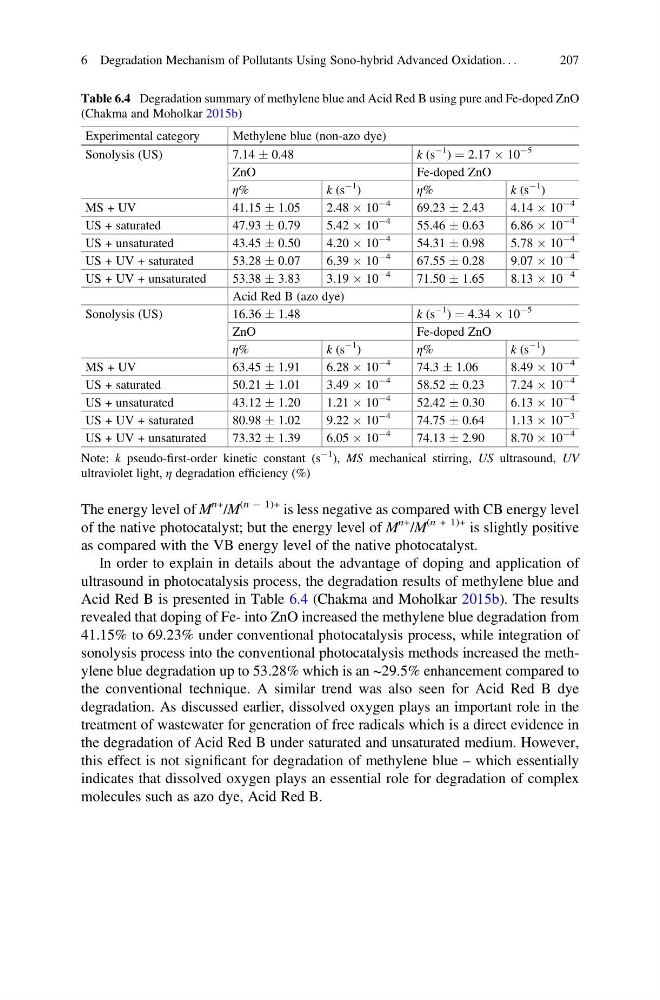
Acid Red B is presented in Table 6.4 (Chakma and Moholkar 2015b). The results
revealed that doping of Fe- into ZnO increased the methylene blue degradation from
41.15% to 69.23% under conventional photocatalysis process, while integration of
sonolysis process into the conventional photocatalysis methods increased the methylene blue degradation up to 53.28% which is an ~29.5% enhancement compared to
the conventional technique. A similar trend was also seen for Acid Red B dye
degradation. As discussed earlier, dissolved oxygen plays an important role in the
treatment of wastewater for generation of free radicals which is a direct evidence in
the degradation of Acid Red B under saturated and unsaturated medium. However,
this effect is not significant for degradation of methylene blue – which essentially
indicates that dissolved oxygen plays an essential role for degradation of complex
molecules such as azo dye, Acid Red B.
Table 6.4 Degradation summary of methylene blue and Acid Red B using pure and Fe-doped ZnO
(Chakma and Moholkar 2015b)
Experimental category
Methylene blue (non-azo dye)
Sonolysis (US)
7.14 Æ 0.48
k (s
À1
) ¼ 2.17 Â 10
À5
ZnO
Fe-doped ZnO
η%
k (s
À1
)
η%
k (s
À1
)
MS + UV
41.15 Æ 1.05
2.48 Â 10
À4
69.23 Æ 2.43
4.14 Â 10
À4
US + saturated
47.93 Æ 0.79
5.42 Â 10
À4
55.46 Æ 0.63
6.86 Â 10
À4
US + unsaturated
43.45 Æ 0.50
4.20 Â 10
À4
54.31 Æ 0.98
5.78 Â 10
À4
US + UV + saturated
53.28 Æ 0.07
6.39 Â 10
À4
67.55 Æ 0.28
9.07 Â 10
À4
US + UV + unsaturated
53.38 Æ 3.83
3.19 Â 10
À4
71.50 Æ 1.65
8.13 Â 10
À4
Acid Red B (azo dye)
Sonolysis (US)
16.36 Æ 1.48
k (s
À1
) ¼ 4.34 Â 10
À5
ZnO
Fe-doped ZnO
η%
k (s
À1
)
η%
k (s
À1
)
MS + UV
63.45 Æ 1.91
6.28 Â 10
À4
74.3 Æ 1.06
8.49 Â 10
À4
US + saturated
50.21 Æ 1.01
3.49 Â 10
À4
58.52 Æ 0.23
7.24 Â 10
À4
US + unsaturated
43.12 Æ 1.20
1.21 Â 10
À4
52.42 Æ 0.30
6.13 Â 10
À4
US + UV + saturated
80.98 Æ 1.02
9.22 Â 10
À4
74.75 Æ 0.64
1.13 Â 10
À3
US + UV + unsaturated
73.32 Æ 1.39
6.05 Â 10
À4
74.13 Æ 2.90
8.70 Â 10
À4
Note: k pseudo-first-order kinetic constant (s
À1
), MS mechanical stirring, US ultrasound, UV
ultraviolet light, η degradation efficiency (%)
6 Degradation Mechanism of Pollutants Using Sono-hybrid Advanced Oxidation. . .
207
n+
/M
(n À 1)+ is less negative as compared with CB energy level
of the native photocatalyst; but the energy level of M
n+
/M
(n + 1)+ is slightly positive
as compared with the VB energy level of the native photocatalyst.
In order to explain in details about the advantage of doping and application of
ultrasound in photocatalysis process, the degradation results of methylene blue and
Acid Red B is presented in Table 6.4 (Chakma and Moholkar 2015b). The results
revealed that doping of Fe- into ZnO increased the methylene blue degradation from
41.15% to 69.23% under conventional photocatalysis process, while integration of
sonolysis process into the conventional photocatalysis methods increased the methylene blue degradation up to 53.28% which is an ~29.5% enhancement compared to
the conventional technique. A similar trend was also seen for Acid Red B dye
degradation. As discussed earlier, dissolved oxygen plays an important role in the
treatment of wastewater for generation of free radicals which is a direct evidence in
the degradation of Acid Red B under saturated and unsaturated medium. However,
this effect is not significant for degradation of methylene blue – which essentially
indicates that dissolved oxygen plays an essential role for degradation of complex
molecules such as azo dye, Acid Red B.
Table 6.4 Degradation summary of methylene blue and Acid Red B using pure and Fe-doped ZnO
(Chakma and Moholkar 2015b)
Experimental category
Methylene blue (non-azo dye)
Sonolysis (US)
7.14 Æ 0.48
k (s
À1
) ¼ 2.17 Â 10
À5
ZnO
Fe-doped ZnO
η%
k (s
À1
)
η%
k (s
À1
)
MS + UV
41.15 Æ 1.05
2.48 Â 10
À4
69.23 Æ 2.43
4.14 Â 10
À4
US + saturated
47.93 Æ 0.79
5.42 Â 10
À4
55.46 Æ 0.63
6.86 Â 10
À4
US + unsaturated
43.45 Æ 0.50
4.20 Â 10
À4
54.31 Æ 0.98
5.78 Â 10
À4
US + UV + saturated
53.28 Æ 0.07
6.39 Â 10
À4
67.55 Æ 0.28
9.07 Â 10
À4
US + UV + unsaturated
53.38 Æ 3.83
3.19 Â 10
À4
71.50 Æ 1.65
8.13 Â 10
À4
Acid Red B (azo dye)
Sonolysis (US)
16.36 Æ 1.48
k (s
À1
) ¼ 4.34 Â 10
À5
ZnO
Fe-doped ZnO
η%
k (s
À1
)
η%
k (s
À1
)
MS + UV
63.45 Æ 1.91
6.28 Â 10
À4
74.3 Æ 1.06
8.49 Â 10
À4
US + saturated
50.21 Æ 1.01
3.49 Â 10
À4
58.52 Æ 0.23
7.24 Â 10
À4
US + unsaturated
43.12 Æ 1.20
1.21 Â 10
À4
52.42 Æ 0.30
6.13 Â 10
À4
US + UV + saturated
80.98 Æ 1.02
9.22 Â 10
À4
74.75 Æ 0.64
1.13 Â 10
À3
US + UV + unsaturated
73.32 Æ 1.39
6.05 Â 10
À4
74.13 Æ 2.90
8.70 Â 10
À4
Note: k pseudo-first-order kinetic constant (s
À1
), MS mechanical stirring, US ultrasound, UV
ultraviolet light, η degradation efficiency (%)
6 Degradation Mechanism of Pollutants Using Sono-hybrid Advanced Oxidation. . .
207