

6.7 Sono-persulfate Oxidation Process
Persulfate oxidation process is another advanced oxidation process for degrading the
recalcitrant pollutants effectively. In this process, metal persulfate generates sulfate
radical anion ( SO
• À
4 ) which has oxidation potential of 2.6 eV (Zou et al. 2014). This
radical can degrade a large variety of organic molecules. To generate SO
• À
4 radical
anions, the persulfate anion (S 2 O
2À
8 ) can be activated using ultraviolet light
(254 nm), heat, and metal ions such as Fe
2+ (Monteagudo et al. 2015; Wang et al.
2015):
S 2 O
2À
8
!
UVC 2 SO
• À
4
S 2 O
2À
8 !
Heat 2 SO
• À
4
S 2 O
2À
8 þ Fe
2þ
! Fe
3þ
þ SO
• À
4 þ SO
2À
4
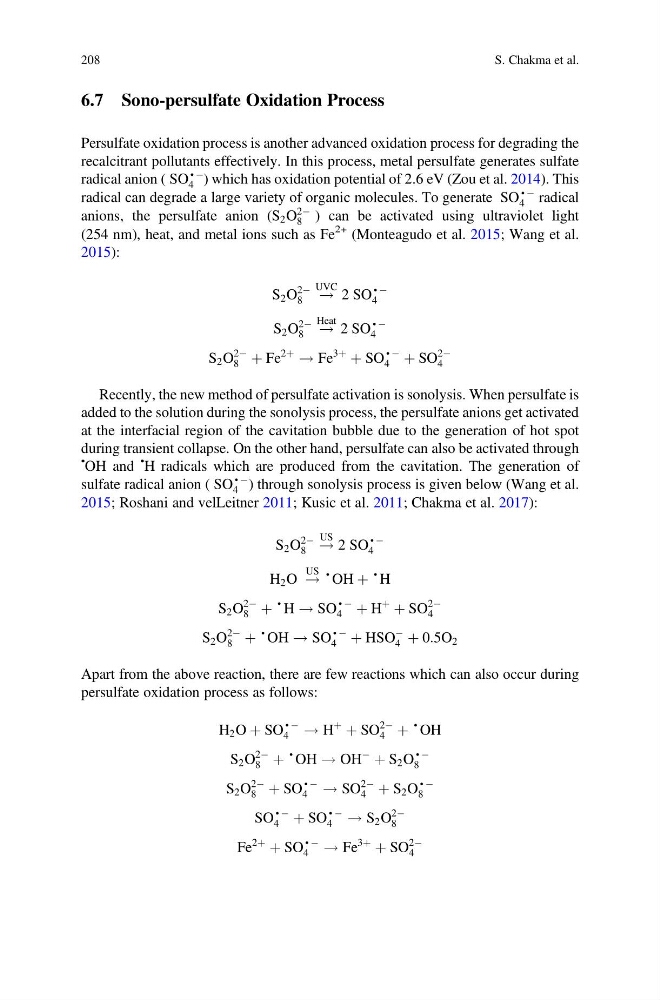
Recently, the new method of persulfate activation is sonolysis. When persulfate is
added to the solution during the sonolysis process, the persulfate anions get activated
at the interfacial region of the cavitation bubble due to the generation of hot spot
during transient collapse. On the other hand, persulfate can also be activated through
•
OH and
•
H radicals which are produced from the cavitation. The generation of
sulfate radical anion ( SO
• À
4 ) through sonolysis process is given below (Wang et al.
2015; Roshani and velLeitner 2011; Kusic et al. 2011; Chakma et al. 2017):
S 2 O
2À
8 !
US 2 SO
• À
4
H 2 O !
US • OH þ
• H
S 2 O
2À
8 þ
• H ! SO
• À
4 þ H
þ
þ SO
2À
4
S 2 O
2À
8 þ
• OH ! SO
• À
4 þ HSO
À
4 þ 0:5O 2
Apart from the above reaction, there are few reactions which can also occur during
persulfate oxidation process as follows:
H 2 O þ SO
• À
4 ! H
þ
þ SO
2À
4 þ
• OH
S 2 O
2À
8 þ
• OH ! OH
À
þ S 2 O
• À
8
S 2 O
2À
8 þ SO
• À
4 ! SO
2À
4 þ S 2 O
• À
8
SO
• À
4 þ SO
• À
4 ! S 2 O
2À
8
Fe
2þ
þ SO
• À
4 ! Fe
3þ
þ SO
2À
4
208
S. Chakma et al.
Persulfate oxidation process is another advanced oxidation process for degrading the
recalcitrant pollutants effectively. In this process, metal persulfate generates sulfate
radical anion ( SO
• À
4 ) which has oxidation potential of 2.6 eV (Zou et al. 2014). This
radical can degrade a large variety of organic molecules. To generate SO
• À
4 radical
anions, the persulfate anion (S 2 O
2À
8 ) can be activated using ultraviolet light
(254 nm), heat, and metal ions such as Fe
2+ (Monteagudo et al. 2015; Wang et al.
2015):
S 2 O
2À
8
!
UVC 2 SO
• À
4
S 2 O
2À
8 !
Heat 2 SO
• À
4
S 2 O
2À
8 þ Fe
2þ
! Fe
3þ
þ SO
• À
4 þ SO
2À
4
Recently, the new method of persulfate activation is sonolysis. When persulfate is
added to the solution during the sonolysis process, the persulfate anions get activated
at the interfacial region of the cavitation bubble due to the generation of hot spot
during transient collapse. On the other hand, persulfate can also be activated through
•
OH and
•
H radicals which are produced from the cavitation. The generation of
sulfate radical anion ( SO
• À
4 ) through sonolysis process is given below (Wang et al.
2015; Roshani and velLeitner 2011; Kusic et al. 2011; Chakma et al. 2017):
S 2 O
2À
8 !
US 2 SO
• À
4
H 2 O !
US • OH þ
• H
S 2 O
2À
8 þ
• H ! SO
• À
4 þ H
þ
þ SO
2À
4
S 2 O
2À
8 þ
• OH ! SO
• À
4 þ HSO
À
4 þ 0:5O 2
Apart from the above reaction, there are few reactions which can also occur during
persulfate oxidation process as follows:
H 2 O þ SO
• À
4 ! H
þ
þ SO
2À
4 þ
• OH
S 2 O
2À
8 þ
• OH ! OH
À
þ S 2 O
• À
8
S 2 O
2À
8 þ SO
• À
4 ! SO
2À
4 þ S 2 O
• À
8
SO
• À
4 þ SO
• À
4 ! S 2 O
2À
8
Fe
2þ
þ SO
• À
4 ! Fe
3þ
þ SO
2À
4
208
S. Chakma et al.