

HO
À
2 þ H
þ
⇄H 2 O 2
e
À
CB TiO 2
ð
Þ þ H 2 O 2 ! HO
•
TiO 2
ð
Þ þ OH
À
O
• À
2 TiO 2
ð
Þ þ H 2 O 2 ! HO
•
TiO 2
ð
Þ þ OH
À
þ O 2
H 2 O 2 þ hv ! 2 HO
•
HO
•
þ H 2 O 2 ! H 2 O þ HO
•
2
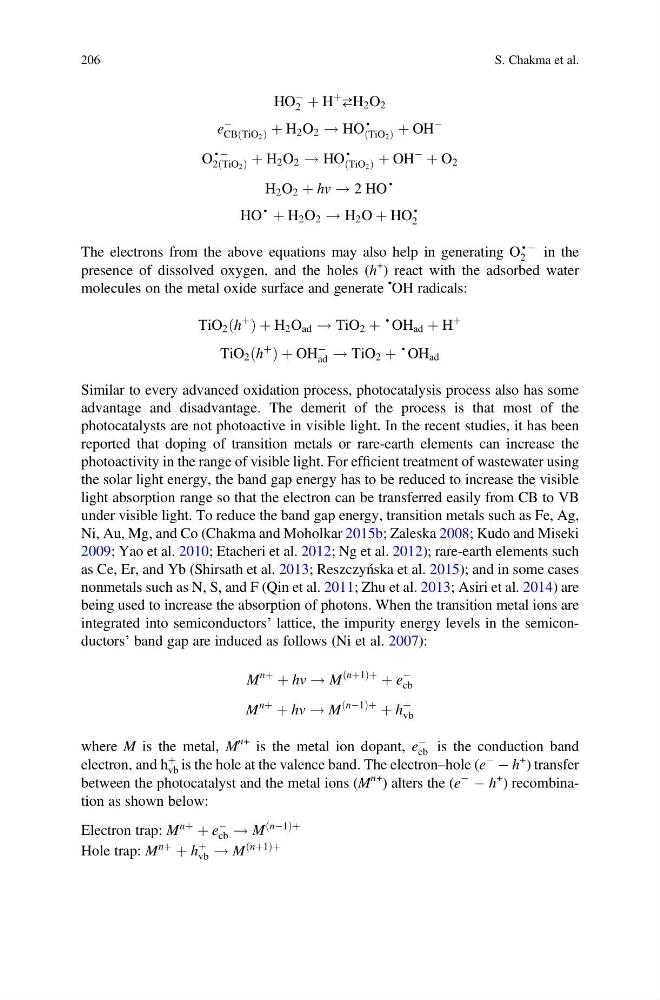
The electrons from the above equations may also help in generating O
• À
2
in the
presence of dissolved oxygen, and the holes (h
+
) react with the adsorbed water
molecules on the metal oxide surface and generate
•
OH radicals:
TiO 2 h
þ
ð Þ þ H 2 O ad ! TiO 2 þ
• OH ad þ H
þ
TiO 2 h
þ
ð Þ þ OH
À
ad ! TiO 2 þ
• OH ad
Similar to every advanced oxidation process, photocatalysis process also has some
advantage and disadvantage. The demerit of the process is that most of the
photocatalysts are not photoactive in visible light. In the recent studies, it has been
reported that doping of transition metals or rare-earth elements can increase the
photoactivity in the range of visible light. For efficient treatment of wastewater using
the solar light energy, the band gap energy has to be reduced to increase the visible
light absorption range so that the electron can be transferred easily from CB to VB
under visible light. To reduce the band gap energy, transition metals such as Fe, Ag,
Ni, Au, Mg, and Co (Chakma and Moholkar 2015b; Zaleska 2008; Kudo and Miseki
2009; Yao et al. 2010; Etacheri et al. 2012; Ng et al. 2012); rare-earth elements such
as Ce, Er, and Yb (Shirsath et al. 2013; Reszczyńska et al. 2015); and in some cases
nonmetals such as N, S, and F (Qin et al. 2011; Zhu et al. 2013; Asiri et al. 2014) are
being used to increase the absorption of photons. When the transition metal ions are
integrated into semiconductors’ lattice, the impurity energy levels in the semiconductors’ band gap are induced as follows (Ni et al. 2007):
M
nþ
þ hv ! M
nþ1
ð
Þþ
þ e
À
cb
M
nþ
þ hv ! M
nÀ1
ð
Þþ
þ h
þ
vb
where M is the metal, M
n+ is the metal ion dopant, e
À
cb is the conduction band
electron, and h
þ
vb is the hole at the valence band. The electron–hole (e
À
À h
+
) transfer
between the photocatalyst and the metal ions (M
n+ ) alters the (e
À
À h
+ ) recombination as shown below:
Electron trap: M
nþ
þ e
À
cb ! M
nÀ1
ð
Þþ
Hole trap: M
nþ
þ h
þ
vb ! M
nþ1
ð
Þþ
206
S. Chakma et al.
À
2 þ H
þ
⇄H 2 O 2
e
À
CB TiO 2
ð
Þ þ H 2 O 2 ! HO
•
TiO 2
ð
Þ þ OH
À
O
• À
2 TiO 2
ð
Þ þ H 2 O 2 ! HO
•
TiO 2
ð
Þ þ OH
À
þ O 2
H 2 O 2 þ hv ! 2 HO
•
HO
•
þ H 2 O 2 ! H 2 O þ HO
•
2
The electrons from the above equations may also help in generating O
• À
2
in the
presence of dissolved oxygen, and the holes (h
+
) react with the adsorbed water
molecules on the metal oxide surface and generate
•
OH radicals:
TiO 2 h
þ
ð Þ þ H 2 O ad ! TiO 2 þ
• OH ad þ H
þ
TiO 2 h
þ
ð Þ þ OH
À
ad ! TiO 2 þ
• OH ad
Similar to every advanced oxidation process, photocatalysis process also has some
advantage and disadvantage. The demerit of the process is that most of the
photocatalysts are not photoactive in visible light. In the recent studies, it has been
reported that doping of transition metals or rare-earth elements can increase the
photoactivity in the range of visible light. For efficient treatment of wastewater using
the solar light energy, the band gap energy has to be reduced to increase the visible
light absorption range so that the electron can be transferred easily from CB to VB
under visible light. To reduce the band gap energy, transition metals such as Fe, Ag,
Ni, Au, Mg, and Co (Chakma and Moholkar 2015b; Zaleska 2008; Kudo and Miseki
2009; Yao et al. 2010; Etacheri et al. 2012; Ng et al. 2012); rare-earth elements such
as Ce, Er, and Yb (Shirsath et al. 2013; Reszczyńska et al. 2015); and in some cases
nonmetals such as N, S, and F (Qin et al. 2011; Zhu et al. 2013; Asiri et al. 2014) are
being used to increase the absorption of photons. When the transition metal ions are
integrated into semiconductors’ lattice, the impurity energy levels in the semiconductors’ band gap are induced as follows (Ni et al. 2007):
M
nþ
þ hv ! M
nþ1
ð
Þþ
þ e
À
cb
M
nþ
þ hv ! M
nÀ1
ð
Þþ
þ h
þ
vb
where M is the metal, M
n+ is the metal ion dopant, e
À
cb is the conduction band
electron, and h
þ
vb is the hole at the valence band. The electron–hole (e
À
À h
+
) transfer
between the photocatalyst and the metal ions (M
n+ ) alters the (e
À
À h
+ ) recombination as shown below:
Electron trap: M
nþ
þ e
À
cb ! M
nÀ1
ð
Þþ
Hole trap: M
nþ
þ h
þ
vb ! M
nþ1
ð
Þþ
206
S. Chakma et al.