

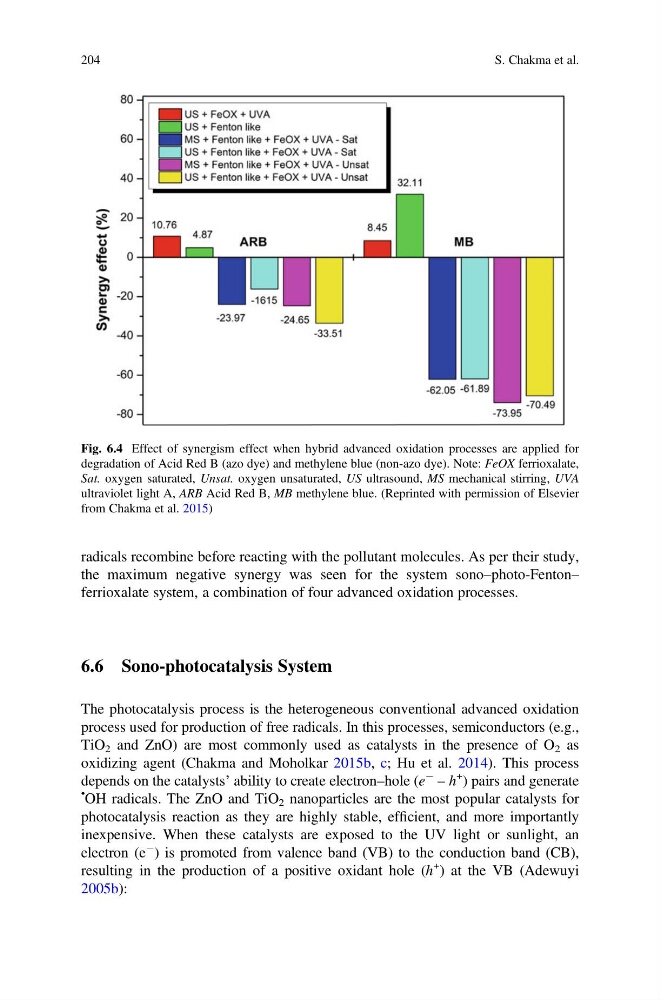
radicals recombine before reacting with the pollutant molecules. As per their study,
the maximum negative synergy was seen for the system sono–photo-Fenton–
ferrioxalate system, a combination of four advanced oxidation processes.
6.6 Sono-photocatalysis System
The photocatalysis process is the heterogeneous conventional advanced oxidation
process used for production of free radicals. In this processes, semiconductors (e.g.,
TiO 2 and ZnO) are most commonly used as catalysts in the presence of O 2 as
oxidizing agent (Chakma and Moholkar 2015b, c; Hu et al. 2014). This process
depends on the catalysts’ ability to create electron–hole (e
À
– h
+
) pairs and generate
•
OH radicals. The ZnO and TiO 2 nanoparticles are the most popular catalysts for
photocatalysis reaction as they are highly stable, efficient, and more importantly
inexpensive. When these catalysts are exposed to the UV light or sunlight, an
electron (e
À
) is promoted from valence band (VB) to the conduction band (CB),
resulting in the production of a positive oxidant hole (h
+
) at the VB (Adewuyi
2005b):
Fig. 6.4 Effect of synergism effect when hybrid advanced oxidation processes are applied for
degradation of Acid Red B (azo dye) and methylene blue (non-azo dye). Note: FeOX ferrioxalate,
Sat. oxygen saturated, Unsat. oxygen unsaturated, US ultrasound, MS mechanical stirring, UVA
ultraviolet light A, ARB Acid Red B, MB methylene blue. (Reprinted with permission of Elsevier
from Chakma et al. 2015)
204
S. Chakma et al.
the maximum negative synergy was seen for the system sono–photo-Fenton–
ferrioxalate system, a combination of four advanced oxidation processes.
6.6 Sono-photocatalysis System
The photocatalysis process is the heterogeneous conventional advanced oxidation
process used for production of free radicals. In this processes, semiconductors (e.g.,
TiO 2 and ZnO) are most commonly used as catalysts in the presence of O 2 as
oxidizing agent (Chakma and Moholkar 2015b, c; Hu et al. 2014). This process
depends on the catalysts’ ability to create electron–hole (e
À
– h
+
) pairs and generate
•
OH radicals. The ZnO and TiO 2 nanoparticles are the most popular catalysts for
photocatalysis reaction as they are highly stable, efficient, and more importantly
inexpensive. When these catalysts are exposed to the UV light or sunlight, an
electron (e
À
) is promoted from valence band (VB) to the conduction band (CB),
resulting in the production of a positive oxidant hole (h
+
) at the VB (Adewuyi
2005b):
Fig. 6.4 Effect of synergism effect when hybrid advanced oxidation processes are applied for
degradation of Acid Red B (azo dye) and methylene blue (non-azo dye). Note: FeOX ferrioxalate,
Sat. oxygen saturated, Unsat. oxygen unsaturated, US ultrasound, MS mechanical stirring, UVA
ultraviolet light A, ARB Acid Red B, MB methylene blue. (Reprinted with permission of Elsevier
from Chakma et al. 2015)
204
S. Chakma et al.