

C 2 O
• À
4 þ Fe C 2 O 4
ð
Þ 3
Â
à 3À ! Fe
2þ
þ 3 C 2 O
2À
4 þ 2 CO 2
C 2 O
• À
4 ! CO 2 þ CO
• À
2
CO
• À
2 þ O 2 ! CO 2 þ O
• À
2
C 2 O
• À
4 þ O 2 ! 2 CO 2 þ O
• À
2
O
• À
2 þ H
þ
! HO
•
2
HO
•
2 þ HO
•
2 ! H 2 O 2 þ O 2
H 2 O 2 þ Fe
2þ
! Fe
3þ
þ HO
•
þ OH
À
Fe
3þ
þ H 2 O 2 ⇄Fe
2þ
þ HO
•
2 þ H
þ
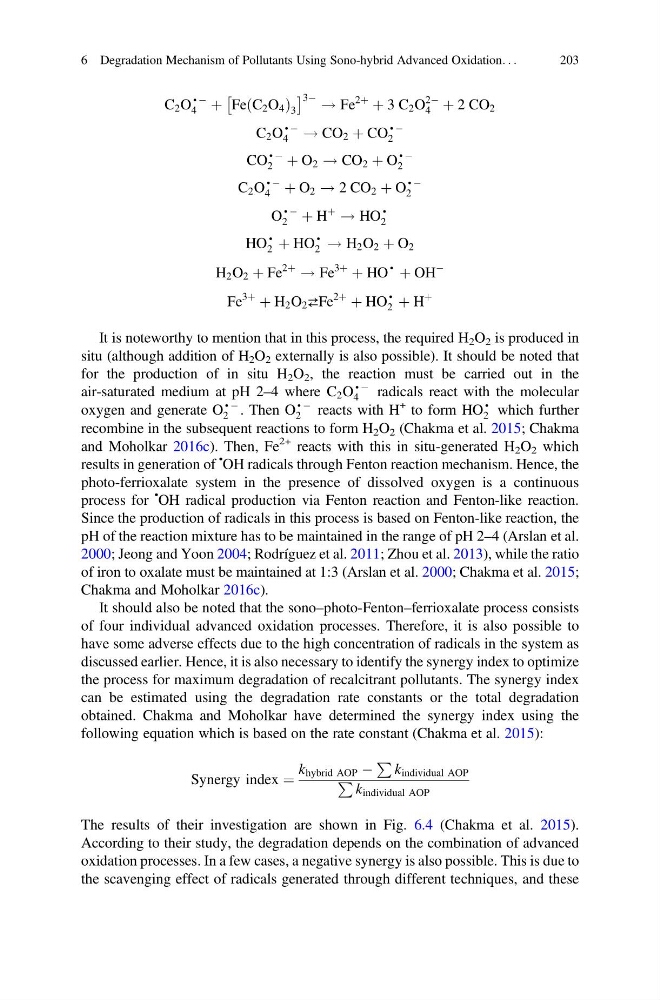
It is noteworthy to mention that in this process, the required H 2 O 2 is produced in
situ (although addition of H 2 O 2 externally is also possible). It should be noted that
for the production of in situ H 2 O 2 , the reaction must be carried out in the
air-saturated medium at pH 2–4 where C 2 O
• À
4
radicals react with the molecular
oxygen and generate O
• À
2 . Then O
• À
2
reacts with H
+ to form HO
•
2 which further
recombine in the subsequent reactions to form H 2 O 2 (Chakma et al. 2015; Chakma
and Moholkar 2016c). Then, Fe
2+ reacts with this in situ-generated H 2 O 2 which
results in generation of
•
OH radicals through Fenton reaction mechanism. Hence, the
photo-ferrioxalate system in the presence of dissolved oxygen is a continuous
process for
•
OH radical production via Fenton reaction and Fenton-like reaction.
Since the production of radicals in this process is based on Fenton-like reaction, the
pH of the reaction mixture has to be maintained in the range of pH 2–4 (Arslan et al.
2000; Jeong and Yoon 2004; Rodríguez et al. 2011; Zhou et al. 2013), while the ratio
of iron to oxalate must be maintained at 1:3 (Arslan et al. 2000; Chakma et al. 2015;
Chakma and Moholkar 2016c).
It should also be noted that the sono–photo-Fenton–ferrioxalate process consists
of four individual advanced oxidation processes. Therefore, it is also possible to
have some adverse effects due to the high concentration of radicals in the system as
discussed earlier. Hence, it is also necessary to identify the synergy index to optimize
the process for maximum degradation of recalcitrant pollutants. The synergy index
can be estimated using the degradation rate constants or the total degradation
obtained. Chakma and Moholkar have determined the synergy index using the
following equation which is based on the rate constant (Chakma et al. 2015):
Synergy index ¼
k hybrid AOP À
P
k individual AOP
P
k individual AOP
The results of their investigation are shown in Fig. 6.4 (Chakma et al. 2015).
According to their study, the degradation depends on the combination of advanced
oxidation processes. In a few cases, a negative synergy is also possible. This is due to
the scavenging effect of radicals generated through different techniques, and these
6 Degradation Mechanism of Pollutants Using Sono-hybrid Advanced Oxidation. . .
203
• À
4 þ Fe C 2 O 4
ð
Þ 3
Â
à 3À ! Fe
2þ
þ 3 C 2 O
2À
4 þ 2 CO 2
C 2 O
• À
4 ! CO 2 þ CO
• À
2
CO
• À
2 þ O 2 ! CO 2 þ O
• À
2
C 2 O
• À
4 þ O 2 ! 2 CO 2 þ O
• À
2
O
• À
2 þ H
þ
! HO
•
2
HO
•
2 þ HO
•
2 ! H 2 O 2 þ O 2
H 2 O 2 þ Fe
2þ
! Fe
3þ
þ HO
•
þ OH
À
Fe
3þ
þ H 2 O 2 ⇄Fe
2þ
þ HO
•
2 þ H
þ
It is noteworthy to mention that in this process, the required H 2 O 2 is produced in
situ (although addition of H 2 O 2 externally is also possible). It should be noted that
for the production of in situ H 2 O 2 , the reaction must be carried out in the
air-saturated medium at pH 2–4 where C 2 O
• À
4
radicals react with the molecular
oxygen and generate O
• À
2 . Then O
• À
2
reacts with H
+ to form HO
•
2 which further
recombine in the subsequent reactions to form H 2 O 2 (Chakma et al. 2015; Chakma
and Moholkar 2016c). Then, Fe
2+ reacts with this in situ-generated H 2 O 2 which
results in generation of
•
OH radicals through Fenton reaction mechanism. Hence, the
photo-ferrioxalate system in the presence of dissolved oxygen is a continuous
process for
•
OH radical production via Fenton reaction and Fenton-like reaction.
Since the production of radicals in this process is based on Fenton-like reaction, the
pH of the reaction mixture has to be maintained in the range of pH 2–4 (Arslan et al.
2000; Jeong and Yoon 2004; Rodríguez et al. 2011; Zhou et al. 2013), while the ratio
of iron to oxalate must be maintained at 1:3 (Arslan et al. 2000; Chakma et al. 2015;
Chakma and Moholkar 2016c).
It should also be noted that the sono–photo-Fenton–ferrioxalate process consists
of four individual advanced oxidation processes. Therefore, it is also possible to
have some adverse effects due to the high concentration of radicals in the system as
discussed earlier. Hence, it is also necessary to identify the synergy index to optimize
the process for maximum degradation of recalcitrant pollutants. The synergy index
can be estimated using the degradation rate constants or the total degradation
obtained. Chakma and Moholkar have determined the synergy index using the
following equation which is based on the rate constant (Chakma et al. 2015):
Synergy index ¼
k hybrid AOP À
P
k individual AOP
P
k individual AOP
The results of their investigation are shown in Fig. 6.4 (Chakma et al. 2015).
According to their study, the degradation depends on the combination of advanced
oxidation processes. In a few cases, a negative synergy is also possible. This is due to
the scavenging effect of radicals generated through different techniques, and these
6 Degradation Mechanism of Pollutants Using Sono-hybrid Advanced Oxidation. . .
203