

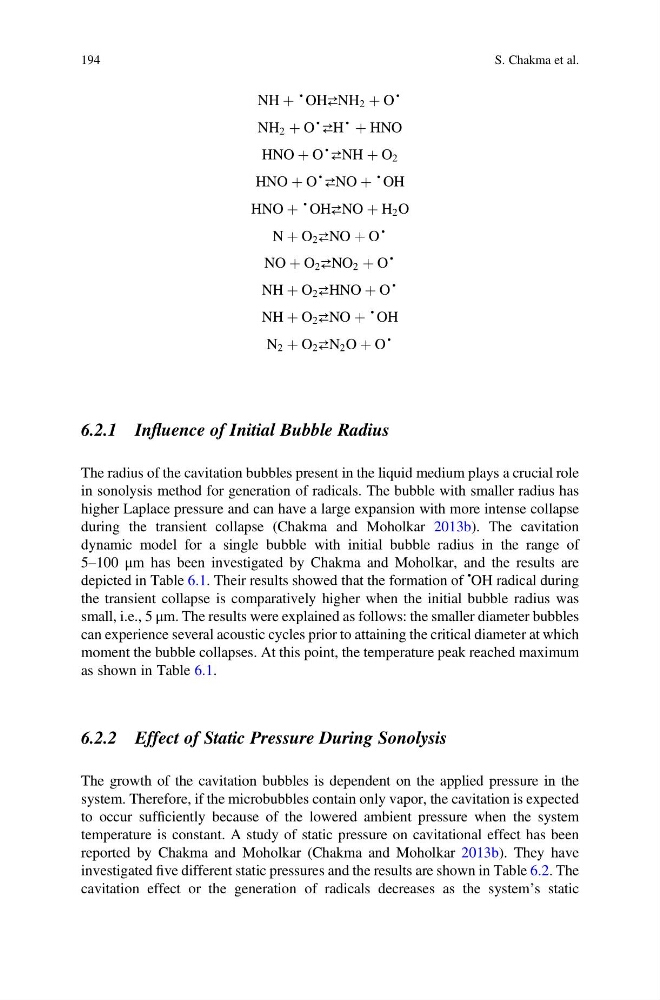
NH þ
• OH⇄NH 2 þ O
•
NH 2 þ O
•
⇄H
•
þ HNO
HNO þ O
•
⇄NH þ O 2
HNO þ O
•
⇄NO þ
• OH
HNO þ
• OH⇄NO þ H 2 O
N þ O 2 ⇄NO þ O
•
NO þ O 2 ⇄NO 2 þ O
•
NH þ O 2 ⇄HNO þ O
•
NH þ O 2 ⇄NO þ
• OH
N 2 þ O 2 ⇄N 2 O þ O
•
6.2.1 Influence of Initial Bubble Radius
The radius of the cavitation bubbles present in the liquid medium plays a crucial role
in sonolysis method for generation of radicals. The bubble with smaller radius has
higher Laplace pressure and can have a large expansion with more intense collapse
during the transient collapse (Chakma and Moholkar 2013b). The cavitation
dynamic model for a single bubble with initial bubble radius in the range of
5–100 μm has been investigated by Chakma and Moholkar, and the results are
depicted in Table 6.1. Their results showed that the formation of
•
OH radical during
the transient collapse is comparatively higher when the initial bubble radius was
small, i.e., 5 μm. The results were explained as follows: the smaller diameter bubbles
can experience several acoustic cycles prior to attaining the critical diameter at which
moment the bubble collapses. At this point, the temperature peak reached maximum
as shown in Table 6.1.
6.2.2 Effect of Static Pressure During Sonolysis
The growth of the cavitation bubbles is dependent on the applied pressure in the
system. Therefore, if the microbubbles contain only vapor, the cavitation is expected
to occur sufficiently because of the lowered ambient pressure when the system
temperature is constant. A study of static pressure on cavitational effect has been
reported by Chakma and Moholkar (Chakma and Moholkar 2013b). They have
investigated five different static pressures and the results are shown in Table 6.2. The
cavitation effect or the generation of radicals decreases as the system’s static
194
S. Chakma et al.
• OH⇄NH 2 þ O
•
NH 2 þ O
•
⇄H
•
þ HNO
HNO þ O
•
⇄NH þ O 2
HNO þ O
•
⇄NO þ
• OH
HNO þ
• OH⇄NO þ H 2 O
N þ O 2 ⇄NO þ O
•
NO þ O 2 ⇄NO 2 þ O
•
NH þ O 2 ⇄HNO þ O
•
NH þ O 2 ⇄NO þ
• OH
N 2 þ O 2 ⇄N 2 O þ O
•
6.2.1 Influence of Initial Bubble Radius
The radius of the cavitation bubbles present in the liquid medium plays a crucial role
in sonolysis method for generation of radicals. The bubble with smaller radius has
higher Laplace pressure and can have a large expansion with more intense collapse
during the transient collapse (Chakma and Moholkar 2013b). The cavitation
dynamic model for a single bubble with initial bubble radius in the range of
5–100 μm has been investigated by Chakma and Moholkar, and the results are
depicted in Table 6.1. Their results showed that the formation of
•
OH radical during
the transient collapse is comparatively higher when the initial bubble radius was
small, i.e., 5 μm. The results were explained as follows: the smaller diameter bubbles
can experience several acoustic cycles prior to attaining the critical diameter at which
moment the bubble collapses. At this point, the temperature peak reached maximum
as shown in Table 6.1.
6.2.2 Effect of Static Pressure During Sonolysis
The growth of the cavitation bubbles is dependent on the applied pressure in the
system. Therefore, if the microbubbles contain only vapor, the cavitation is expected
to occur sufficiently because of the lowered ambient pressure when the system
temperature is constant. A study of static pressure on cavitational effect has been
reported by Chakma and Moholkar (Chakma and Moholkar 2013b). They have
investigated five different static pressures and the results are shown in Table 6.2. The
cavitation effect or the generation of radicals decreases as the system’s static
194
S. Chakma et al.