

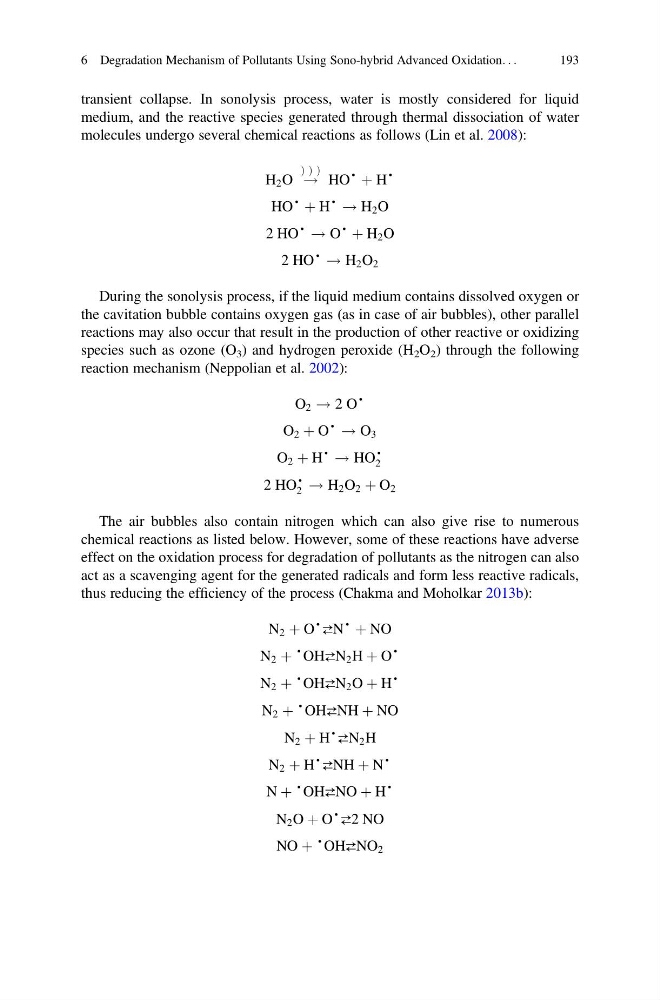
transient collapse. In sonolysis process, water is mostly considered for liquid
medium, and the reactive species generated through thermal dissociation of water
molecules undergo several chemical reactions as follows (Lin et al. 2008):
H 2 O !
Þ Þ Þ
HO
•
þ H
•
HO
•
þ H
•
! H 2 O
2 HO
•
! O
•
þ H 2 O
2 HO
•
! H 2 O 2
During the sonolysis process, if the liquid medium contains dissolved oxygen or
the cavitation bubble contains oxygen gas (as in case of air bubbles), other parallel
reactions may also occur that result in the production of other reactive or oxidizing
species such as ozone (O 3 ) and hydrogen peroxide (H 2 O 2 ) through the following
reaction mechanism (Neppolian et al. 2002):
O 2 ! 2 O
•
O 2 þ O
•
! O 3
O 2 þ H
•
! HO
•
2
2 HO
•
2 ! H 2 O 2 þ O 2
The air bubbles also contain nitrogen which can also give rise to numerous
chemical reactions as listed below. However, some of these reactions have adverse
effect on the oxidation process for degradation of pollutants as the nitrogen can also
act as a scavenging agent for the generated radicals and form less reactive radicals,
thus reducing the efficiency of the process (Chakma and Moholkar 2013b):
N 2 þ O
•
⇄N
•
þ NO
N 2 þ
• OH⇄N 2 H þ O
•
N 2 þ
• OH⇄N 2 O þ H
•
N 2 þ
• OH⇄NH þ NO
N 2 þ H
•
⇄N 2 H
N 2 þ H
•
⇄NH þ N
•
N þ
• OH⇄NO þ H
•
N 2 O þ O
•
⇄2 NO
NO þ
• OH⇄NO 2
6 Degradation Mechanism of Pollutants Using Sono-hybrid Advanced Oxidation. . .
193
medium, and the reactive species generated through thermal dissociation of water
molecules undergo several chemical reactions as follows (Lin et al. 2008):
H 2 O !
Þ Þ Þ
HO
•
þ H
•
HO
•
þ H
•
! H 2 O
2 HO
•
! O
•
þ H 2 O
2 HO
•
! H 2 O 2
During the sonolysis process, if the liquid medium contains dissolved oxygen or
the cavitation bubble contains oxygen gas (as in case of air bubbles), other parallel
reactions may also occur that result in the production of other reactive or oxidizing
species such as ozone (O 3 ) and hydrogen peroxide (H 2 O 2 ) through the following
reaction mechanism (Neppolian et al. 2002):
O 2 ! 2 O
•
O 2 þ O
•
! O 3
O 2 þ H
•
! HO
•
2
2 HO
•
2 ! H 2 O 2 þ O 2
The air bubbles also contain nitrogen which can also give rise to numerous
chemical reactions as listed below. However, some of these reactions have adverse
effect on the oxidation process for degradation of pollutants as the nitrogen can also
act as a scavenging agent for the generated radicals and form less reactive radicals,
thus reducing the efficiency of the process (Chakma and Moholkar 2013b):
N 2 þ O
•
⇄N
•
þ NO
N 2 þ
• OH⇄N 2 H þ O
•
N 2 þ
• OH⇄N 2 O þ H
•
N 2 þ
• OH⇄NH þ NO
N 2 þ H
•
⇄N 2 H
N 2 þ H
•
⇄NH þ N
•
N þ
• OH⇄NO þ H
•
N 2 O þ O
•
⇄2 NO
NO þ
• OH⇄NO 2
6 Degradation Mechanism of Pollutants Using Sono-hybrid Advanced Oxidation. . .
193