

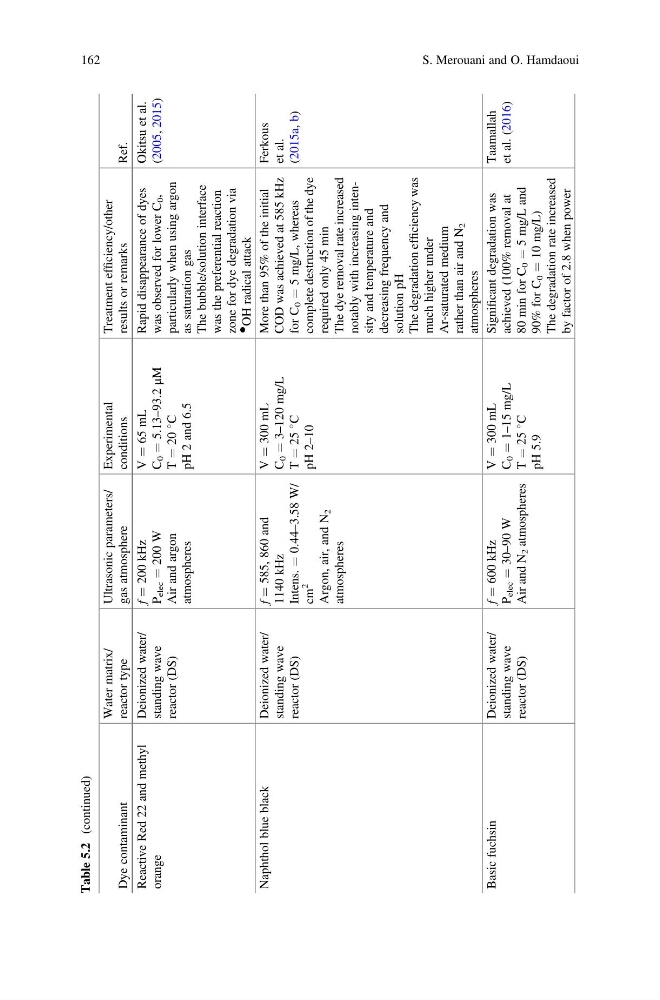
Table 5.2
(continued)
Dye contaminant
Water matrix/
reactor type
Ultrasonic parameters/
gas atmosphere
Experimental
conditions
Treatment efficiency/other
results or remarks
Ref.
Reactive Red 22 and methyl
orange
Deionized water/
standing wave
reactor (DS)
f ¼ 200 kHz
P
elec
¼ 200 W
Air and argon
atmospheres
V
¼ 65 mL
C
0
¼ 5.13–93.2
μM
T
¼ 20
C
pH 2 and 6.5
Rapid disappearance of dyes
was observed for lower C
0 ,
particularly when using argon
as saturation gas
The bubble/solution interface
was the preferential reaction
zone for dye degradation via
●
OH radical attack
Okitsu et al.
(2005, 2015)
Naphthol blue black
Deionized water/
standing wave
reactor (DS)
f ¼ 585, 860 and
1140 kHz
Intens.
¼ 0.44–3.58 W/
cm
2
Argon, air, and N
2
atmospheres
V
¼ 300 mL
C
0
¼ 3–120 mg/L
T
¼ 25
C
pH 2–10
More than 95% of the initial
COD was achieved at 585 kHz
for C
0
¼ 5 mg/L, whereas
complete destruction of the dye
required only 45 min
The dye removal rate increased
notably with increasing intensity and temperature and
decreasing frequency and
solution pH
The degradation efficiency was
much higher under
Ar-saturated medium
rather than air and N
2
atmospheres
Ferkous
et al.
(2015a, b)
Basic fuchsin
Deionized water/
standing wave
reactor (DS)
f ¼ 600 kHz
P
elec
¼ 30–90 W
Air and N
2 atmospheres
V
¼ 300 mL
C
0
¼ 1–15 mg/L
T
¼ 25
C
pH 5.9
Significant degradation was
achieved (100% removal at
80 min for C
0
¼ 5 mg/L and
90% for C
0
¼ 10 mg/L)
The degradation rate increased
by factor of 2.8 when power
Taamallah
et al. (2016)
162
S. Merouani and O. Hamdaoui
(continued)
Dye contaminant
Water matrix/
reactor type
Ultrasonic parameters/
gas atmosphere
Experimental
conditions
Treatment efficiency/other
results or remarks
Ref.
Reactive Red 22 and methyl
orange
Deionized water/
standing wave
reactor (DS)
f ¼ 200 kHz
P
elec
¼ 200 W
Air and argon
atmospheres
V
¼ 65 mL
C
0
¼ 5.13–93.2
μM
T
¼ 20
C
pH 2 and 6.5
Rapid disappearance of dyes
was observed for lower C
0 ,
particularly when using argon
as saturation gas
The bubble/solution interface
was the preferential reaction
zone for dye degradation via
●
OH radical attack
Okitsu et al.
(2005, 2015)
Naphthol blue black
Deionized water/
standing wave
reactor (DS)
f ¼ 585, 860 and
1140 kHz
Intens.
¼ 0.44–3.58 W/
cm
2
Argon, air, and N
2
atmospheres
V
¼ 300 mL
C
0
¼ 3–120 mg/L
T
¼ 25
C
pH 2–10
More than 95% of the initial
COD was achieved at 585 kHz
for C
0
¼ 5 mg/L, whereas
complete destruction of the dye
required only 45 min
The dye removal rate increased
notably with increasing intensity and temperature and
decreasing frequency and
solution pH
The degradation efficiency was
much higher under
Ar-saturated medium
rather than air and N
2
atmospheres
Ferkous
et al.
(2015a, b)
Basic fuchsin
Deionized water/
standing wave
reactor (DS)
f ¼ 600 kHz
P
elec
¼ 30–90 W
Air and N
2 atmospheres
V
¼ 300 mL
C
0
¼ 1–15 mg/L
T
¼ 25
C
pH 5.9
Significant degradation was
achieved (100% removal at
80 min for C
0
¼ 5 mg/L and
90% for C
0
¼ 10 mg/L)
The degradation rate increased
by factor of 2.8 when power
Taamallah
et al. (2016)
162
S. Merouani and O. Hamdaoui