

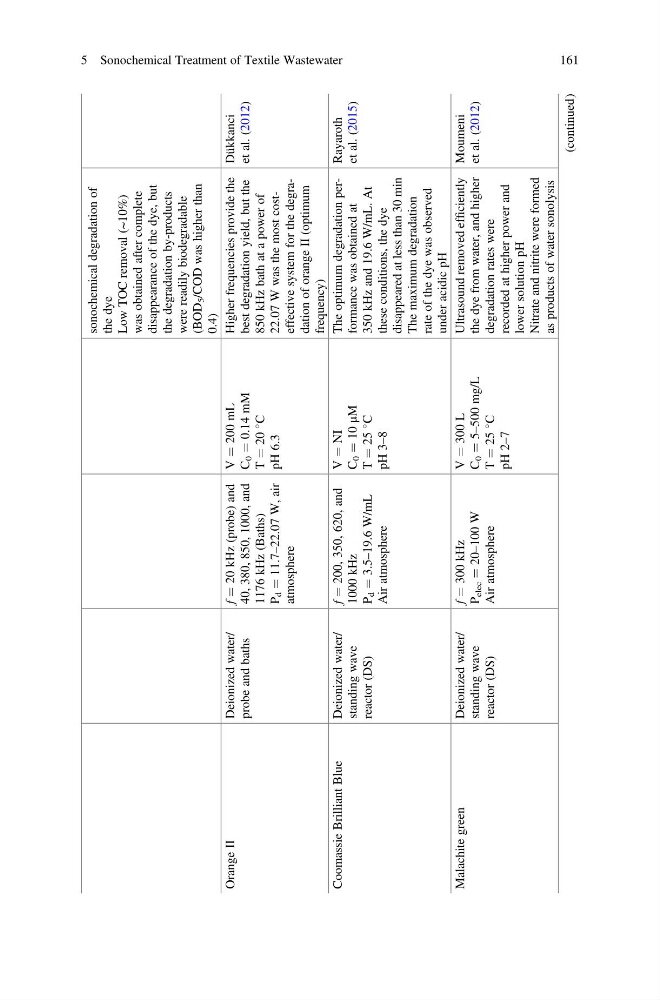
sonochemical degradation of
the dye
Low TOC removal (~10%)
was obtained after complete
disappearance of the dye, but
the degradation by-products
were readily biodegradable
(BOD
5 /COD was higher than
0.4)
Orange II
Deionized water/
probe and baths
f ¼ 20 kHz (probe) and
40, 380, 850, 1000, and
1176 kHz (Baths)
P
d
¼ 11.7–22.07 W, air
atmosphere
V
¼ 200 mL
C
0
¼ 0.14 mM
T
¼ 20
C
pH 6.3
Higher frequencies provide the
best degradation yield, but the
850 kHz bath at a power of
22.07 W was the most costeffective system for the degradation of orange II (optimum
frequency)
Dükkanci
et al. (2012)
Coomassie Brilliant Blue
Deionized water/
standing wave
reactor (DS)
f ¼ 200, 350, 620, and
1000 kHz
P
d
¼ 3.5–19.6 W/mL
Air atmosphere
V
¼ NI
C
0
¼ 10
μM
T
¼ 25
C
pH 3–8
The optimum degradation performance was obtained at
350 kHz and 19.6 W/mL. At
these conditions, the dye
disappeared at less than 30 min
The maximum degradation
rate of the dye was observed
under acidic pH
Rayaroth
et al. (2015)
Malachite green
Deionized water/
standing wave
reactor (DS)
f ¼ 300 kHz
P
elec
¼ 20–100 W
Air atmosphere
V
¼ 300 L
C
0
¼ 5–500 mg/L
T
¼ 25
C
pH 2–7
Ultrasound removed efficiently
the dye from water, and higher
degradation rates were
recorded at higher power and
lower solution pH
Nitrate and nitrite were formed
as products of water sonolysis
Moumeni
et al. (2012)
(continued)
5 Sonochemical Treatment of Textile Wastewater
161
the dye
Low TOC removal (~10%)
was obtained after complete
disappearance of the dye, but
the degradation by-products
were readily biodegradable
(BOD
5 /COD was higher than
0.4)
Orange II
Deionized water/
probe and baths
f ¼ 20 kHz (probe) and
40, 380, 850, 1000, and
1176 kHz (Baths)
P
d
¼ 11.7–22.07 W, air
atmosphere
V
¼ 200 mL
C
0
¼ 0.14 mM
T
¼ 20
C
pH 6.3
Higher frequencies provide the
best degradation yield, but the
850 kHz bath at a power of
22.07 W was the most costeffective system for the degradation of orange II (optimum
frequency)
Dükkanci
et al. (2012)
Coomassie Brilliant Blue
Deionized water/
standing wave
reactor (DS)
f ¼ 200, 350, 620, and
1000 kHz
P
d
¼ 3.5–19.6 W/mL
Air atmosphere
V
¼ NI
C
0
¼ 10
μM
T
¼ 25
C
pH 3–8
The optimum degradation performance was obtained at
350 kHz and 19.6 W/mL. At
these conditions, the dye
disappeared at less than 30 min
The maximum degradation
rate of the dye was observed
under acidic pH
Rayaroth
et al. (2015)
Malachite green
Deionized water/
standing wave
reactor (DS)
f ¼ 300 kHz
P
elec
¼ 20–100 W
Air atmosphere
V
¼ 300 L
C
0
¼ 5–500 mg/L
T
¼ 25
C
pH 2–7
Ultrasound removed efficiently
the dye from water, and higher
degradation rates were
recorded at higher power and
lower solution pH
Nitrate and nitrite were formed
as products of water sonolysis
Moumeni
et al. (2012)
(continued)
5 Sonochemical Treatment of Textile Wastewater
161