

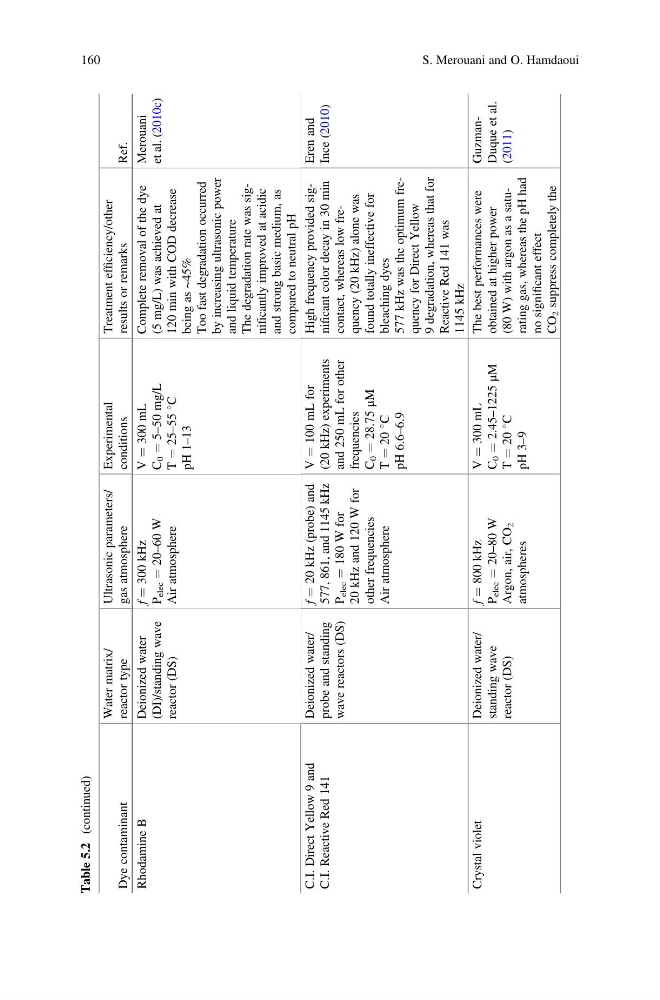
Table 5.2
(continued)
Dye contaminant
Water matrix/
reactor type
Ultrasonic parameters/
gas atmosphere
Experimental
conditions
Treatment efficiency/other
results or remarks
Ref.
Rhodamine B
Deionized water
(DI)/standing wave
reactor (DS)
f ¼ 300 kHz
P
elec
¼ 20–60 W
Air atmosphere
V
¼ 300 mL
C
0
¼ 5–50 mg/L
T
¼ 25–55
C
pH 1–13
Complete removal of the dye
(5 mg/L) was achieved at
120 min with COD decrease
being as ~45%
Too fast degradation occurred
by increasing ultrasonic power
and liquid temperature
The degradation rate was significantly improved at acidic
and strong basic medium, as
compared to neutral pH
Merouani
et al. (2010c)
C.I. Direct Yellow 9 and
C.I. Reactive Red 141
Deionized water/
probe and standing
wave reactors (DS)
f ¼ 20 kHz (probe) and
577, 861, and 1145 kHz
P
elec
¼ 180 W for
20 kHz and 120 W for
other frequencies
Air atmosphere
V
¼ 100 mL for
(20 kHz) experiments
and 250 mL for other
frequencies
C
0
¼ 28.75
μM
T
¼ 20
C
pH 6.6–6.9
High frequency provided significant color decay in 30 min
contact, whereas low frequency (20 kHz) alone was
found totally ineffective for
bleaching dyes
577 kHz was the optimum frequency for Direct Yellow
9 degradation, whereas that for
Reactive Red 141 was
1145 kHz
Eren and
Ince (2010)
Crystal violet
Deionized water/
standing wave
reactor (DS)
f ¼ 800 kHz
P
elec
¼ 20–80 W
Argon, air, CO
2
atmospheres
V
¼ 300 mL
C
0
¼ 2.45–1225
μM
T
¼ 20
C
pH 3–9
The best performances were
obtained at higher power
(80 W) with argon as a saturating gas, whereas the pH had
no significant effect
CO
2 suppress completely the
GuzmanDuque et al.
(2011)
160
S. Merouani and O. Hamdaoui
(continued)
Dye contaminant
Water matrix/
reactor type
Ultrasonic parameters/
gas atmosphere
Experimental
conditions
Treatment efficiency/other
results or remarks
Ref.
Rhodamine B
Deionized water
(DI)/standing wave
reactor (DS)
f ¼ 300 kHz
P
elec
¼ 20–60 W
Air atmosphere
V
¼ 300 mL
C
0
¼ 5–50 mg/L
T
¼ 25–55
C
pH 1–13
Complete removal of the dye
(5 mg/L) was achieved at
120 min with COD decrease
being as ~45%
Too fast degradation occurred
by increasing ultrasonic power
and liquid temperature
The degradation rate was significantly improved at acidic
and strong basic medium, as
compared to neutral pH
Merouani
et al. (2010c)
C.I. Direct Yellow 9 and
C.I. Reactive Red 141
Deionized water/
probe and standing
wave reactors (DS)
f ¼ 20 kHz (probe) and
577, 861, and 1145 kHz
P
elec
¼ 180 W for
20 kHz and 120 W for
other frequencies
Air atmosphere
V
¼ 100 mL for
(20 kHz) experiments
and 250 mL for other
frequencies
C
0
¼ 28.75
μM
T
¼ 20
C
pH 6.6–6.9
High frequency provided significant color decay in 30 min
contact, whereas low frequency (20 kHz) alone was
found totally ineffective for
bleaching dyes
577 kHz was the optimum frequency for Direct Yellow
9 degradation, whereas that for
Reactive Red 141 was
1145 kHz
Eren and
Ince (2010)
Crystal violet
Deionized water/
standing wave
reactor (DS)
f ¼ 800 kHz
P
elec
¼ 20–80 W
Argon, air, CO
2
atmospheres
V
¼ 300 mL
C
0
¼ 2.45–1225
μM
T
¼ 20
C
pH 3–9
The best performances were
obtained at higher power
(80 W) with argon as a saturating gas, whereas the pH had
no significant effect
CO
2 suppress completely the
GuzmanDuque et al.
(2011)
160
S. Merouani and O. Hamdaoui