

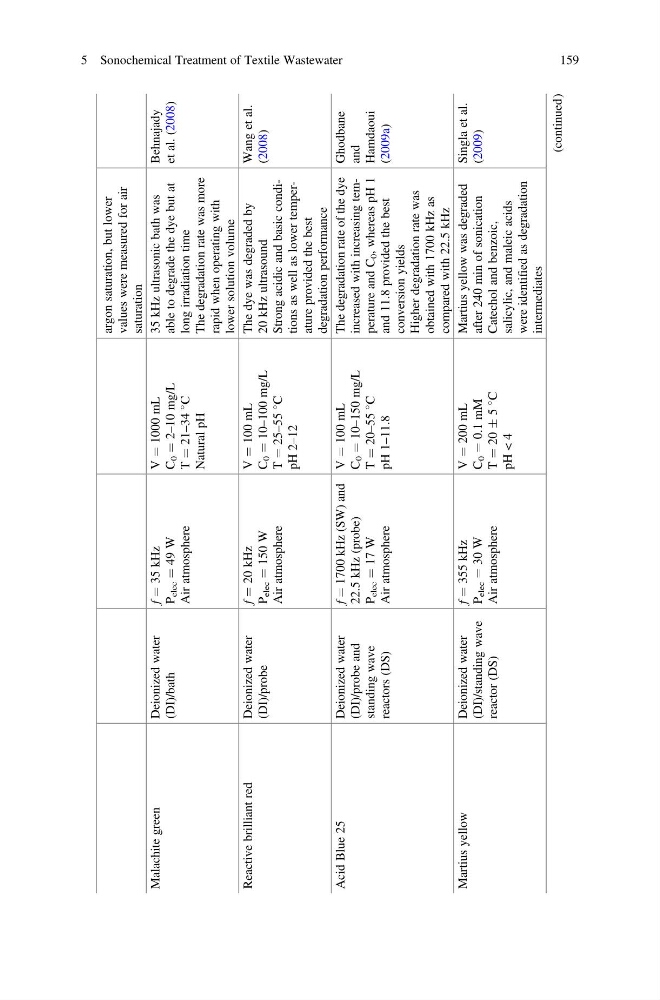
argon saturation, but lower
values were measured for air
saturation
Malachite green
Deionized water
(DI)/bath
f ¼ 35 kHz
P
elec
¼ 49 W
Air atmosphere
V
¼ 1000 mL
C
0
¼ 2–10 mg/L
T
¼ 21–34
C
Natural pH
35 kHz ultrasonic bath was
able to degrade the dye but at
long irradiation time
The degradation rate was more
rapid when operating with
lower solution volume
Behnajady
et al. (2008)
Reactive brilliant red
Deionized water
(DI)/probe
f ¼ 20 kHz
P
elec
¼ 150 W
Air atmosphere
V
¼ 100 mL
C
0
¼ 10–100 mg/L
T
¼ 25–55
C
pH 2–12
The dye was degraded by
20 kHz ultrasound
Strong acidic and basic conditions as well as lower temperature provided the best
degradation performance
Wang et al.
(2008)
Acid Blue 25
Deionized water
(DI)/probe and
standing wave
reactors (DS)
f ¼ 1700 kHz (SW) and
22.5 kHz (probe)
P
elec
¼ 17 W
Air atmosphere
V
¼ 100 mL
C
0
¼ 10–150 mg/L
T
¼ 20–55
C
pH 1–11.8
The degradation rate of the dye
increased with increasing temperature and C
0 , whereas pH 1
and 11.8 provided the best
conversion yields
Higher degradation rate was
obtained with 1700 kHz as
compared with 22.5 kHz
Ghodbane
and
Hamdaoui
(2009a)
Martius yellow
Deionized water
(DI)/standing wave
reactor (DS)
f ¼ 355 kHz
P
elec
¼ 30 W
Air atmosphere
V
¼ 200 mL
C
0
¼ 0.1 mM
T
¼ 20
Æ 5
C
pH < 4
Martius yellow was degraded
after 240 min of sonication
Catechol and benzoic,
salicylic, and maleic acids
were identified as degradation
intermediates
Singla et al.
(2009)
(continued)
5 Sonochemical Treatment of Textile Wastewater
159
values were measured for air
saturation
Malachite green
Deionized water
(DI)/bath
f ¼ 35 kHz
P
elec
¼ 49 W
Air atmosphere
V
¼ 1000 mL
C
0
¼ 2–10 mg/L
T
¼ 21–34
C
Natural pH
35 kHz ultrasonic bath was
able to degrade the dye but at
long irradiation time
The degradation rate was more
rapid when operating with
lower solution volume
Behnajady
et al. (2008)
Reactive brilliant red
Deionized water
(DI)/probe
f ¼ 20 kHz
P
elec
¼ 150 W
Air atmosphere
V
¼ 100 mL
C
0
¼ 10–100 mg/L
T
¼ 25–55
C
pH 2–12
The dye was degraded by
20 kHz ultrasound
Strong acidic and basic conditions as well as lower temperature provided the best
degradation performance
Wang et al.
(2008)
Acid Blue 25
Deionized water
(DI)/probe and
standing wave
reactors (DS)
f ¼ 1700 kHz (SW) and
22.5 kHz (probe)
P
elec
¼ 17 W
Air atmosphere
V
¼ 100 mL
C
0
¼ 10–150 mg/L
T
¼ 20–55
C
pH 1–11.8
The degradation rate of the dye
increased with increasing temperature and C
0 , whereas pH 1
and 11.8 provided the best
conversion yields
Higher degradation rate was
obtained with 1700 kHz as
compared with 22.5 kHz
Ghodbane
and
Hamdaoui
(2009a)
Martius yellow
Deionized water
(DI)/standing wave
reactor (DS)
f ¼ 355 kHz
P
elec
¼ 30 W
Air atmosphere
V
¼ 200 mL
C
0
¼ 0.1 mM
T
¼ 20
Æ 5
C
pH < 4
Martius yellow was degraded
after 240 min of sonication
Catechol and benzoic,
salicylic, and maleic acids
were identified as degradation
intermediates
Singla et al.
(2009)
(continued)
5 Sonochemical Treatment of Textile Wastewater
159