

may be due to the increase rate of collision frequency between the dye molecules and
generated radicals species. But, increase in dye concentration above optimal level
shutters the catalyst surface from ultraviolet irradiation which hindered the activation
of TiO 2 to generate radicals which considerable decline productivity of catalysts
(Tang et al. 1995).
As methyl red is ionic in nature, its degradation is more as compared to nonpolar
methyl orange. Also, at pH above the zero point charge (pH ZPC is 6.2), TiO 2 surface
is negatively charged, whereas at pH below zero point charge, its surface is positively charged (Chou and Liao 2005). The zero point charge is a state when electric
charge density on the surface of catalyst is zero. Zero point charge relates the
occurrence of adsorption of pollutant on the surface and can be easily understood
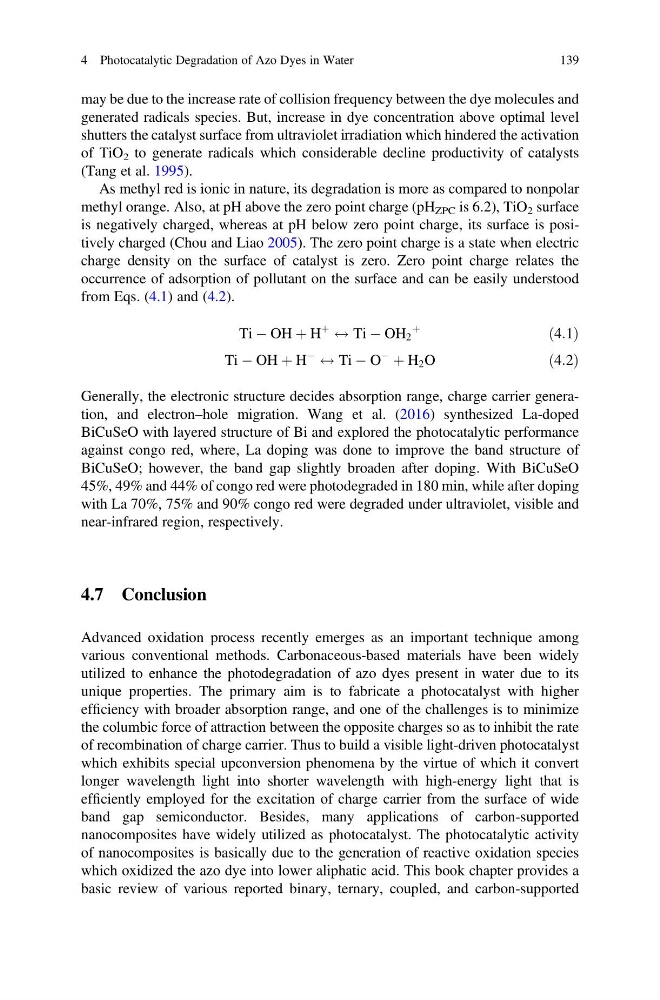
from Eqs. (4.1) and (4.2).
Ti À OH þ H
þ
$ Ti À OH 2
þ
ð4:1Þ
Ti À OH þ H
À
$ Ti À O
À
þ H 2 O
ð4:2Þ
Generally, the electronic structure decides absorption range, charge carrier generation, and electron–hole migration. Wang et al. (2016) synthesized La-doped
BiCuSeO with layered structure of Bi and explored the photocatalytic performance
against congo red, where, La doping was done to improve the band structure of
BiCuSeO; however, the band gap slightly broaden after doping. With BiCuSeO
45%, 49% and 44% of congo red were photodegraded in 180 min, while after doping
with La 70%, 75% and 90% congo red were degraded under ultraviolet, visible and
near-infrared region, respectively.
4.7 Conclusion
Advanced oxidation process recently emerges as an important technique among
various conventional methods. Carbonaceous-based materials have been widely
utilized to enhance the photodegradation of azo dyes present in water due to its
unique properties. The primary aim is to fabricate a photocatalyst with higher
efficiency with broader absorption range, and one of the challenges is to minimize
the columbic force of attraction between the opposite charges so as to inhibit the rate
of recombination of charge carrier. Thus to build a visible light-driven photocatalyst
which exhibits special upconversion phenomena by the virtue of which it convert
longer wavelength light into shorter wavelength with high-energy light that is
efficiently employed for the excitation of charge carrier from the surface of wide
band gap semiconductor. Besides, many applications of carbon-supported
nanocomposites have widely utilized as photocatalyst. The photocatalytic activity
of nanocomposites is basically due to the generation of reactive oxidation species
which oxidized the azo dye into lower aliphatic acid. This book chapter provides a
basic review of various reported binary, ternary, coupled, and carbon-supported
4 Photocatalytic Degradation of Azo Dyes in Water
139
generated radicals species. But, increase in dye concentration above optimal level
shutters the catalyst surface from ultraviolet irradiation which hindered the activation
of TiO 2 to generate radicals which considerable decline productivity of catalysts
(Tang et al. 1995).
As methyl red is ionic in nature, its degradation is more as compared to nonpolar
methyl orange. Also, at pH above the zero point charge (pH ZPC is 6.2), TiO 2 surface
is negatively charged, whereas at pH below zero point charge, its surface is positively charged (Chou and Liao 2005). The zero point charge is a state when electric
charge density on the surface of catalyst is zero. Zero point charge relates the
occurrence of adsorption of pollutant on the surface and can be easily understood
from Eqs. (4.1) and (4.2).
Ti À OH þ H
þ
$ Ti À OH 2
þ
ð4:1Þ
Ti À OH þ H
À
$ Ti À O
À
þ H 2 O
ð4:2Þ
Generally, the electronic structure decides absorption range, charge carrier generation, and electron–hole migration. Wang et al. (2016) synthesized La-doped
BiCuSeO with layered structure of Bi and explored the photocatalytic performance
against congo red, where, La doping was done to improve the band structure of
BiCuSeO; however, the band gap slightly broaden after doping. With BiCuSeO
45%, 49% and 44% of congo red were photodegraded in 180 min, while after doping
with La 70%, 75% and 90% congo red were degraded under ultraviolet, visible and
near-infrared region, respectively.
4.7 Conclusion
Advanced oxidation process recently emerges as an important technique among
various conventional methods. Carbonaceous-based materials have been widely
utilized to enhance the photodegradation of azo dyes present in water due to its
unique properties. The primary aim is to fabricate a photocatalyst with higher
efficiency with broader absorption range, and one of the challenges is to minimize
the columbic force of attraction between the opposite charges so as to inhibit the rate
of recombination of charge carrier. Thus to build a visible light-driven photocatalyst
which exhibits special upconversion phenomena by the virtue of which it convert
longer wavelength light into shorter wavelength with high-energy light that is
efficiently employed for the excitation of charge carrier from the surface of wide
band gap semiconductor. Besides, many applications of carbon-supported
nanocomposites have widely utilized as photocatalyst. The photocatalytic activity
of nanocomposites is basically due to the generation of reactive oxidation species
which oxidized the azo dye into lower aliphatic acid. This book chapter provides a
basic review of various reported binary, ternary, coupled, and carbon-supported
4 Photocatalytic Degradation of Azo Dyes in Water
139