

are considered, and one of the important factors is it must be cost-effective and
eco-friendly. ZnIn 2 S 4 , another photocatalyst, were utilized for the removal of methyl
orange under visible light through adsorption and photodegradation process (Liu
et al. 2017). However, no significant amount of methyl orange degradation or
removal was reported. On the other side, photocatalyst is quite effective for the
degradation of rhodamine B as nearly 97% of dye was degraded. High efficiency
was ascribed due to the lower bond energy of C¼N in rhodamine B as compared to
azo group in methyl orange which makes reactive oxidation species easy to break.
Petrella et al. (2014) studied the photodegradation of methyl red and methyl
orange using TiO 2 immobilized on cement mortar under solar light. The immobilization of TiO 2 on cement mortar prevents the leaching of nanoparticle. The synergistic effect of TiO 2 and ultraviolet irradiation is responsible for methyl red and
methyl orange degradation. The kinetics of degradation depends upon the catalyst
surface thus obeys a pseudo-first-order kinetics. The initial increase in degradation
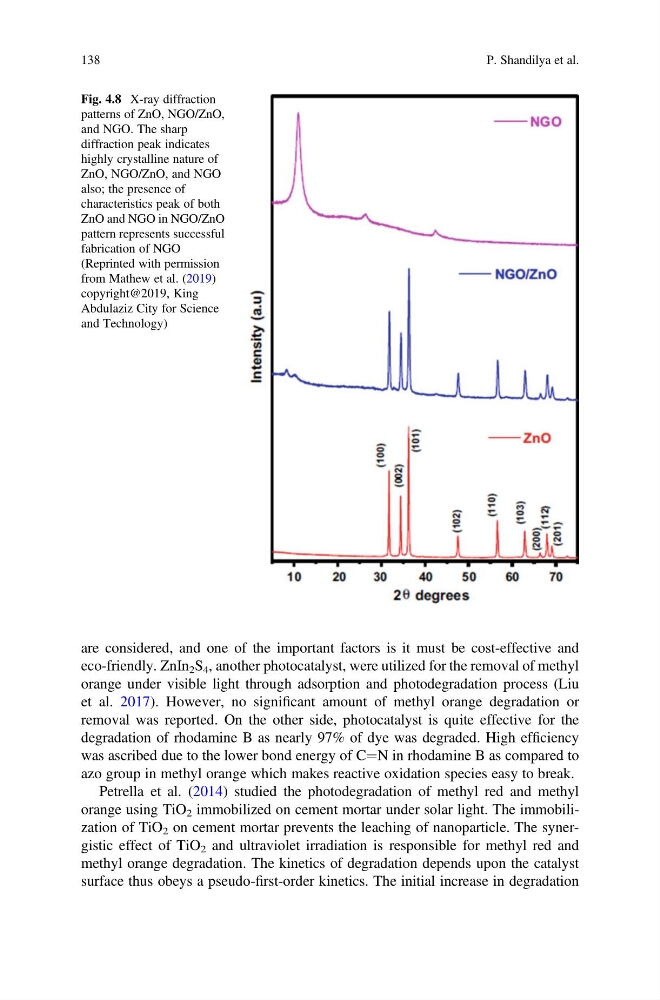
Fig. 4.8 X-ray diffraction
patterns of ZnO, NGO/ZnO,
and NGO. The sharp
diffraction peak indicates
highly crystalline nature of
ZnO, NGO/ZnO, and NGO
also; the presence of
characteristics peak of both
ZnO and NGO in NGO/ZnO
pattern represents successful
fabrication of NGO
(Reprinted with permission
from Mathew et al. (2019)
copyright@2019, King
Abdulaziz City for Science
and Technology)
138
P. Shandilya et al.
eco-friendly. ZnIn 2 S 4 , another photocatalyst, were utilized for the removal of methyl
orange under visible light through adsorption and photodegradation process (Liu
et al. 2017). However, no significant amount of methyl orange degradation or
removal was reported. On the other side, photocatalyst is quite effective for the
degradation of rhodamine B as nearly 97% of dye was degraded. High efficiency
was ascribed due to the lower bond energy of C¼N in rhodamine B as compared to
azo group in methyl orange which makes reactive oxidation species easy to break.
Petrella et al. (2014) studied the photodegradation of methyl red and methyl
orange using TiO 2 immobilized on cement mortar under solar light. The immobilization of TiO 2 on cement mortar prevents the leaching of nanoparticle. The synergistic effect of TiO 2 and ultraviolet irradiation is responsible for methyl red and
methyl orange degradation. The kinetics of degradation depends upon the catalyst
surface thus obeys a pseudo-first-order kinetics. The initial increase in degradation
Fig. 4.8 X-ray diffraction
patterns of ZnO, NGO/ZnO,
and NGO. The sharp
diffraction peak indicates
highly crystalline nature of
ZnO, NGO/ZnO, and NGO
also; the presence of
characteristics peak of both
ZnO and NGO in NGO/ZnO
pattern represents successful
fabrication of NGO
(Reprinted with permission
from Mathew et al. (2019)
copyright@2019, King
Abdulaziz City for Science
and Technology)
138
P. Shandilya et al.