

were heated in microwave oven of 500 W for 2–10 min, a yellow-colored solution
changes to dark brown which indicates the formation of carbon nanoparticles.
Microwave method was very less time-consuming as the nanoparticles were synthesized in just 10 min. Umrao et al. (2015) reported microwave carbonization
followed by aromatization of acetyl acetone as a precursor to prepare graphene
quantum dots having tunable size and surface functionalities. Graphene quantum
dots can be modified for specific application by tailoring the size, surface, and band
gap. Acetyl acetone is weakly acidic in nature, which is why dehydration and
decomposition reaction under microwave irradiation proceed in a controlled manner
followed by aldol condensation and cycloaddition reaction.
Further, doping of carbon quantum dots with heteroatom boron, nitrogen, sulfur,
and fluorine is a potent approach for adjusting optical and electronic property of
carbonaceous material. Kundu et al. (2015) also used one-step microwave technique
for the preparation of codoped nitrogen, fluorine, and luminescent graphene quantum dots with average size of 2 nm by using multi-walled carbon nanotubes as
precursor in ionic liquid. The coupling of ionic liquid with microwave technique
enables ultrafast process and also increases the quantum yield to nearly 70%. Due to
short reaction times, microwave irradiation method is extensively utilized for the
preparation of carbon quantum dots. Graphite, a well-known precursor, comprised of
stacked graphene sheets is one of the readily available and inexpensive materials for
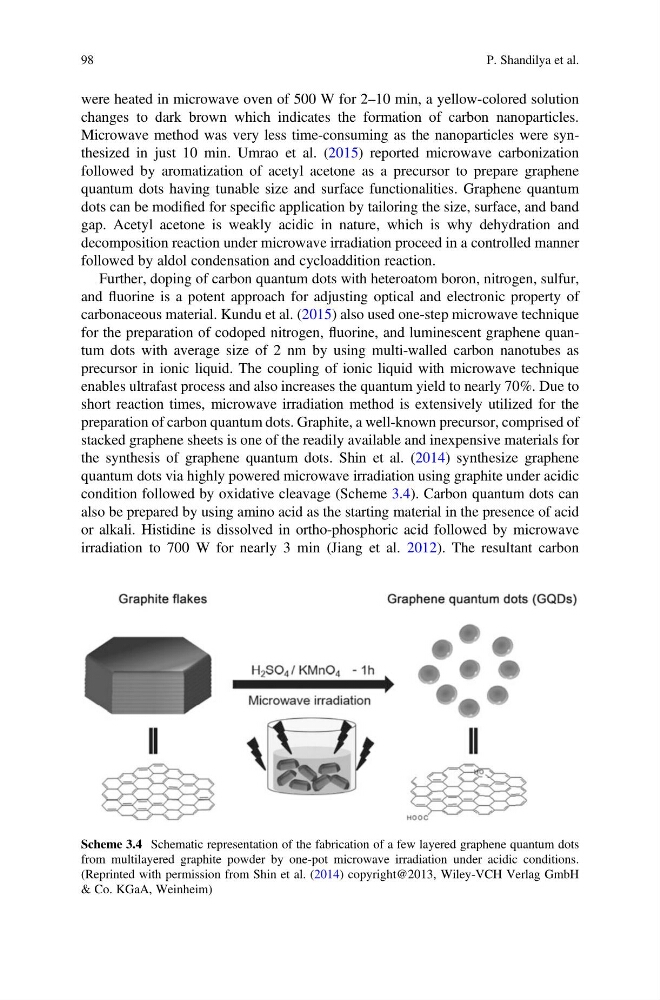
the synthesis of graphene quantum dots. Shin et al. (2014) synthesize graphene
quantum dots via highly powered microwave irradiation using graphite under acidic
condition followed by oxidative cleavage (Scheme 3.4). Carbon quantum dots can
also be prepared by using amino acid as the starting material in the presence of acid
or alkali. Histidine is dissolved in ortho-phosphoric acid followed by microwave
irradiation to 700 W for nearly 3 min (Jiang et al. 2012). The resultant carbon
Scheme 3.4 Schematic representation of the fabrication of a few layered graphene quantum dots
from multilayered graphite powder by one-pot microwave irradiation under acidic conditions.
(Reprinted with permission from Shin et al. (2014) copyright@2013, Wiley-VCH Verlag GmbH
& Co. KGaA, Weinheim)
98
P. Shandilya et al.
changes to dark brown which indicates the formation of carbon nanoparticles.
Microwave method was very less time-consuming as the nanoparticles were synthesized in just 10 min. Umrao et al. (2015) reported microwave carbonization
followed by aromatization of acetyl acetone as a precursor to prepare graphene
quantum dots having tunable size and surface functionalities. Graphene quantum
dots can be modified for specific application by tailoring the size, surface, and band
gap. Acetyl acetone is weakly acidic in nature, which is why dehydration and
decomposition reaction under microwave irradiation proceed in a controlled manner
followed by aldol condensation and cycloaddition reaction.
Further, doping of carbon quantum dots with heteroatom boron, nitrogen, sulfur,
and fluorine is a potent approach for adjusting optical and electronic property of
carbonaceous material. Kundu et al. (2015) also used one-step microwave technique
for the preparation of codoped nitrogen, fluorine, and luminescent graphene quantum dots with average size of 2 nm by using multi-walled carbon nanotubes as
precursor in ionic liquid. The coupling of ionic liquid with microwave technique
enables ultrafast process and also increases the quantum yield to nearly 70%. Due to
short reaction times, microwave irradiation method is extensively utilized for the
preparation of carbon quantum dots. Graphite, a well-known precursor, comprised of
stacked graphene sheets is one of the readily available and inexpensive materials for
the synthesis of graphene quantum dots. Shin et al. (2014) synthesize graphene
quantum dots via highly powered microwave irradiation using graphite under acidic
condition followed by oxidative cleavage (Scheme 3.4). Carbon quantum dots can
also be prepared by using amino acid as the starting material in the presence of acid
or alkali. Histidine is dissolved in ortho-phosphoric acid followed by microwave
irradiation to 700 W for nearly 3 min (Jiang et al. 2012). The resultant carbon
Scheme 3.4 Schematic representation of the fabrication of a few layered graphene quantum dots
from multilayered graphite powder by one-pot microwave irradiation under acidic conditions.
(Reprinted with permission from Shin et al. (2014) copyright@2013, Wiley-VCH Verlag GmbH
& Co. KGaA, Weinheim)
98
P. Shandilya et al.