

quantum dots were dispersed and purified with ultrapure water using dialysis
membrane to remove the impurities.
Pyrolytic Route
Liu et al. (2011) for the first time synthesized mono-dispersed disklike graphene
quantum dots wit 2–3 nm thickness and $60 nm in diameter. The graphene quantum
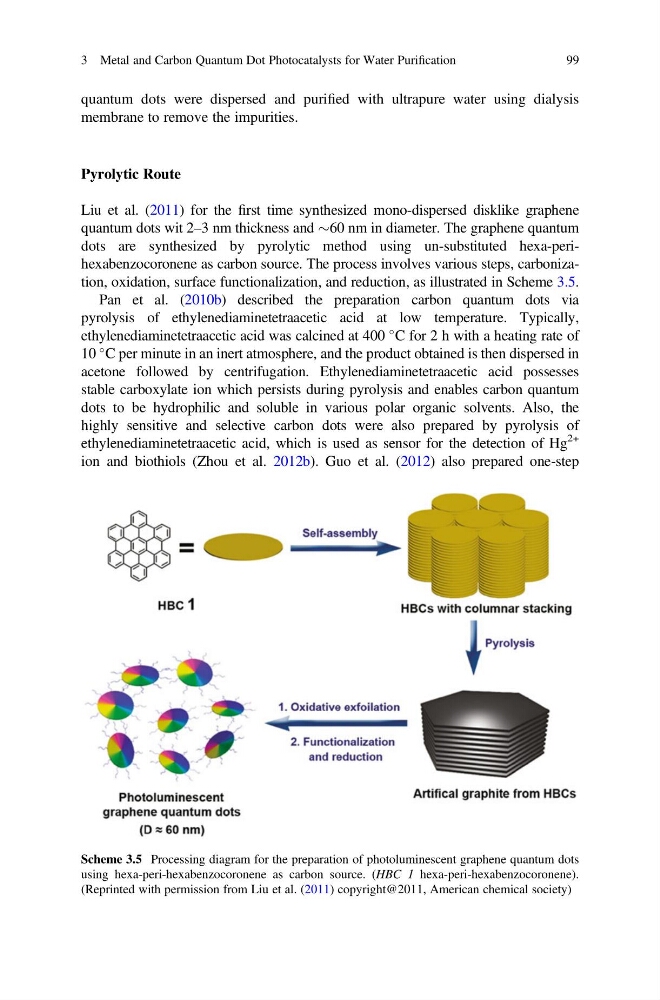
dots are synthesized by pyrolytic method using un-substituted hexa-perihexabenzocoronene as carbon source. The process involves various steps, carbonization, oxidation, surface functionalization, and reduction, as illustrated in Scheme 3.5.
Pan et al. (2010b) described the preparation carbon quantum dots via
pyrolysis of ethylenediaminetetraacetic acid at low temperature. Typically,
ethylenediaminetetraacetic acid was calcined at 400
C for 2 h with a heating rate of
10
C per minute in an inert atmosphere, and the product obtained is then dispersed in
acetone followed by centrifugation. Ethylenediaminetetraacetic acid possesses
stable carboxylate ion which persists during pyrolysis and enables carbon quantum
dots to be hydrophilic and soluble in various polar organic solvents. Also, the
highly sensitive and selective carbon dots were also prepared by pyrolysis of
ethylenediaminetetraacetic acid, which is used as sensor for the detection of Hg
2+
ion and biothiols (Zhou et al. 2012b). Guo et al. (2012) also prepared one-step
Scheme 3.5 Processing diagram for the preparation of photoluminescent graphene quantum dots
using hexa-peri-hexabenzocoronene as carbon source. (HBC 1 hexa-peri-hexabenzocoronene).
(Reprinted with permission from Liu et al. (2011) copyright@2011, American chemical society)
3 Metal and Carbon Quantum Dot Photocatalysts for Water Purification
99
membrane to remove the impurities.
Pyrolytic Route
Liu et al. (2011) for the first time synthesized mono-dispersed disklike graphene
quantum dots wit 2–3 nm thickness and $60 nm in diameter. The graphene quantum
dots are synthesized by pyrolytic method using un-substituted hexa-perihexabenzocoronene as carbon source. The process involves various steps, carbonization, oxidation, surface functionalization, and reduction, as illustrated in Scheme 3.5.
Pan et al. (2010b) described the preparation carbon quantum dots via
pyrolysis of ethylenediaminetetraacetic acid at low temperature. Typically,
ethylenediaminetetraacetic acid was calcined at 400
C for 2 h with a heating rate of
10
C per minute in an inert atmosphere, and the product obtained is then dispersed in
acetone followed by centrifugation. Ethylenediaminetetraacetic acid possesses
stable carboxylate ion which persists during pyrolysis and enables carbon quantum
dots to be hydrophilic and soluble in various polar organic solvents. Also, the
highly sensitive and selective carbon dots were also prepared by pyrolysis of
ethylenediaminetetraacetic acid, which is used as sensor for the detection of Hg
2+
ion and biothiols (Zhou et al. 2012b). Guo et al. (2012) also prepared one-step
Scheme 3.5 Processing diagram for the preparation of photoluminescent graphene quantum dots
using hexa-peri-hexabenzocoronene as carbon source. (HBC 1 hexa-peri-hexabenzocoronene).
(Reprinted with permission from Liu et al. (2011) copyright@2011, American chemical society)
3 Metal and Carbon Quantum Dot Photocatalysts for Water Purification
99