

wavelength visible light into short wavelength ultraviolet light which can now
generate electron–hole pair on the surface of ZnO nanoparticle (Scheme 3.2b). As
the band gap of ZnO is 3.3 eV which lies in ultraviolet region, therefore light of
shorter wavelength can only initiate the excitation process.
Microwave Method
Microwave method is a low-cost, facile, rapid, and green method with high quantum
yield efficiency in comparison to hydrothermal method (Yang et al. 2013b).
Photoluminescent carbon dots were also synthesized by using flour as a source of
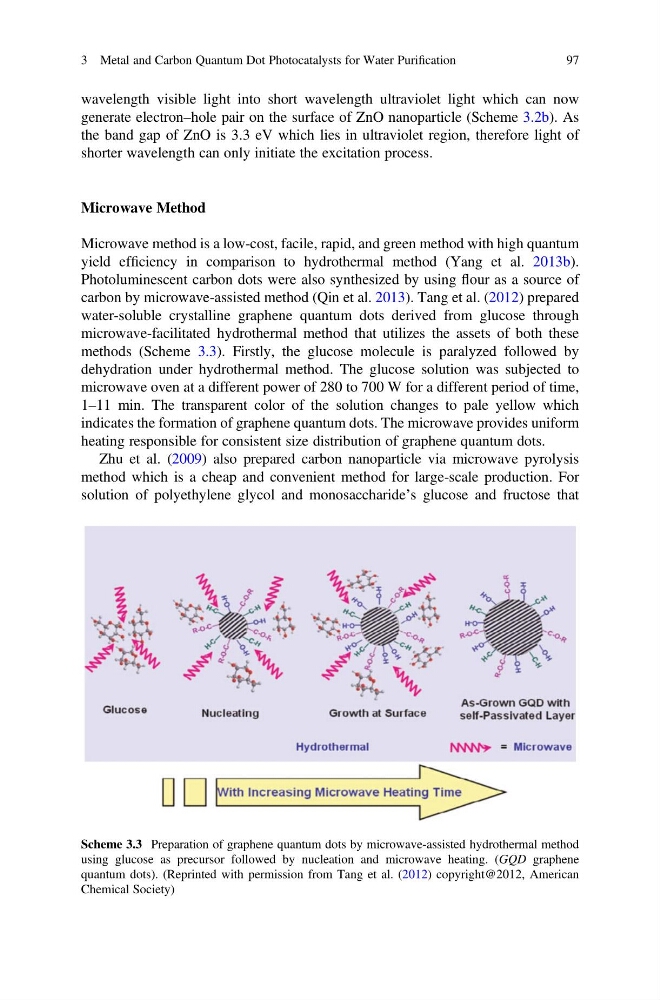
carbon by microwave-assisted method (Qin et al. 2013). Tang et al. (2012) prepared
water-soluble crystalline graphene quantum dots derived from glucose through
microwave-facilitated hydrothermal method that utilizes the assets of both these
methods (Scheme 3.3). Firstly, the glucose molecule is paralyzed followed by
dehydration under hydrothermal method. The glucose solution was subjected to
microwave oven at a different power of 280 to 700 W for a different period of time,
1–11 min. The transparent color of the solution changes to pale yellow which
indicates the formation of graphene quantum dots. The microwave provides uniform
heating responsible for consistent size distribution of graphene quantum dots.
Zhu et al. (2009) also prepared carbon nanoparticle via microwave pyrolysis
method which is a cheap and convenient method for large-scale production. For
solution of polyethylene glycol and monosaccharide’s glucose and fructose that
Scheme 3.3 Preparation of graphene quantum dots by microwave-assisted hydrothermal method
using glucose as precursor followed by nucleation and microwave heating. (GQD graphene
quantum dots). (Reprinted with permission from Tang et al. (2012) copyright@2012, American
Chemical Society)
3 Metal and Carbon Quantum Dot Photocatalysts for Water Purification
97
generate electron–hole pair on the surface of ZnO nanoparticle (Scheme 3.2b). As
the band gap of ZnO is 3.3 eV which lies in ultraviolet region, therefore light of
shorter wavelength can only initiate the excitation process.
Microwave Method
Microwave method is a low-cost, facile, rapid, and green method with high quantum
yield efficiency in comparison to hydrothermal method (Yang et al. 2013b).
Photoluminescent carbon dots were also synthesized by using flour as a source of
carbon by microwave-assisted method (Qin et al. 2013). Tang et al. (2012) prepared
water-soluble crystalline graphene quantum dots derived from glucose through
microwave-facilitated hydrothermal method that utilizes the assets of both these
methods (Scheme 3.3). Firstly, the glucose molecule is paralyzed followed by
dehydration under hydrothermal method. The glucose solution was subjected to
microwave oven at a different power of 280 to 700 W for a different period of time,
1–11 min. The transparent color of the solution changes to pale yellow which
indicates the formation of graphene quantum dots. The microwave provides uniform
heating responsible for consistent size distribution of graphene quantum dots.
Zhu et al. (2009) also prepared carbon nanoparticle via microwave pyrolysis
method which is a cheap and convenient method for large-scale production. For
solution of polyethylene glycol and monosaccharide’s glucose and fructose that
Scheme 3.3 Preparation of graphene quantum dots by microwave-assisted hydrothermal method
using glucose as precursor followed by nucleation and microwave heating. (GQD graphene
quantum dots). (Reprinted with permission from Tang et al. (2012) copyright@2012, American
Chemical Society)
3 Metal and Carbon Quantum Dot Photocatalysts for Water Purification
97