

32
O. Mahjoub et al.
and Egypt are highly dependent on external resources (Senegal and Nile Rivers) by
96% and 97%, respectively. Tunisia and Algeria, where 79% and 53% of domestic
water resources have been already mobilized, respectively, are less dependent on
transboundary water resources, to meet only 9% and 3% of their needs, respectively. North Africa is highly exposed to climate change through changing weather
patterns coupled with frequent droughts. Based on projections of climate change in
the region using different climate models and scenarios drawn from those used by
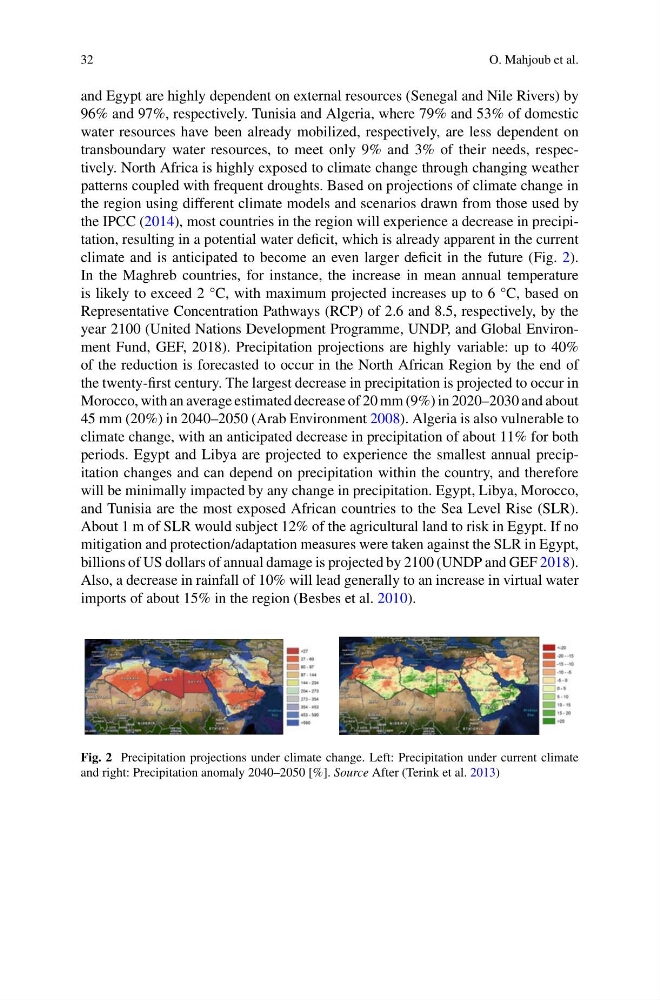
the IPCC (2014), most countries in the region will experience a decrease in precipitation, resulting in a potential water deficit, which is already apparent in the current
climate and is anticipated to become an even larger deficit in the future (Fig. 2).
In the Maghreb countries, for instance, the increase in mean annual temperature
is likely to exceed 2 °C, with maximum projected increases up to 6 °C, based on
Representative Concentration Pathways (RCP) of 2.6 and 8.5, respectively, by the
year 2100 (United Nations Development Programme, UNDP, and Global Environment Fund, GEF, 2018). Precipitation projections are highly variable: up to 40%
of the reduction is forecasted to occur in the North African Region by the end of
the twenty-first century. The largest decrease in precipitation is projected to occur in
Morocco, with an average estimated decrease of 20 mm (9%) in 2020–2030 and about
45 mm (20%) in 2040–2050 (Arab Environment 2008). Algeria is also vulnerable to
climate change, with an anticipated decrease in precipitation of about 11% for both
periods. Egypt and Libya are projected to experience the smallest annual precipitation changes and can depend on precipitation within the country, and therefore
will be minimally impacted by any change in precipitation. Egypt, Libya, Morocco,
and Tunisia are the most exposed African countries to the Sea Level Rise (SLR).
About 1 m of SLR would subject 12% of the agricultural land to risk in Egypt. If no
mitigation and protection/adaptation measures were taken against the SLR in Egypt,
billions of US dollars of annual damage is projected by 2100 (UNDP and GEF 2018).
Also, a decrease in rainfall of 10% will lead generally to an increase in virtual water
imports of about 15% in the region (Besbes et al. 2010).
Fig. 2 Precipitation projections under climate change. Left: Precipitation under current climate
and right: Precipitation anomaly 2040–2050 [%]. Source After (Terink et al. 2013)
O. Mahjoub et al.
and Egypt are highly dependent on external resources (Senegal and Nile Rivers) by
96% and 97%, respectively. Tunisia and Algeria, where 79% and 53% of domestic
water resources have been already mobilized, respectively, are less dependent on
transboundary water resources, to meet only 9% and 3% of their needs, respectively. North Africa is highly exposed to climate change through changing weather
patterns coupled with frequent droughts. Based on projections of climate change in
the region using different climate models and scenarios drawn from those used by
the IPCC (2014), most countries in the region will experience a decrease in precipitation, resulting in a potential water deficit, which is already apparent in the current
climate and is anticipated to become an even larger deficit in the future (Fig. 2).
In the Maghreb countries, for instance, the increase in mean annual temperature
is likely to exceed 2 °C, with maximum projected increases up to 6 °C, based on
Representative Concentration Pathways (RCP) of 2.6 and 8.5, respectively, by the
year 2100 (United Nations Development Programme, UNDP, and Global Environment Fund, GEF, 2018). Precipitation projections are highly variable: up to 40%
of the reduction is forecasted to occur in the North African Region by the end of
the twenty-first century. The largest decrease in precipitation is projected to occur in
Morocco, with an average estimated decrease of 20 mm (9%) in 2020–2030 and about
45 mm (20%) in 2040–2050 (Arab Environment 2008). Algeria is also vulnerable to
climate change, with an anticipated decrease in precipitation of about 11% for both
periods. Egypt and Libya are projected to experience the smallest annual precipitation changes and can depend on precipitation within the country, and therefore
will be minimally impacted by any change in precipitation. Egypt, Libya, Morocco,
and Tunisia are the most exposed African countries to the Sea Level Rise (SLR).
About 1 m of SLR would subject 12% of the agricultural land to risk in Egypt. If no
mitigation and protection/adaptation measures were taken against the SLR in Egypt,
billions of US dollars of annual damage is projected by 2100 (UNDP and GEF 2018).
Also, a decrease in rainfall of 10% will lead generally to an increase in virtual water
imports of about 15% in the region (Besbes et al. 2010).
Fig. 2 Precipitation projections under climate change. Left: Precipitation under current climate
and right: Precipitation anomaly 2040–2050 [%]. Source After (Terink et al. 2013)