

3 Water Resource Availability and Quality …
33
2.2 Non-renewable Water Resources
A non-renewable water source is defined as groundwater reservoirs with a negligible
rate of recharge for human uses. Although groundwater reservoirs may allow for
the storage of huge quantities of water accumulated during the pluvial periods of
Quaternary, they are not sustainable in the long term, because the current rate of
recharge will slowly deplete aquifers compared to discharge ones. Moreover, the
increase in the cost of pumping, as well as the deterioration of the water quality in
some areas, may also make the abstraction of fossil water less attractive with time.
Except for Morocco, all sub-region countries have limited renewable water
resources lie on top of important non-renewable groundwater basins which overlap
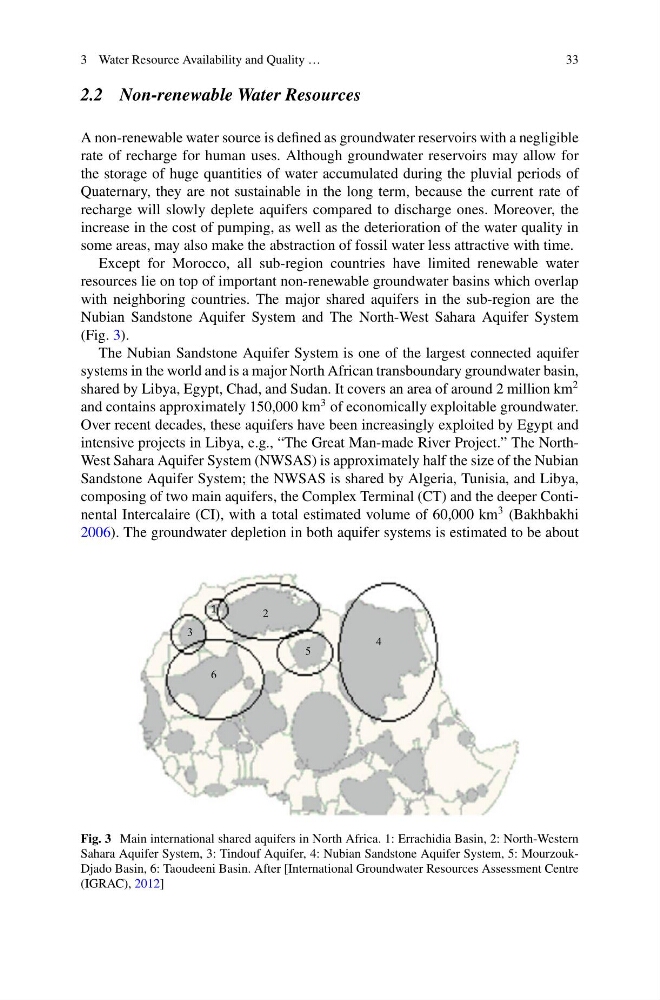
with neighboring countries. The major shared aquifers in the sub-region are the
Nubian Sandstone Aquifer System and The North-West Sahara Aquifer System
(Fig. 3).
The Nubian Sandstone Aquifer System is one of the largest connected aquifer
systems in the world and is a major North African transboundary groundwater basin,
shared by Libya, Egypt, Chad, and Sudan. It covers an area of around 2 million km
2
and contains approximately 150,000 km
3 of economically exploitable groundwater.
Over recent decades, these aquifers have been increasingly exploited by Egypt and
intensive projects in Libya, e.g., “The Great Man-made River Project.” The NorthWest Sahara Aquifer System (NWSAS) is approximately half the size of the Nubian
Sandstone Aquifer System; the NWSAS is shared by Algeria, Tunisia, and Libya,
composing of two main aquifers, the Complex Terminal (CT) and the deeper Continental Intercalaire (CI), with a total estimated volume of 60,000 km
3 (Bakhbakhi
2006). The groundwater depletion in both aquifer systems is estimated to be about
1
2
3
4
5
6
Fig. 3 Main international shared aquifers in North Africa. 1: Errachidia Basin, 2: North-Western
Sahara Aquifer System, 3: Tindouf Aquifer, 4: Nubian Sandstone Aquifer System, 5: MourzoukDjado Basin, 6: Taoudeeni Basin. After [International Groundwater Resources Assessment Centre
(IGRAC), 2012]
33
2.2 Non-renewable Water Resources
A non-renewable water source is defined as groundwater reservoirs with a negligible
rate of recharge for human uses. Although groundwater reservoirs may allow for
the storage of huge quantities of water accumulated during the pluvial periods of
Quaternary, they are not sustainable in the long term, because the current rate of
recharge will slowly deplete aquifers compared to discharge ones. Moreover, the
increase in the cost of pumping, as well as the deterioration of the water quality in
some areas, may also make the abstraction of fossil water less attractive with time.
Except for Morocco, all sub-region countries have limited renewable water
resources lie on top of important non-renewable groundwater basins which overlap
with neighboring countries. The major shared aquifers in the sub-region are the
Nubian Sandstone Aquifer System and The North-West Sahara Aquifer System
(Fig. 3).
The Nubian Sandstone Aquifer System is one of the largest connected aquifer
systems in the world and is a major North African transboundary groundwater basin,
shared by Libya, Egypt, Chad, and Sudan. It covers an area of around 2 million km
2
and contains approximately 150,000 km
3 of economically exploitable groundwater.
Over recent decades, these aquifers have been increasingly exploited by Egypt and
intensive projects in Libya, e.g., “The Great Man-made River Project.” The NorthWest Sahara Aquifer System (NWSAS) is approximately half the size of the Nubian
Sandstone Aquifer System; the NWSAS is shared by Algeria, Tunisia, and Libya,
composing of two main aquifers, the Complex Terminal (CT) and the deeper Continental Intercalaire (CI), with a total estimated volume of 60,000 km
3 (Bakhbakhi
2006). The groundwater depletion in both aquifer systems is estimated to be about
1
2
3
4
5
6
Fig. 3 Main international shared aquifers in North Africa. 1: Errachidia Basin, 2: North-Western
Sahara Aquifer System, 3: Tindouf Aquifer, 4: Nubian Sandstone Aquifer System, 5: MourzoukDjado Basin, 6: Taoudeeni Basin. After [International Groundwater Resources Assessment Centre
(IGRAC), 2012]