

466
L. Ferrini et al.
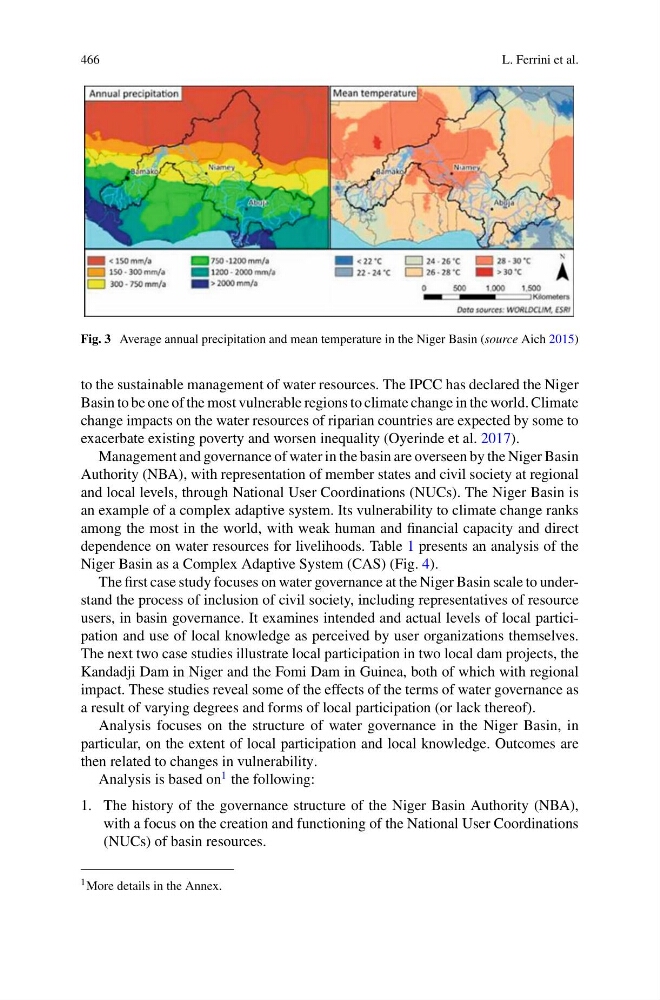
Fig. 3 Average annual precipitation and mean temperature in the Niger Basin (source Aich 2015)
to the sustainable management of water resources. The IPCC has declared the Niger
Basin to be one of the most vulnerable regions to climate change in the world. Climate
change impacts on the water resources of riparian countries are expected by some to
exacerbate existing poverty and worsen inequality (Oyerinde et al. 2017).
Management and governance of water in the basin are overseen by the Niger Basin
Authority (NBA), with representation of member states and civil society at regional
and local levels, through National User Coordinations (NUCs). The Niger Basin is
an example of a complex adaptive system. Its vulnerability to climate change ranks
among the most in the world, with weak human and financial capacity and direct
dependence on water resources for livelihoods. Table 1 presents an analysis of the
Niger Basin as a Complex Adaptive System (CAS) (Fig. 4).
The first case study focuses on water governance at the Niger Basin scale to understand the process of inclusion of civil society, including representatives of resource
users, in basin governance. It examines intended and actual levels of local participation and use of local knowledge as perceived by user organizations themselves.
The next two case studies illustrate local participation in two local dam projects, the
Kandadji Dam in Niger and the Fomi Dam in Guinea, both of which with regional
impact. These studies reveal some of the effects of the terms of water governance as
a result of varying degrees and forms of local participation (or lack thereof).
Analysis focuses on the structure of water governance in the Niger Basin, in
particular, on the extent of local participation and local knowledge. Outcomes are
then related to changes in vulnerability.
Analysis is based on
1 the following:
1. The history of the governance structure of the Niger Basin Authority (NBA),
with a focus on the creation and functioning of the National User Coordinations
(NUCs) of basin resources.
1 More details in the Annex.
L. Ferrini et al.
Fig. 3 Average annual precipitation and mean temperature in the Niger Basin (source Aich 2015)
to the sustainable management of water resources. The IPCC has declared the Niger
Basin to be one of the most vulnerable regions to climate change in the world. Climate
change impacts on the water resources of riparian countries are expected by some to
exacerbate existing poverty and worsen inequality (Oyerinde et al. 2017).
Management and governance of water in the basin are overseen by the Niger Basin
Authority (NBA), with representation of member states and civil society at regional
and local levels, through National User Coordinations (NUCs). The Niger Basin is
an example of a complex adaptive system. Its vulnerability to climate change ranks
among the most in the world, with weak human and financial capacity and direct
dependence on water resources for livelihoods. Table 1 presents an analysis of the
Niger Basin as a Complex Adaptive System (CAS) (Fig. 4).
The first case study focuses on water governance at the Niger Basin scale to understand the process of inclusion of civil society, including representatives of resource
users, in basin governance. It examines intended and actual levels of local participation and use of local knowledge as perceived by user organizations themselves.
The next two case studies illustrate local participation in two local dam projects, the
Kandadji Dam in Niger and the Fomi Dam in Guinea, both of which with regional
impact. These studies reveal some of the effects of the terms of water governance as
a result of varying degrees and forms of local participation (or lack thereof).
Analysis focuses on the structure of water governance in the Niger Basin, in
particular, on the extent of local participation and local knowledge. Outcomes are
then related to changes in vulnerability.
Analysis is based on
1 the following:
1. The history of the governance structure of the Niger Basin Authority (NBA),
with a focus on the creation and functioning of the National User Coordinations
(NUCs) of basin resources.
1 More details in the Annex.