

20 Does the Use of Local Knowledge in Complex Systems …
465
5 Materials and Methods
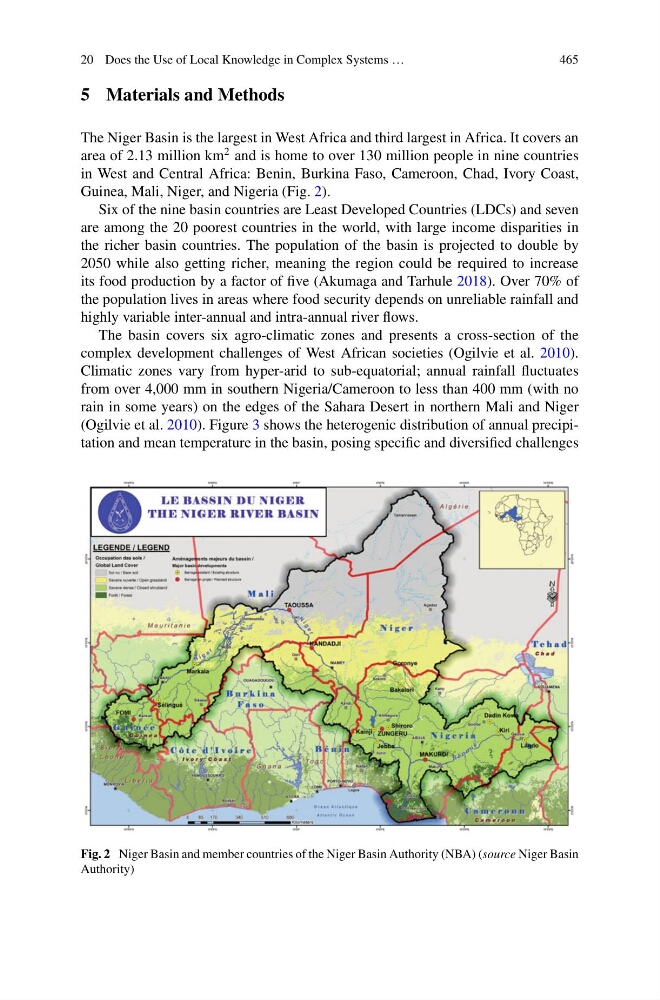
The Niger Basin is the largest in West Africa and third largest in Africa. It covers an
area of 2.13 million km
2 and is home to over 130 million people in nine countries
in West and Central Africa: Benin, Burkina Faso, Cameroon, Chad, Ivory Coast,
Guinea, Mali, Niger, and Nigeria (Fig. 2).
Six of the nine basin countries are Least Developed Countries (LDCs) and seven
are among the 20 poorest countries in the world, with large income disparities in
the richer basin countries. The population of the basin is projected to double by
2050 while also getting richer, meaning the region could be required to increase
its food production by a factor of five (Akumaga and Tarhule 2018). Over 70% of
the population lives in areas where food security depends on unreliable rainfall and
highly variable inter-annual and intra-annual river flows.
The basin covers six agro-climatic zones and presents a cross-section of the
complex development challenges of West African societies (Ogilvie et al. 2010).
Climatic zones vary from hyper-arid to sub-equatorial; annual rainfall fluctuates
from over 4,000 mm in southern Nigeria/Cameroon to less than 400 mm (with no
rain in some years) on the edges of the Sahara Desert in northern Mali and Niger
(Ogilvie et al. 2010). Figure 3 shows the heterogenic distribution of annual precipitation and mean temperature in the basin, posing specific and diversified challenges
Fig. 2 Niger Basin and member countries of the Niger Basin Authority (NBA) (source Niger Basin
Authority)
465
5 Materials and Methods
The Niger Basin is the largest in West Africa and third largest in Africa. It covers an
area of 2.13 million km
2 and is home to over 130 million people in nine countries
in West and Central Africa: Benin, Burkina Faso, Cameroon, Chad, Ivory Coast,
Guinea, Mali, Niger, and Nigeria (Fig. 2).
Six of the nine basin countries are Least Developed Countries (LDCs) and seven
are among the 20 poorest countries in the world, with large income disparities in
the richer basin countries. The population of the basin is projected to double by
2050 while also getting richer, meaning the region could be required to increase
its food production by a factor of five (Akumaga and Tarhule 2018). Over 70% of
the population lives in areas where food security depends on unreliable rainfall and
highly variable inter-annual and intra-annual river flows.
The basin covers six agro-climatic zones and presents a cross-section of the
complex development challenges of West African societies (Ogilvie et al. 2010).
Climatic zones vary from hyper-arid to sub-equatorial; annual rainfall fluctuates
from over 4,000 mm in southern Nigeria/Cameroon to less than 400 mm (with no
rain in some years) on the edges of the Sahara Desert in northern Mali and Niger
(Ogilvie et al. 2010). Figure 3 shows the heterogenic distribution of annual precipitation and mean temperature in the basin, posing specific and diversified challenges
Fig. 2 Niger Basin and member countries of the Niger Basin Authority (NBA) (source Niger Basin
Authority)