

20 Does the Use of Local Knowledge in Complex Systems …
467
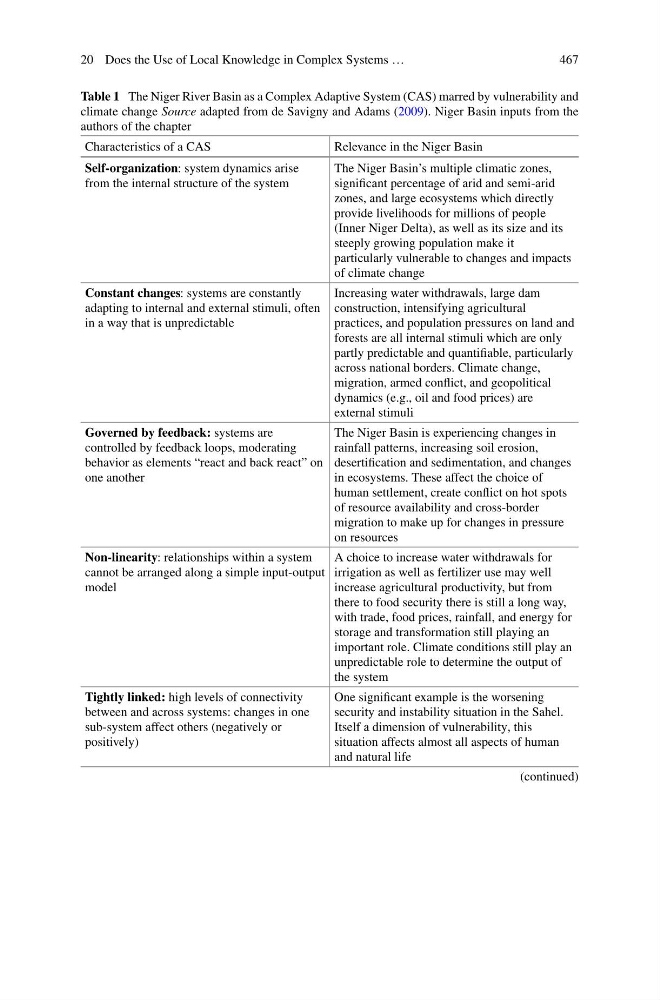
Table 1 The Niger River Basin as a Complex Adaptive System (CAS) marred by vulnerability and
climate change Source adapted from de Savigny and Adams (2009). Niger Basin inputs from the
authors of the chapter
Characteristics of a CAS
Relevance in the Niger Basin
Self-organization: system dynamics arise
from the internal structure of the system
The Niger Basin’s multiple climatic zones,
significant percentage of arid and semi-arid
zones, and large ecosystems which directly
provide livelihoods for millions of people
(Inner Niger Delta), as well as its size and its
steeply growing population make it
particularly vulnerable to changes and impacts
of climate change
Constant changes: systems are constantly
adapting to internal and external stimuli, often
in a way that is unpredictable
Increasing water withdrawals, large dam
construction, intensifying agricultural
practices, and population pressures on land and
forests are all internal stimuli which are only
partly predictable and quantifiable, particularly
across national borders. Climate change,
migration, armed conflict, and geopolitical
dynamics (e.g., oil and food prices) are
external stimuli
Governed by feedback: systems are
controlled by feedback loops, moderating
behavior as elements “react and back react” on
one another
The Niger Basin is experiencing changes in
rainfall patterns, increasing soil erosion,
desertification and sedimentation, and changes
in ecosystems. These affect the choice of
human settlement, create conflict on hot spots
of resource availability and cross-border
migration to make up for changes in pressure
on resources
Non-linearity: relationships within a system
cannot be arranged along a simple input-output
model
A choice to increase water withdrawals for
irrigation as well as fertilizer use may well
increase agricultural productivity, but from
there to food security there is still a long way,
with trade, food prices, rainfall, and energy for
storage and transformation still playing an
important role. Climate conditions still play an
unpredictable role to determine the output of
the system
Tightly linked: high levels of connectivity
between and across systems: changes in one
sub-system affect others (negatively or
positively)
One significant example is the worsening
security and instability situation in the Sahel.
Itself a dimension of vulnerability, this
situation affects almost all aspects of human
and natural life
(continued)
467
Table 1 The Niger River Basin as a Complex Adaptive System (CAS) marred by vulnerability and
climate change Source adapted from de Savigny and Adams (2009). Niger Basin inputs from the
authors of the chapter
Characteristics of a CAS
Relevance in the Niger Basin
Self-organization: system dynamics arise
from the internal structure of the system
The Niger Basin’s multiple climatic zones,
significant percentage of arid and semi-arid
zones, and large ecosystems which directly
provide livelihoods for millions of people
(Inner Niger Delta), as well as its size and its
steeply growing population make it
particularly vulnerable to changes and impacts
of climate change
Constant changes: systems are constantly
adapting to internal and external stimuli, often
in a way that is unpredictable
Increasing water withdrawals, large dam
construction, intensifying agricultural
practices, and population pressures on land and
forests are all internal stimuli which are only
partly predictable and quantifiable, particularly
across national borders. Climate change,
migration, armed conflict, and geopolitical
dynamics (e.g., oil and food prices) are
external stimuli
Governed by feedback: systems are
controlled by feedback loops, moderating
behavior as elements “react and back react” on
one another
The Niger Basin is experiencing changes in
rainfall patterns, increasing soil erosion,
desertification and sedimentation, and changes
in ecosystems. These affect the choice of
human settlement, create conflict on hot spots
of resource availability and cross-border
migration to make up for changes in pressure
on resources
Non-linearity: relationships within a system
cannot be arranged along a simple input-output
model
A choice to increase water withdrawals for
irrigation as well as fertilizer use may well
increase agricultural productivity, but from
there to food security there is still a long way,
with trade, food prices, rainfall, and energy for
storage and transformation still playing an
important role. Climate conditions still play an
unpredictable role to determine the output of
the system
Tightly linked: high levels of connectivity
between and across systems: changes in one
sub-system affect others (negatively or
positively)
One significant example is the worsening
security and instability situation in the Sahel.
Itself a dimension of vulnerability, this
situation affects almost all aspects of human
and natural life
(continued)