

448
M. C. Moseki
(World Bank 2016), while precipitation predictions indicate that in the future there
could be either wetter or drier conditions compared to the historical record.
Forecasts show reduced runoff as a result of lower precipitation, recurring
droughts, and increased temperature. The LHWP is expected to become more
water-stressed into the future due to both demands and unfavorable climatic effects.
4.1 Livelihoods and Vulnerabilities
Most communities in Lesotho, particularly in rural setting markedly dependent on
agriculture, with maize as the staple crop and livestock production to sustain livelihoods of households in the highlands. Resources from the wild (such as fuel materials,
building materials, plants, and medicines), which are found on primary production
and resource harvesting, are also critical for meeting daily nutritional and survival
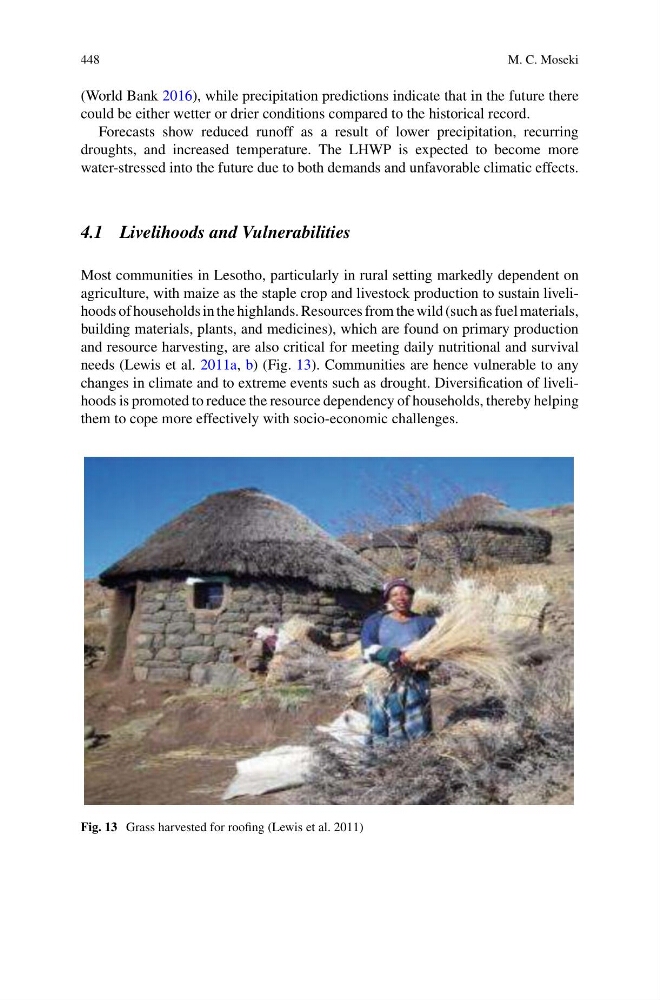
needs (Lewis et al. 2011a, b) (Fig. 13). Communities are hence vulnerable to any
changes in climate and to extreme events such as drought. Diversification of livelihoods is promoted to reduce the resource dependency of households, thereby helping
them to cope more effectively with socio-economic challenges.
Fig. 13 Grass harvested for roofing (Lewis et al. 2011)
M. C. Moseki
(World Bank 2016), while precipitation predictions indicate that in the future there
could be either wetter or drier conditions compared to the historical record.
Forecasts show reduced runoff as a result of lower precipitation, recurring
droughts, and increased temperature. The LHWP is expected to become more
water-stressed into the future due to both demands and unfavorable climatic effects.
4.1 Livelihoods and Vulnerabilities
Most communities in Lesotho, particularly in rural setting markedly dependent on
agriculture, with maize as the staple crop and livestock production to sustain livelihoods of households in the highlands. Resources from the wild (such as fuel materials,
building materials, plants, and medicines), which are found on primary production
and resource harvesting, are also critical for meeting daily nutritional and survival
needs (Lewis et al. 2011a, b) (Fig. 13). Communities are hence vulnerable to any
changes in climate and to extreme events such as drought. Diversification of livelihoods is promoted to reduce the resource dependency of households, thereby helping
them to cope more effectively with socio-economic challenges.
Fig. 13 Grass harvested for roofing (Lewis et al. 2011)