

16 Potential Transboundary Impacts of the Grand Ethiopian …
383
10 Potential Climate Change Impacts on the Blue Nile
Flows
According to ESCWA (2017a, b), in the Blue Nile Basin, the change in mean temperature for Representative Concentration Pathway (RCP) 4.5 shows an increase of 1.5 °C
at mid-century and 1.8 °C at end century. For RCP 8.5, temperatures increase by 2 °C
for mid-century and 3.6 °C at end century. At the seasonal level, the highest increase
in temperature is shown to occur in winter with an increase of as much as 3.9 °C
by the end of the century for RCP 8.5. Precipitation results for RCP 4.5 projected
a change of −6 and −5% at mid- and end centuries, respectively. For RCP 8.5,
precipitation change is −3% for mid-century and −5% by end century, reaching the
greatest reduction in winter, with a 7% decrease.
The headwaters of the Blue Nile in the Ethiopian Highlands show broad variation
among individual ensemble members for runoff in both models (HYPE and VIC); no
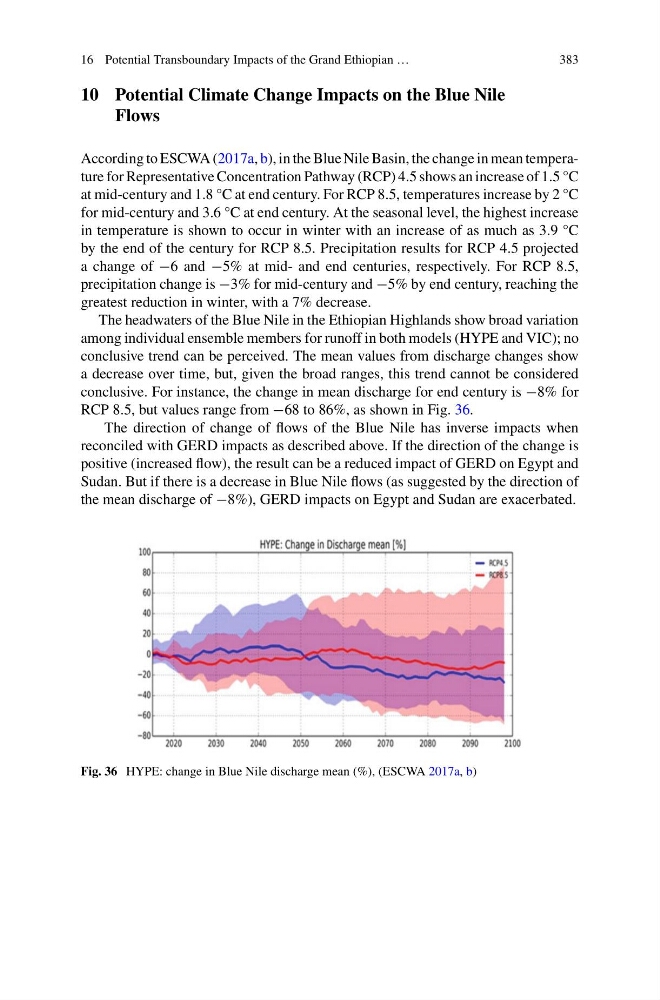
conclusive trend can be perceived. The mean values from discharge changes show
a decrease over time, but, given the broad ranges, this trend cannot be considered
conclusive. For instance, the change in mean discharge for end century is −8% for
RCP 8.5, but values range from −68 to 86%, as shown in Fig. 36.
The direction of change of flows of the Blue Nile has inverse impacts when
reconciled with GERD impacts as described above. If the direction of the change is
positive (increased flow), the result can be a reduced impact of GERD on Egypt and
Sudan. But if there is a decrease in Blue Nile flows (as suggested by the direction of
the mean discharge of −8%), GERD impacts on Egypt and Sudan are exacerbated.
Fig. 36 HYPE: change in Blue Nile discharge mean (%), (ESCWA 2017a, b)
383
10 Potential Climate Change Impacts on the Blue Nile
Flows
According to ESCWA (2017a, b), in the Blue Nile Basin, the change in mean temperature for Representative Concentration Pathway (RCP) 4.5 shows an increase of 1.5 °C
at mid-century and 1.8 °C at end century. For RCP 8.5, temperatures increase by 2 °C
for mid-century and 3.6 °C at end century. At the seasonal level, the highest increase
in temperature is shown to occur in winter with an increase of as much as 3.9 °C
by the end of the century for RCP 8.5. Precipitation results for RCP 4.5 projected
a change of −6 and −5% at mid- and end centuries, respectively. For RCP 8.5,
precipitation change is −3% for mid-century and −5% by end century, reaching the
greatest reduction in winter, with a 7% decrease.
The headwaters of the Blue Nile in the Ethiopian Highlands show broad variation
among individual ensemble members for runoff in both models (HYPE and VIC); no
conclusive trend can be perceived. The mean values from discharge changes show
a decrease over time, but, given the broad ranges, this trend cannot be considered
conclusive. For instance, the change in mean discharge for end century is −8% for
RCP 8.5, but values range from −68 to 86%, as shown in Fig. 36.
The direction of change of flows of the Blue Nile has inverse impacts when
reconciled with GERD impacts as described above. If the direction of the change is
positive (increased flow), the result can be a reduced impact of GERD on Egypt and
Sudan. But if there is a decrease in Blue Nile flows (as suggested by the direction of
the mean discharge of −8%), GERD impacts on Egypt and Sudan are exacerbated.
Fig. 36 HYPE: change in Blue Nile discharge mean (%), (ESCWA 2017a, b)