

380
K. M. AbuZeid
Operating
after
first filling period
of 62 BCM and
keeping
this
storage as the
minimum during
operation
Average
flows
for
Blue Nile in
the first 10
years
of
filling and
operation
(m
3 / year)
Water level in front of the HAD at the beginning of time series at 175 m
Total Deficit
Volume per
country
Withdrawals by Egypt and Sudan
55.5
55
53.5
53
52.5
5
.
0
5
5
.
1
5
2
5
18.5
18
16.5
16
15.5
5
.
3
1
5
.
4
1
5
1
Deficiency Volume
(BCM/year/each country)
Variable
0.5
2
2.5
3
3.5
4
5
Deficiency Years
Filling Period in 4
Years
50
21
7
15
7
62
Filling Period in 5
Years
45
23
1
1
4
8
7
61
Filling Period in 6
Years
38
20
2
2
5
5
56
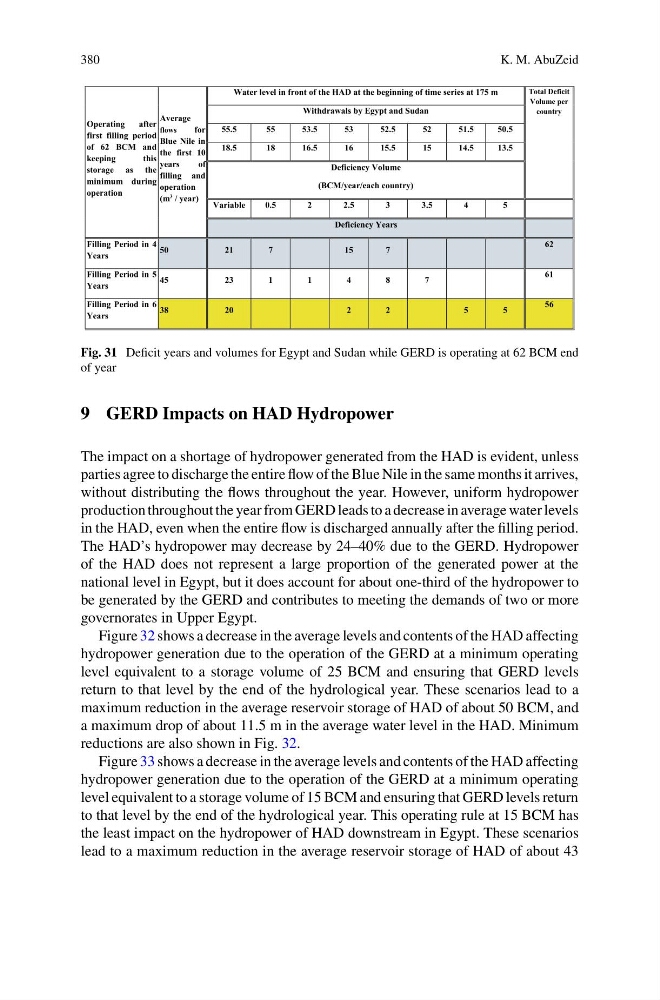
Fig. 31 Deficit years and volumes for Egypt and Sudan while GERD is operating at 62 BCM end
of year
9 GERD Impacts on HAD Hydropower
The impact on a shortage of hydropower generated from the HAD is evident, unless
parties agree to discharge the entire flow of the Blue Nile in the same months it arrives,
without distributing the flows throughout the year. However, uniform hydropower
production throughout the year from GERD leads to a decrease in average water levels
in the HAD, even when the entire flow is discharged annually after the filling period.
The HAD’s hydropower may decrease by 24–40% due to the GERD. Hydropower
of the HAD does not represent a large proportion of the generated power at the
national level in Egypt, but it does account for about one-third of the hydropower to
be generated by the GERD and contributes to meeting the demands of two or more
governorates in Upper Egypt.
Figure 32 shows a decrease in the average levels and contents of the HAD affecting
hydropower generation due to the operation of the GERD at a minimum operating
level equivalent to a storage volume of 25 BCM and ensuring that GERD levels
return to that level by the end of the hydrological year. These scenarios lead to a
maximum reduction in the average reservoir storage of HAD of about 50 BCM, and
a maximum drop of about 11.5 m in the average water level in the HAD. Minimum
reductions are also shown in Fig. 32.
Figure 33 shows a decrease in the average levels and contents of the HAD affecting
hydropower generation due to the operation of the GERD at a minimum operating
level equivalent to a storage volume of 15 BCM and ensuring that GERD levels return
to that level by the end of the hydrological year. This operating rule at 15 BCM has
the least impact on the hydropower of HAD downstream in Egypt. These scenarios
lead to a maximum reduction in the average reservoir storage of HAD of about 43
K. M. AbuZeid
Operating
after
first filling period
of 62 BCM and
keeping
this
storage as the
minimum during
operation
Average
flows
for
Blue Nile in
the first 10
years
of
filling and
operation
(m
3 / year)
Water level in front of the HAD at the beginning of time series at 175 m
Total Deficit
Volume per
country
Withdrawals by Egypt and Sudan
55.5
55
53.5
53
52.5
5
.
0
5
5
.
1
5
2
5
18.5
18
16.5
16
15.5
5
.
3
1
5
.
4
1
5
1
Deficiency Volume
(BCM/year/each country)
Variable
0.5
2
2.5
3
3.5
4
5
Deficiency Years
Filling Period in 4
Years
50
21
7
15
7
62
Filling Period in 5
Years
45
23
1
1
4
8
7
61
Filling Period in 6
Years
38
20
2
2
5
5
56
Fig. 31 Deficit years and volumes for Egypt and Sudan while GERD is operating at 62 BCM end
of year
9 GERD Impacts on HAD Hydropower
The impact on a shortage of hydropower generated from the HAD is evident, unless
parties agree to discharge the entire flow of the Blue Nile in the same months it arrives,
without distributing the flows throughout the year. However, uniform hydropower
production throughout the year from GERD leads to a decrease in average water levels
in the HAD, even when the entire flow is discharged annually after the filling period.
The HAD’s hydropower may decrease by 24–40% due to the GERD. Hydropower
of the HAD does not represent a large proportion of the generated power at the
national level in Egypt, but it does account for about one-third of the hydropower to
be generated by the GERD and contributes to meeting the demands of two or more
governorates in Upper Egypt.
Figure 32 shows a decrease in the average levels and contents of the HAD affecting
hydropower generation due to the operation of the GERD at a minimum operating
level equivalent to a storage volume of 25 BCM and ensuring that GERD levels
return to that level by the end of the hydrological year. These scenarios lead to a
maximum reduction in the average reservoir storage of HAD of about 50 BCM, and
a maximum drop of about 11.5 m in the average water level in the HAD. Minimum
reductions are also shown in Fig. 32.
Figure 33 shows a decrease in the average levels and contents of the HAD affecting
hydropower generation due to the operation of the GERD at a minimum operating
level equivalent to a storage volume of 15 BCM and ensuring that GERD levels return
to that level by the end of the hydrological year. This operating rule at 15 BCM has
the least impact on the hydropower of HAD downstream in Egypt. These scenarios
lead to a maximum reduction in the average reservoir storage of HAD of about 43