

13 Assessment of Hydrological Impacts …
287
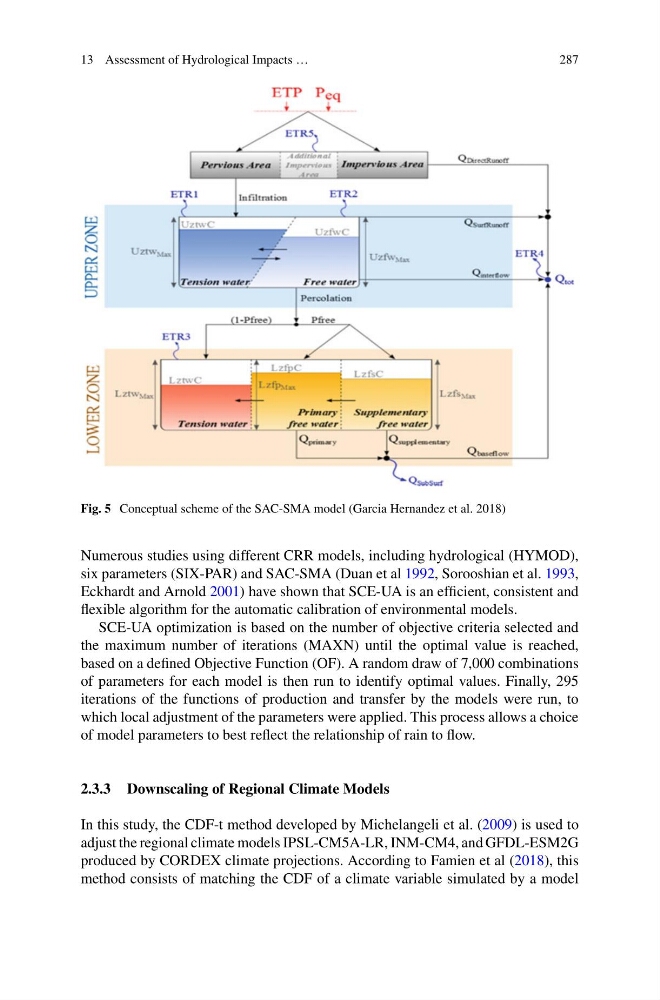
Fig. 5 Conceptual scheme of the SAC-SMA model (Garcia Hernandez et al. 2018)
Numerous studies using different CRR models, including hydrological (HYMOD),
six parameters (SIX-PAR) and SAC-SMA (Duan et al 1992, Sorooshian et al. 1993,
Eckhardt and Arnold 2001) have shown that SCE-UA is an efficient, consistent and
flexible algorithm for the automatic calibration of environmental models.
SCE-UA optimization is based on the number of objective criteria selected and
the maximum number of iterations (MAXN) until the optimal value is reached,
based on a defined Objective Function (OF). A random draw of 7,000 combinations
of parameters for each model is then run to identify optimal values. Finally, 295
iterations of the functions of production and transfer by the models were run, to
which local adjustment of the parameters were applied. This process allows a choice
of model parameters to best reflect the relationship of rain to flow.
2.3.3 Downscaling of Regional Climate Models
In this study, the CDF-t method developed by Michelangeli et al. (2009) is used to
adjust the regional climate models IPSL-CM5A-LR, INM-CM4, and GFDL-ESM2G
produced by CORDEX climate projections. According to Famien et al (2018), this
method consists of matching the CDF of a climate variable simulated by a model
287
Fig. 5 Conceptual scheme of the SAC-SMA model (Garcia Hernandez et al. 2018)
Numerous studies using different CRR models, including hydrological (HYMOD),
six parameters (SIX-PAR) and SAC-SMA (Duan et al 1992, Sorooshian et al. 1993,
Eckhardt and Arnold 2001) have shown that SCE-UA is an efficient, consistent and
flexible algorithm for the automatic calibration of environmental models.
SCE-UA optimization is based on the number of objective criteria selected and
the maximum number of iterations (MAXN) until the optimal value is reached,
based on a defined Objective Function (OF). A random draw of 7,000 combinations
of parameters for each model is then run to identify optimal values. Finally, 295
iterations of the functions of production and transfer by the models were run, to
which local adjustment of the parameters were applied. This process allows a choice
of model parameters to best reflect the relationship of rain to flow.
2.3.3 Downscaling of Regional Climate Models
In this study, the CDF-t method developed by Michelangeli et al. (2009) is used to
adjust the regional climate models IPSL-CM5A-LR, INM-CM4, and GFDL-ESM2G
produced by CORDEX climate projections. According to Famien et al (2018), this
method consists of matching the CDF of a climate variable simulated by a model