

286
I. Thiaw et al.
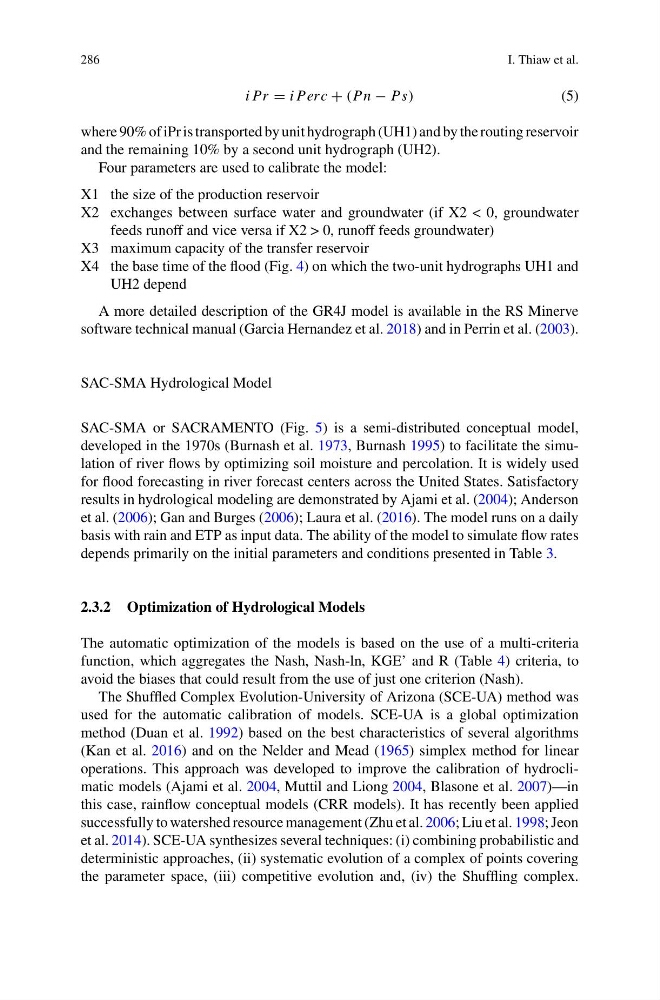
i Pr = i Perc + (Pn − Ps)
(5)
where 90% of iPr is transported by unit hydrograph (UH1) and by the routing reservoir
and the remaining 10% by a second unit hydrograph (UH2).
Four parameters are used to calibrate the model:
X1 the size of the production reservoir
X2 exchanges between surface water and groundwater (if X2 < 0, groundwater
feeds runoff and vice versa if X2 > 0, runoff feeds groundwater)
X3 maximum capacity of the transfer reservoir
X4 the base time of the flood (Fig. 4) on which the two-unit hydrographs UH1 and
UH2 depend
A more detailed description of the GR4J model is available in the RS Minerve
software technical manual (Garcia Hernandez et al. 2018) and in Perrin et al. (2003).
SAC-SMA Hydrological Model
SAC-SMA or SACRAMENTO (Fig. 5) is a semi-distributed conceptual model,
developed in the 1970s (Burnash et al. 1973, Burnash 1995) to facilitate the simulation of river flows by optimizing soil moisture and percolation. It is widely used
for flood forecasting in river forecast centers across the United States. Satisfactory
results in hydrological modeling are demonstrated by Ajami et al. (2004); Anderson
et al. (2006); Gan and Burges (2006); Laura et al. (2016). The model runs on a daily
basis with rain and ETP as input data. The ability of the model to simulate flow rates
depends primarily on the initial parameters and conditions presented in Table 3.
2.3.2 Optimization of Hydrological Models
The automatic optimization of the models is based on the use of a multi-criteria
function, which aggregates the Nash, Nash-ln, KGE’ and R (Table 4) criteria, to
avoid the biases that could result from the use of just one criterion (Nash).
The Shuffled Complex Evolution-University of Arizona (SCE-UA) method was
used for the automatic calibration of models. SCE-UA is a global optimization
method (Duan et al. 1992) based on the best characteristics of several algorithms
(Kan et al. 2016) and on the Nelder and Mead (1965) simplex method for linear
operations. This approach was developed to improve the calibration of hydroclimatic models (Ajami et al. 2004, Muttil and Liong 2004, Blasone et al. 2007)—in
this case, rainflow conceptual models (CRR models). It has recently been applied
successfully to watershed resource management (Zhu et al. 2006; Liu et al. 1998; Jeon
et al. 2014). SCE-UA synthesizes several techniques: (i) combining probabilistic and
deterministic approaches, (ii) systematic evolution of a complex of points covering
the parameter space, (iii) competitive evolution and, (iv) the Shuffling complex.
I. Thiaw et al.
i Pr = i Perc + (Pn − Ps)
(5)
where 90% of iPr is transported by unit hydrograph (UH1) and by the routing reservoir
and the remaining 10% by a second unit hydrograph (UH2).
Four parameters are used to calibrate the model:
X1 the size of the production reservoir
X2 exchanges between surface water and groundwater (if X2 < 0, groundwater
feeds runoff and vice versa if X2 > 0, runoff feeds groundwater)
X3 maximum capacity of the transfer reservoir
X4 the base time of the flood (Fig. 4) on which the two-unit hydrographs UH1 and
UH2 depend
A more detailed description of the GR4J model is available in the RS Minerve
software technical manual (Garcia Hernandez et al. 2018) and in Perrin et al. (2003).
SAC-SMA Hydrological Model
SAC-SMA or SACRAMENTO (Fig. 5) is a semi-distributed conceptual model,
developed in the 1970s (Burnash et al. 1973, Burnash 1995) to facilitate the simulation of river flows by optimizing soil moisture and percolation. It is widely used
for flood forecasting in river forecast centers across the United States. Satisfactory
results in hydrological modeling are demonstrated by Ajami et al. (2004); Anderson
et al. (2006); Gan and Burges (2006); Laura et al. (2016). The model runs on a daily
basis with rain and ETP as input data. The ability of the model to simulate flow rates
depends primarily on the initial parameters and conditions presented in Table 3.
2.3.2 Optimization of Hydrological Models
The automatic optimization of the models is based on the use of a multi-criteria
function, which aggregates the Nash, Nash-ln, KGE’ and R (Table 4) criteria, to
avoid the biases that could result from the use of just one criterion (Nash).
The Shuffled Complex Evolution-University of Arizona (SCE-UA) method was
used for the automatic calibration of models. SCE-UA is a global optimization
method (Duan et al. 1992) based on the best characteristics of several algorithms
(Kan et al. 2016) and on the Nelder and Mead (1965) simplex method for linear
operations. This approach was developed to improve the calibration of hydroclimatic models (Ajami et al. 2004, Muttil and Liong 2004, Blasone et al. 2007)—in
this case, rainflow conceptual models (CRR models). It has recently been applied
successfully to watershed resource management (Zhu et al. 2006; Liu et al. 1998; Jeon
et al. 2014). SCE-UA synthesizes several techniques: (i) combining probabilistic and
deterministic approaches, (ii) systematic evolution of a complex of points covering
the parameter space, (iii) competitive evolution and, (iv) the Shuffling complex.