

148
M. T. Sall et al.
area (Kamara 2013), it is of particular value for its diversified and rich natural environment, its past and current developments (Diop, 1995 cited by 2017) and its strong
potential for Integrated Water Resources Management (IWRM), thanks to its rich
but vulnerable water resources.
The area has important potential for economic development, which in turn offers
the potential to contribute significantly to the country’s water and food security. But
it is a highly anthropized environment where fresh water mixes with saltwater on
very heterogeneous soils, which makes it highly vulnerable. Environmental degradation affects agriculture, fishing, hydropower production, shipping and drinking
water production (Diop 2017). For these reasons, local public and private actors are
calling for the implementation of an IWRM approach to address these challenges in
a participatory, coordinated and inclusive manner.
In the context of climate change adaptation, the time has come to reflect on the
state and evolution of current agricultural production models and to move towards
integrated and sustainable development. In this respect, a new approach through the
Water-Energy-Food nexus (i.e., the connection among these several elements) seems
relevant. Since the Bonn Summit in 2011 (The Water, Energy and Food Security
Nexus, November 16, 2011), this concept has been the subject of numerous studies,
especially in southern nations.
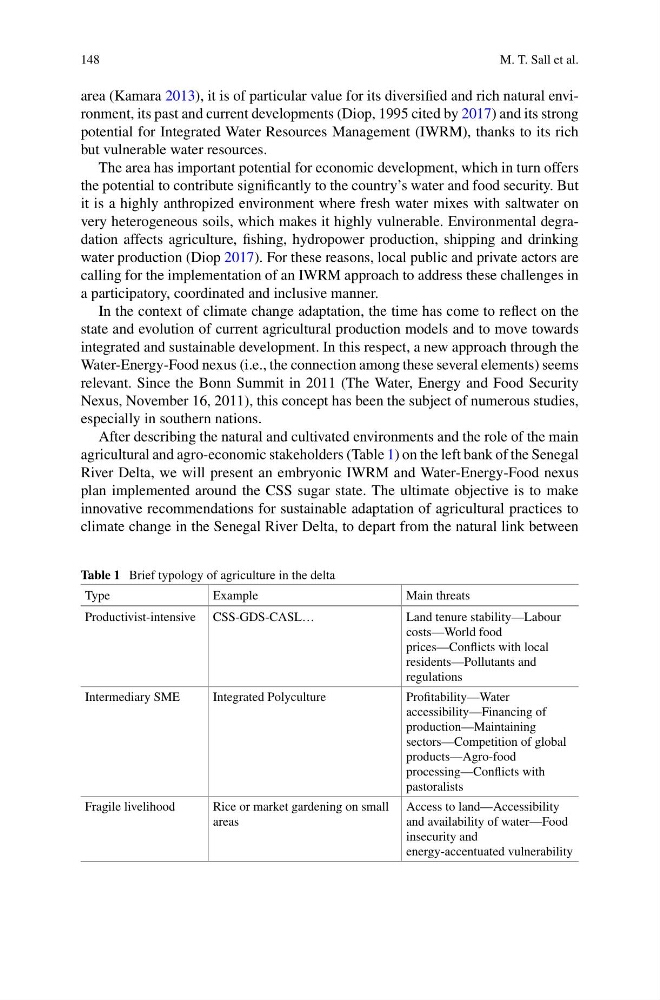
After describing the natural and cultivated environments and the role of the main
agricultural and agro-economic stakeholders (Table 1) on the left bank of the Senegal
River Delta, we will present an embryonic IWRM and Water-Energy-Food nexus
plan implemented around the CSS sugar state. The ultimate objective is to make
innovative recommendations for sustainable adaptation of agricultural practices to
climate change in the Senegal River Delta, to depart from the natural link between
Table 1 Brief typology of agriculture in the delta
Type
Example
Main threats
Productivist-intensive CSS-GDS-CASL…
Land tenure stability—Labour
costs—World food
prices—Conflicts with local
residents—Pollutants and
regulations
Intermediary SME
Integrated Polyculture
Profitability—Water
accessibility—Financing of
production—Maintaining
sectors—Competition of global
products—Agro-food
processing—Conflicts with
pastoralists
Fragile livelihood
Rice or market gardening on small
areas
Access to land—Accessibility
and availability of water—Food
insecurity and
energy-accentuated vulnerability
M. T. Sall et al.
area (Kamara 2013), it is of particular value for its diversified and rich natural environment, its past and current developments (Diop, 1995 cited by 2017) and its strong
potential for Integrated Water Resources Management (IWRM), thanks to its rich
but vulnerable water resources.
The area has important potential for economic development, which in turn offers
the potential to contribute significantly to the country’s water and food security. But
it is a highly anthropized environment where fresh water mixes with saltwater on
very heterogeneous soils, which makes it highly vulnerable. Environmental degradation affects agriculture, fishing, hydropower production, shipping and drinking
water production (Diop 2017). For these reasons, local public and private actors are
calling for the implementation of an IWRM approach to address these challenges in
a participatory, coordinated and inclusive manner.
In the context of climate change adaptation, the time has come to reflect on the
state and evolution of current agricultural production models and to move towards
integrated and sustainable development. In this respect, a new approach through the
Water-Energy-Food nexus (i.e., the connection among these several elements) seems
relevant. Since the Bonn Summit in 2011 (The Water, Energy and Food Security
Nexus, November 16, 2011), this concept has been the subject of numerous studies,
especially in southern nations.
After describing the natural and cultivated environments and the role of the main
agricultural and agro-economic stakeholders (Table 1) on the left bank of the Senegal
River Delta, we will present an embryonic IWRM and Water-Energy-Food nexus
plan implemented around the CSS sugar state. The ultimate objective is to make
innovative recommendations for sustainable adaptation of agricultural practices to
climate change in the Senegal River Delta, to depart from the natural link between
Table 1 Brief typology of agriculture in the delta
Type
Example
Main threats
Productivist-intensive CSS-GDS-CASL…
Land tenure stability—Labour
costs—World food
prices—Conflicts with local
residents—Pollutants and
regulations
Intermediary SME
Integrated Polyculture
Profitability—Water
accessibility—Financing of
production—Maintaining
sectors—Competition of global
products—Agro-food
processing—Conflicts with
pastoralists
Fragile livelihood
Rice or market gardening on small
areas
Access to land—Accessibility
and availability of water—Food
insecurity and
energy-accentuated vulnerability