

7 A Framework for IWRM in the Water-Energy-Food …
149
the two approaches in order to transfer best practices from the agro-industry to
smallholders.
The energy aspect of the nexus will be discussed in relation to the residual or
dedicated biomass of crops and its possible adaptation in the village environment.
Our summary will focus on prospective potential links among irrigated agriculture,
non-food biomass and sustainable energy.
2 Natural and Cultivated Environments: Constraints
and Assets
The Senegal River Delta is a vast set of lowlands and forms a kind of oasis between
two dry Sahelian countries (Fig. 2). Its dense hydrographic network is composed of
marigots (basins fed by several rivers: the Gorom, Djeuss, Lampsar), and lagoons
(Fig. 1), separated from the sea by the coastal zone (Cissé 2011). The main basin,
Guiers Lake, is connected to the Senegal River by the Taouey channel. It is a natural
depression, where the flow is now partially controlled. It plays a role in regulating
floods in the Senegal River thanks to its high storage capacity (Kane 1997), and has
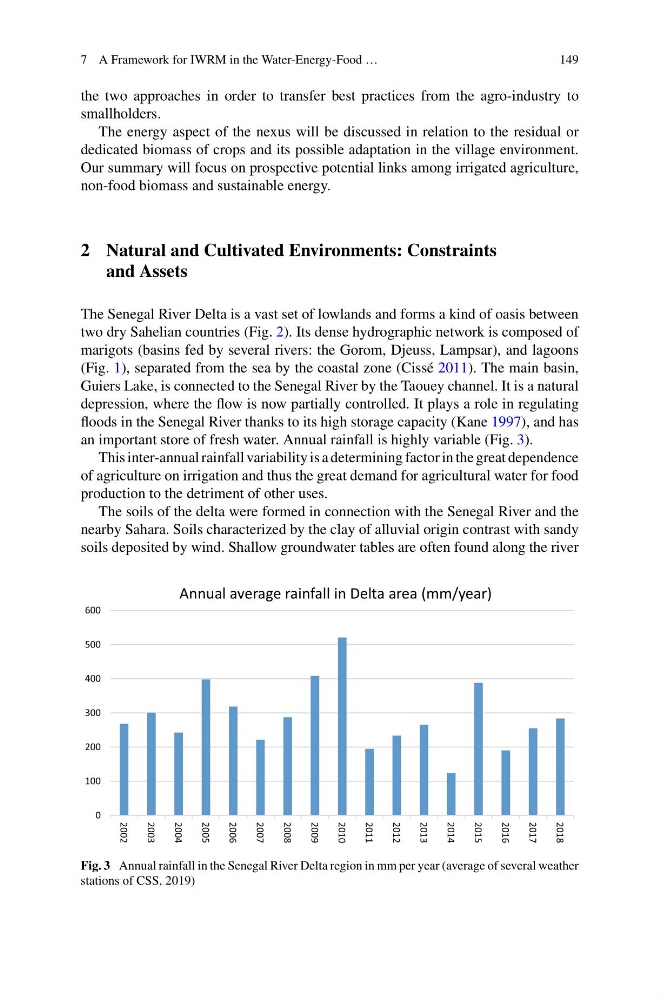
an important store of fresh water. Annual rainfall is highly variable (Fig. 3).
This inter-annual rainfall variability is a determining factor in the great dependence
of agriculture on irrigation and thus the great demand for agricultural water for food
production to the detriment of other uses.
The soils of the delta were formed in connection with the Senegal River and the
nearby Sahara. Soils characterized by the clay of alluvial origin contrast with sandy
soils deposited by wind. Shallow groundwater tables are often found along the river
0
100
200
300
400
500
600
2002
2003
2004
2005
2006
2007
2008
2009
2010
2011
2012
2013
2014
2015
2016
2017
2018
Annual average rainfall in Delta area (mm/year)
Fig. 3 Annual rainfall in the Senegal River Delta region in mm per year (average of several weather
stations of CSS, 2019)
149
the two approaches in order to transfer best practices from the agro-industry to
smallholders.
The energy aspect of the nexus will be discussed in relation to the residual or
dedicated biomass of crops and its possible adaptation in the village environment.
Our summary will focus on prospective potential links among irrigated agriculture,
non-food biomass and sustainable energy.
2 Natural and Cultivated Environments: Constraints
and Assets
The Senegal River Delta is a vast set of lowlands and forms a kind of oasis between
two dry Sahelian countries (Fig. 2). Its dense hydrographic network is composed of
marigots (basins fed by several rivers: the Gorom, Djeuss, Lampsar), and lagoons
(Fig. 1), separated from the sea by the coastal zone (Cissé 2011). The main basin,
Guiers Lake, is connected to the Senegal River by the Taouey channel. It is a natural
depression, where the flow is now partially controlled. It plays a role in regulating
floods in the Senegal River thanks to its high storage capacity (Kane 1997), and has
an important store of fresh water. Annual rainfall is highly variable (Fig. 3).
This inter-annual rainfall variability is a determining factor in the great dependence
of agriculture on irrigation and thus the great demand for agricultural water for food
production to the detriment of other uses.
The soils of the delta were formed in connection with the Senegal River and the
nearby Sahara. Soils characterized by the clay of alluvial origin contrast with sandy
soils deposited by wind. Shallow groundwater tables are often found along the river
0
100
200
300
400
500
600
2002
2003
2004
2005
2006
2007
2008
2009
2010
2011
2012
2013
2014
2015
2016
2017
2018
Annual average rainfall in Delta area (mm/year)
Fig. 3 Annual rainfall in the Senegal River Delta region in mm per year (average of several weather
stations of CSS, 2019)