

140
T. A. Abiye and K. C. Leketa
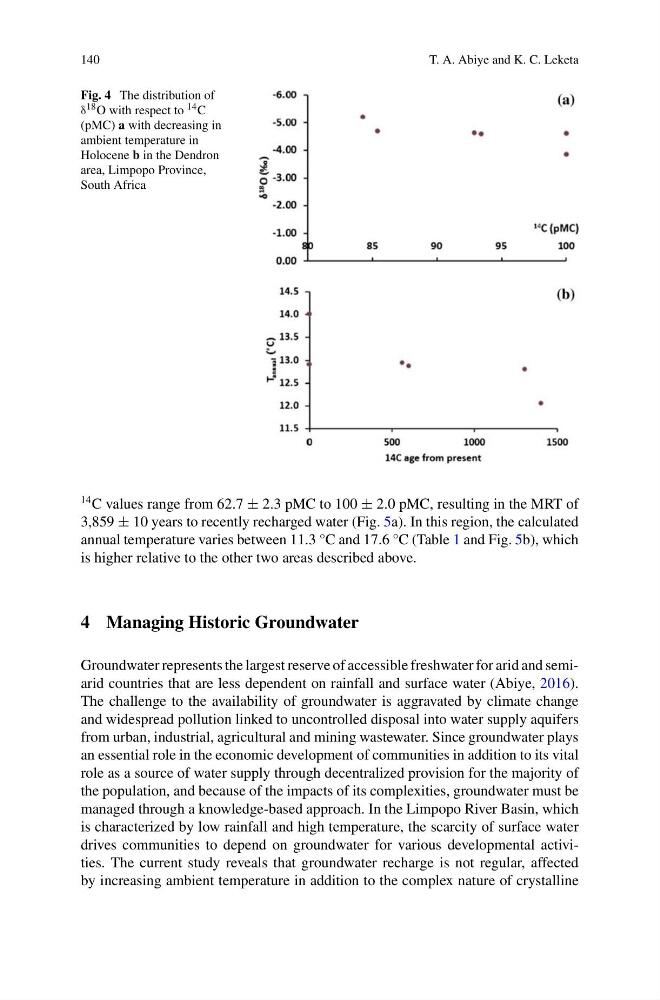
Fig. 4 The distribution of
δ 18 O with respect to 14 C
(pMC) a with decreasing in
ambient temperature in
Holocene b in the Dendron
area, Limpopo Province,
South Africa
14 C values range from 62.7 ± 2.3 pMC to 100 ± 2.0 pMC, resulting in the MRT of
3,859 ± 10 years to recently recharged water (Fig. 5a). In this region, the calculated
annual temperature varies between 11.3 °C and 17.6 °C (Table 1 and Fig. 5b), which
is higher relative to the other two areas described above.
4 Managing Historic Groundwater
Groundwater represents the largest reserve of accessible freshwater for arid and semiarid countries that are less dependent on rainfall and surface water (Abiye, 2016).
The challenge to the availability of groundwater is aggravated by climate change
and widespread pollution linked to uncontrolled disposal into water supply aquifers
from urban, industrial, agricultural and mining wastewater. Since groundwater plays
an essential role in the economic development of communities in addition to its vital
role as a source of water supply through decentralized provision for the majority of
the population, and because of the impacts of its complexities, groundwater must be
managed through a knowledge-based approach. In the Limpopo River Basin, which
is characterized by low rainfall and high temperature, the scarcity of surface water
drives communities to depend on groundwater for various developmental activities. The current study reveals that groundwater recharge is not regular, affected
by increasing ambient temperature in addition to the complex nature of crystalline
T. A. Abiye and K. C. Leketa
Fig. 4 The distribution of
δ 18 O with respect to 14 C
(pMC) a with decreasing in
ambient temperature in
Holocene b in the Dendron
area, Limpopo Province,
South Africa
14 C values range from 62.7 ± 2.3 pMC to 100 ± 2.0 pMC, resulting in the MRT of
3,859 ± 10 years to recently recharged water (Fig. 5a). In this region, the calculated
annual temperature varies between 11.3 °C and 17.6 °C (Table 1 and Fig. 5b), which
is higher relative to the other two areas described above.
4 Managing Historic Groundwater
Groundwater represents the largest reserve of accessible freshwater for arid and semiarid countries that are less dependent on rainfall and surface water (Abiye, 2016).
The challenge to the availability of groundwater is aggravated by climate change
and widespread pollution linked to uncontrolled disposal into water supply aquifers
from urban, industrial, agricultural and mining wastewater. Since groundwater plays
an essential role in the economic development of communities in addition to its vital
role as a source of water supply through decentralized provision for the majority of
the population, and because of the impacts of its complexities, groundwater must be
managed through a knowledge-based approach. In the Limpopo River Basin, which
is characterized by low rainfall and high temperature, the scarcity of surface water
drives communities to depend on groundwater for various developmental activities. The current study reveals that groundwater recharge is not regular, affected
by increasing ambient temperature in addition to the complex nature of crystalline