

6 Historic Climatic Variability and Change: The Importance …
139
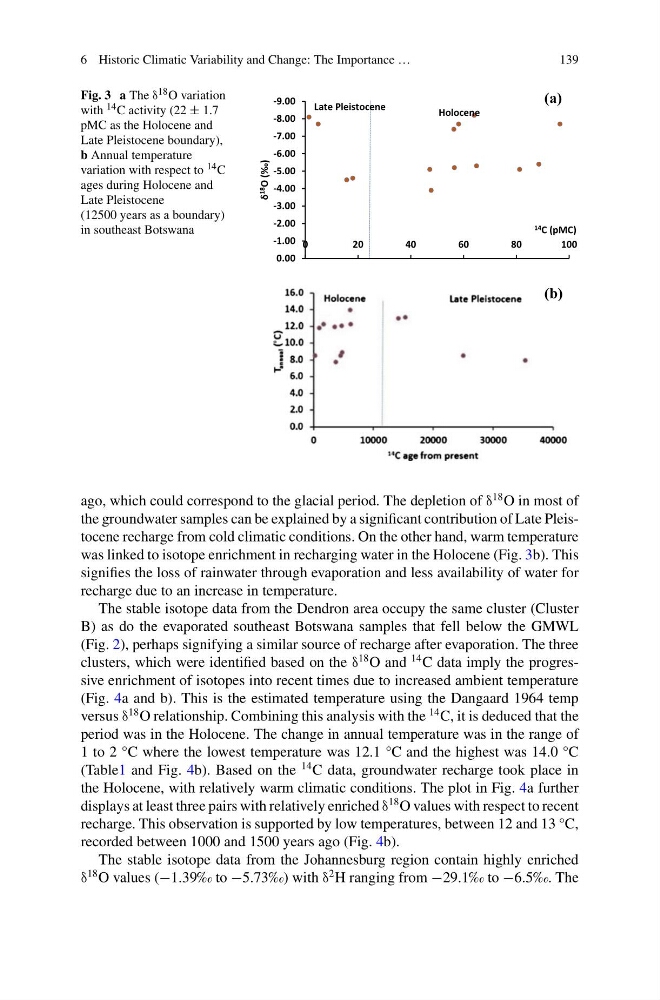
Fig. 3 a The δ 18 O variation
with 14 C activity (22 ± 1.7
pMC as the Holocene and
Late Pleistocene boundary),
b Annual temperature
variation with respect to 14 C
ages during Holocene and
Late Pleistocene
(12500 years as a boundary)
in southeast Botswana
-9.00
-8.00
-7.00
-6.00
-5.00
-4.00
-3.00
-2.00
-1.00
0.00
0
2 0
4 0
6 0
8 0
1 0 0
δ 18
O (‰)
14 C (pMC)
Late Pleistocene
Holocene
(a)
(b)
ago, which could correspond to the glacial period. The depletion of δ
18 O in most of
the groundwater samples can be explained by a significant contribution of Late Pleistocene recharge from cold climatic conditions. On the other hand, warm temperature
was linked to isotope enrichment in recharging water in the Holocene (Fig. 3b). This
signifies the loss of rainwater through evaporation and less availability of water for
recharge due to an increase in temperature.
The stable isotope data from the Dendron area occupy the same cluster (Cluster
B) as do the evaporated southeast Botswana samples that fell below the GMWL
(Fig. 2), perhaps signifying a similar source of recharge after evaporation. The three
clusters, which were identified based on the δ
18 O and
14 C data imply the progressive enrichment of isotopes into recent times due to increased ambient temperature
(Fig. 4a and b). This is the estimated temperature using the Dangaard 1964 temp
versus δ
18 O relationship. Combining this analysis with the
14 C, it is deduced that the
period was in the Holocene. The change in annual temperature was in the range of
1 to 2 °C where the lowest temperature was 12.1 °C and the highest was 14.0 °C
(Table1 and Fig. 4b). Based on the
14 C data, groundwater recharge took place in
the Holocene, with relatively warm climatic conditions. The plot in Fig. 4a further
displays at least three pairs with relatively enriched δ
18 O values with respect to recent
recharge. This observation is supported by low temperatures, between 12 and 13 °C,
recorded between 1000 and 1500 years ago (Fig. 4b).
The stable isotope data from the Johannesburg region contain highly enriched
δ
18 O values (−1.39‰ to −5.73‰) with δ
2 H ranging from −29.1‰ to −6.5‰. The
139
Fig. 3 a The δ 18 O variation
with 14 C activity (22 ± 1.7
pMC as the Holocene and
Late Pleistocene boundary),
b Annual temperature
variation with respect to 14 C
ages during Holocene and
Late Pleistocene
(12500 years as a boundary)
in southeast Botswana
-9.00
-8.00
-7.00
-6.00
-5.00
-4.00
-3.00
-2.00
-1.00
0.00
0
2 0
4 0
6 0
8 0
1 0 0
δ 18
O (‰)
14 C (pMC)
Late Pleistocene
Holocene
(a)
(b)
ago, which could correspond to the glacial period. The depletion of δ
18 O in most of
the groundwater samples can be explained by a significant contribution of Late Pleistocene recharge from cold climatic conditions. On the other hand, warm temperature
was linked to isotope enrichment in recharging water in the Holocene (Fig. 3b). This
signifies the loss of rainwater through evaporation and less availability of water for
recharge due to an increase in temperature.
The stable isotope data from the Dendron area occupy the same cluster (Cluster
B) as do the evaporated southeast Botswana samples that fell below the GMWL
(Fig. 2), perhaps signifying a similar source of recharge after evaporation. The three
clusters, which were identified based on the δ
18 O and
14 C data imply the progressive enrichment of isotopes into recent times due to increased ambient temperature
(Fig. 4a and b). This is the estimated temperature using the Dangaard 1964 temp
versus δ
18 O relationship. Combining this analysis with the
14 C, it is deduced that the
period was in the Holocene. The change in annual temperature was in the range of
1 to 2 °C where the lowest temperature was 12.1 °C and the highest was 14.0 °C
(Table1 and Fig. 4b). Based on the
14 C data, groundwater recharge took place in
the Holocene, with relatively warm climatic conditions. The plot in Fig. 4a further
displays at least three pairs with relatively enriched δ
18 O values with respect to recent
recharge. This observation is supported by low temperatures, between 12 and 13 °C,
recorded between 1000 and 1500 years ago (Fig. 4b).
The stable isotope data from the Johannesburg region contain highly enriched
δ
18 O values (−1.39‰ to −5.73‰) with δ
2 H ranging from −29.1‰ to −6.5‰. The