

6 Historic Climatic Variability and Change: The Importance …
141
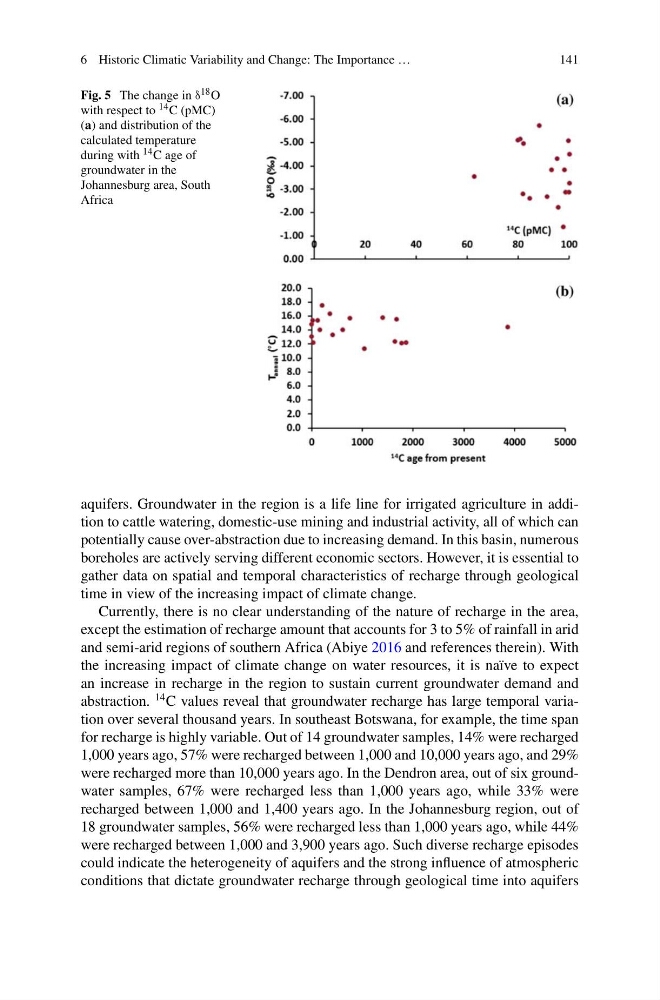
Fig. 5 The change in δ 18 O
with respect to 14 C (pMC)
(a) and distribution of the
calculated temperature
during with 14 C age of
groundwater in the
Johannesburg area, South
Africa
aquifers. Groundwater in the region is a life line for irrigated agriculture in addition to cattle watering, domestic-use mining and industrial activity, all of which can
potentially cause over-abstraction due to increasing demand. In this basin, numerous
boreholes are actively serving different economic sectors. However, it is essential to
gather data on spatial and temporal characteristics of recharge through geological
time in view of the increasing impact of climate change.
Currently, there is no clear understanding of the nature of recharge in the area,
except the estimation of recharge amount that accounts for 3 to 5% of rainfall in arid
and semi-arid regions of southern Africa (Abiye 2016 and references therein). With
the increasing impact of climate change on water resources, it is naïve to expect
an increase in recharge in the region to sustain current groundwater demand and
abstraction.
14 C values reveal that groundwater recharge has large temporal variation over several thousand years. In southeast Botswana, for example, the time span
for recharge is highly variable. Out of 14 groundwater samples, 14% were recharged
1,000 years ago, 57% were recharged between 1,000 and 10,000 years ago, and 29%
were recharged more than 10,000 years ago. In the Dendron area, out of six groundwater samples, 67% were recharged less than 1,000 years ago, while 33% were
recharged between 1,000 and 1,400 years ago. In the Johannesburg region, out of
18 groundwater samples, 56% were recharged less than 1,000 years ago, while 44%
were recharged between 1,000 and 3,900 years ago. Such diverse recharge episodes
could indicate the heterogeneity of aquifers and the strong influence of atmospheric
conditions that dictate groundwater recharge through geological time into aquifers
141
Fig. 5 The change in δ 18 O
with respect to 14 C (pMC)
(a) and distribution of the
calculated temperature
during with 14 C age of
groundwater in the
Johannesburg area, South
Africa
aquifers. Groundwater in the region is a life line for irrigated agriculture in addition to cattle watering, domestic-use mining and industrial activity, all of which can
potentially cause over-abstraction due to increasing demand. In this basin, numerous
boreholes are actively serving different economic sectors. However, it is essential to
gather data on spatial and temporal characteristics of recharge through geological
time in view of the increasing impact of climate change.
Currently, there is no clear understanding of the nature of recharge in the area,
except the estimation of recharge amount that accounts for 3 to 5% of rainfall in arid
and semi-arid regions of southern Africa (Abiye 2016 and references therein). With
the increasing impact of climate change on water resources, it is naïve to expect
an increase in recharge in the region to sustain current groundwater demand and
abstraction.
14 C values reveal that groundwater recharge has large temporal variation over several thousand years. In southeast Botswana, for example, the time span
for recharge is highly variable. Out of 14 groundwater samples, 14% were recharged
1,000 years ago, 57% were recharged between 1,000 and 10,000 years ago, and 29%
were recharged more than 10,000 years ago. In the Dendron area, out of six groundwater samples, 67% were recharged less than 1,000 years ago, while 33% were
recharged between 1,000 and 1,400 years ago. In the Johannesburg region, out of
18 groundwater samples, 56% were recharged less than 1,000 years ago, while 44%
were recharged between 1,000 and 3,900 years ago. Such diverse recharge episodes
could indicate the heterogeneity of aquifers and the strong influence of atmospheric
conditions that dictate groundwater recharge through geological time into aquifers